
High performance isn’t a byproduct of pressure; it’s the mathematical result of aligning individual motivation with strategic organizational velocity. You’ve likely hit your quarterly targets while watching your best talent eye the exit, struggling to maintain a culture of ownership across global time zones and hybrid desks. It’s a common executive paradox where meeting traditional KPIs doesn’t always equate to a healthy, sustainable culture. To break this cycle, you must look beyond surface-level output and master the specific team performance metrics for leaders that actually drive long-term growth.
I’ve spent over 40 years navigating these exact complexities at the highest levels of global leadership. I know that the gap between a group of individuals and a high-velocity organization is bridged by strategy, not just effort. This guide provides the strategic frameworks and psychological drivers required to transform your management layer into a self-managing engine. We’ll examine how to align personal ambition with company goals to ensure your organization doesn’t just move, but accelerates with purpose and precision.
Key Takeaways
- Shift your leadership paradigm from tracking mere activity to measuring strategic outcomes that resonate with a meaning-driven workforce.
- Apply The Motivation Equation to diagnose performance gaps and harness individual drive as the ultimate multiplier for your team’s execution.
- Distinguish between tactical “busyness” and strategic impact to ensure your organization is moving with high velocity rather than just high effort.
- Master the essential team performance metrics for leaders to conduct motivation audits and strip away the tactical noise that stalls growth.
- Adopt the executive mentor archetype to evolve performance from a quarterly goal into a sustainable, self-managing culture of excellence.
Beyond the Dashboard: Why Traditional Metrics Fail Leaders in 2026
Stop staring at your spreadsheets. They’re often lying to you. Most traditional dashboards focus on activity, yet they fail to capture the invisible current of motivation that actually drives results. In 2026, the paradigm has shifted. We’re moving away from activity-based management toward outcome-based leadership. This isn’t just a trend; it’s a survival requirement for any executive managing a global footprint.
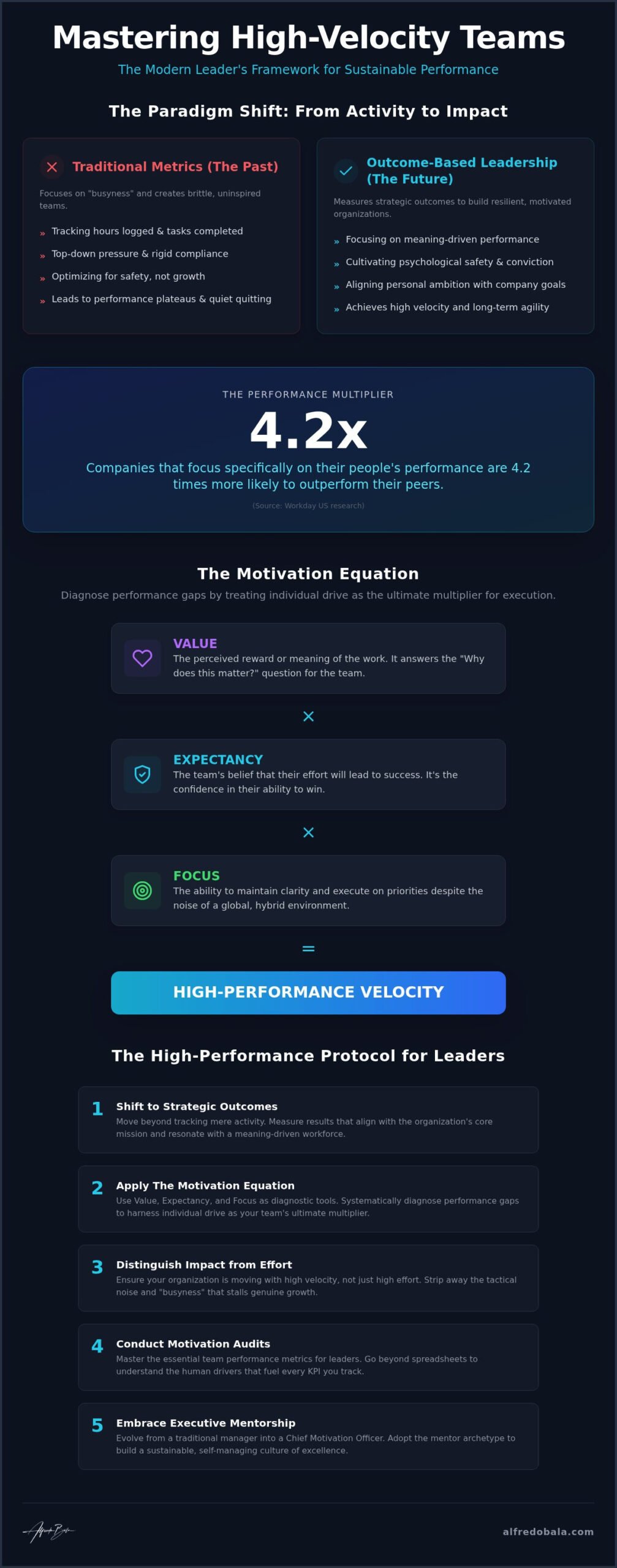
The 2026 workforce demands meaning-driven performance. They aren’t satisfied with paycheck-driven activity. When leaders rely solely on a standard performance indicator like hours logged or tasks completed, they miss the hidden costs of quiet quitting and performance plateaus. These invisible drains on your organization’s energy can stall even the most robust teams. According to Workday US research from February 2026, companies that focus specifically on their people’s performance are 4.2 times more likely to outperform their peers. To reach that level, you must redefine your focus. Team performance is the collective velocity of an organization toward a shared strategic vision. It’s not about how fast people are running. It’s about whether they’re running in the right direction with full conviction.
The Breakdown of Command and Control
Top-down pressure creates brittle teams. When you lead through fear or rigid compliance, your organization might meet its KPIs, but it will fail under the first sign of external stress. I’ve seen this play out across forty years of global leadership. The transition from a traditional manager to a Chief Motivation Officer is the only way to secure long-term loyalty and agility. In 2026, authority is granted by the leader, but peak performance is volunteered by the team. You can’t demand high velocity; you have to cultivate the environment where it happens naturally. This requires a deep understanding of team performance metrics for leaders that prioritize psychological safety and collective intelligence over simple output.
Identifying the Performance Ceiling
Many teams hit a ceiling not because they lack talent, but because they’ve optimized for safety rather than growth. You’ll recognize this when your mid-level management stops taking risks and starts defending the status quo. It’s vital to differentiate between a skill gap and a motivation gap. A skill gap needs training, but a motivation gap requires a total strategic realignment. By leveraging proven executive leadership development strategies, you can identify these organizational plateaus before they become permanent. Breaking through requires moving past the dashboard and looking at the human drivers that fuel every metric you track.
Decoding The Motivation Equation for High-Performance Teams
To build a high-velocity organization, you must first understand the physics of human drive. Strategy provides the map, but motivation provides the fuel. I’ve often said that logic opens the mind, but emotion moves the feet. If your team understands the “what” but lacks the “why,” they’ll never reach peak performance. This is where many executive dashboards fail. They track the output without auditing the engine that produces it.
The Motivation Equation is my proprietary framework designed to solve this. It’s a masterclass in human performance that treats individual drive as the ultimate multiplier for tactical execution. When you master The Motivation Equation, you stop guessing why performance has stalled and start engineering success. It’s about aligning personal “Whys” with the corporate mission to create a sense of unstoppable momentum that survives even the most volatile market shifts.
The Elements of the Equation
Motivation isn’t a vague feeling; it’s the result of specific variables. In a team context, these variables are Value, Expectancy, and Focus. Value is the perceived reward or meaning of the work. Expectancy is the team’s belief that their effort will actually lead to success. Focus is the ability to maintain clarity despite the noise of a global, hybrid environment. These are the real team performance metrics for leaders who want to move beyond surface-level KPIs. Research from Harvard Business School Online on the characteristics of effective teams highlights that psychological safety and clear goals are foundational, but the Equation takes it further by quantifying the internal drive that powers those goals. You can audit your team’s current levels by assessing where these variables are weakest.
From Individual Drive to Collective Velocity
Think about the “1% Rule” for team performance. You don’t need a total overhaul to see massive results. Small, consistent gains in individual motivation lead to exponential collective output. Your job as an executive is to create a culture of “High-Expectancy.” This is an environment where success feels like an inevitability, not a roll of the dice. You must also act as a filter for “Impulsiveness.” By reducing tactical distractions and keeping the team locked on mission-critical objectives, you preserve their energy for high-impact work. Understanding these team performance metrics for leaders allows you to reduce organizational friction and increase velocity. If you’re ready to dive deeper into these mechanics, exploring my leadership and team development insights can help you start your own motivation audit today.
Strategic Alignment vs. Tactical Activity: The Performance Comparison
Activity is not achievement. In my decades of global leadership, I’ve seen countless executives mistake a frantic pace for high performance. Being “busy” is actually the greatest enemy of being high-performing. It creates a false sense of progress while the organization drifts away from its core objectives. When you analyze team performance metrics for leaders, the most dangerous data point is often a high volume of tactical activity that yields zero strategic impact. Your job is to define the “North Star” that prevents this wasted effort and ensures every ounce of energy moves the needle toward market growth.
The difference between Output and Impact is the difference between surviving and thriving. Tactical output is clearing a backlog; strategic impact is driving a new market expansion. To reorient your team, you must stop rewarding the “grind” and start celebrating the “win.” This requires a fundamental shift in how you evaluate success, moving from tracking hours to measuring organizational velocity. According to research from monday.com in March 2026, 79% of operating-model redesigns were successful when led with clear strategic intent, yet many leaders still struggle to bridge the gap between daily tasks and long-term vision.
Busy vs. Productive: A Leader’s Diagnostic
Identifying “shadow work” is critical for maintaining team energy. Shadow work consists of those invisible, unproductive filler tasks like redundant meetings and excessive email chains that drain your talent without advancing your goals. I encourage a results-only mindset where the focus remains on the finish line, not the path taken. Use the comparison below to audit your current operations.
| Tactical Activity (The “Busy” Trap) | Strategic Performance (The “Impact” Reality) |
|---|---|
| Back-to-back internal status meetings | High-level innovation and problem-solving sessions |
| Managing a never-ending email inbox | Executing market expansion and growth initiatives |
| Focusing on “how” tasks are completed | Focusing on the “why” and the ultimate strategic result |
| Hitting activity quotas (calls, clicks, logs) | Achieving measurable increases in organizational velocity |
The Power of Organizational Velocity
Velocity is speed with direction. Without a clear “North Star,” speed is just chaos. My insights as a keynote speaker for organizational growth focus on re-aligning disconnected departments so they move as a single, high-velocity unit. This alignment is rooted in psychological safety. When teams feel safe to make decisions, the speed of those decisions increases. Data from March 2026 shows that 76% of leadership performance comes from collective intelligence and team cohesion. By fostering this environment, you ensure that your team performance metrics for leaders reflect a group that isn’t just moving fast, but is moving toward the right destination with absolute precision.
The 5-Step Performance Protocol for Global Leaders
Execution is a discipline, not a hope. To move from a group of talented individuals to a high-velocity organization, you need a repeatable system. I’ve developed a five-step protocol that strips away the complexity of modern management and focuses on the core drivers of organizational success. This isn’t about annual reviews that are too slow for 2026; it’s about real-time alignment and psychological momentum. By following this protocol, you’ll establish team performance metrics for leaders that actually reflect your organization’s health and potential.
- Step 1: Conduct a Motivation Audit. Use the Equation framework to identify where drive is leaking.
- Step 2: Clarify Mission-Critical Objectives. Eliminate tactical noise by focusing only on what moves the needle.
- Step 3: Implement High-Frequency Feedback. Move from quarterly check-ins to weekly loops to maintain momentum.
- Step 4: Empower Micro-Leadership. Delegate authority and outcomes, not just a list of tasks.
- Step 5: Celebrate Velocity Milestones. Reinforce your performance culture by recognizing strategic wins publicly.
Auditing and Clarifying the Mission
You can’t fix what you haven’t diagnosed. Start with one-on-one “Motivation Conversations” to reveal hidden friction within your ranks. It’s often not a lack of skill, but a lack of clarity or expectancy. When you simplify your KPIs, every team member knows exactly how their daily effort contributes to the win. I recommend using proven how to build motivated teams techniques to determine if a member needs a boost in Value or a clearer path to success. Data from Hatchproof in April 2026 shows that companies using weekly KPI reviews see 60% higher team engagement. This high-frequency approach ensures that team performance metrics for leaders stay relevant and actionable.
Empowerment and Ownership
True leadership is about creating more leaders, not more followers. There’s a massive difference between delegating a task and delegating an outcome. When you delegate the outcome, you grant the authority to solve problems, which builds a high performance team through radical ownership. This shift allows you to step back from the tactical weeds and focus on the strategic horizon. Public recognition of these strategic wins acts as the fuel for future performance, reinforcing that impact is valued over mere activity. If you’re ready to implement these shifts at scale, my leadership and team development insights offer the roadmap you need to start today.
Sustaining High Performance through Executive Mentorship
High performance isn’t a static achievement you can check off a list. It’s a living, breathing discipline that requires constant cultivation from the top down. As an executive who has climbed to the highest echelons of global business, you are the “Success Story” archetype for your entire organization. Your team looks to you to set the emotional and strategic tone. If your personal drive wavers, no amount of software or tracking tools will save your results. Sustaining excellence requires a transition from being the person with the answers to being the mentor who builds a pipeline of future leaders who can execute in your absence.
Building this leadership pipeline is the ultimate test of an executive’s legacy. By integrating qualitative leadership growth into your team performance metrics for leaders, you create a culture that values long-term resilience over short-term spikes. You must leverage every tool at your disposal, including external expertise like board advisors and keynote speakers, to inject fresh energy into your ranks when internal momentum begins to plateau. This external perspective prevents organizational stagnation and keeps the collective focus on high-velocity impact.
The Leader as the Performance Catalyst
Developing a seasoned executive presence is about more than just command. It’s about inspiring a level of confidence that vibrates through every level of the company. You must recognize that your personal motivation levels often act as the ceiling for your team’s performance. If you aren’t growing, they won’t grow. A leader’s greatest contribution is not their expertise, but their ability to amplify the expertise of others. When you act as a catalyst, you stop being a bottleneck and start being the force that accelerates collective intelligence and tactical precision.
Scaling Through Professional Development
Investing in your people is the only way to scale impact across global time zones. This goes beyond standard HR training; it involves high-impact speaking events and deep-dive strategy sessions that challenge the status quo. You can use my established frameworks to transform your next corporate retreat into a performance launchpad. Integrating these team performance metrics for leaders into your professional development plan ensures that your culture remains self-managing and mission-aligned. Whether it’s through a keynote engagement or a strategic board seat advisory, bringing a global perspective to your organization can reignite the passion required for market dominance. Bring the gravitas of a global executive to your team’s development and watch your organizational velocity reach new heights.
Mastering the Velocity of 2026
Peak performance isn’t a static destination; it’s a continuous state of alignment between individual drive and strategic intent. We’ve explored how moving beyond traditional dashboards and applying the Motivation Equation can transform a group of individuals into a high-velocity organization. By prioritizing strategic impact over mere tactical activity and implementing a rigorous performance protocol, you ensure your organization doesn’t just survive the complexities of the 2026 market, but dominates it.
Mastering the right team performance metrics for leaders allows you to strip away tactical noise and focus on the human drivers that truly fuel growth. With over 40 years of global leadership experience as a former CEO and Board Advisor, I’ve seen how a seasoned perspective can reignite a stalled team. It’s time to bridge the gap between where your team is today and where they’re capable of going. Elevate your team’s performance with Alfredo Bala (The Motivation Guy)’s executive insights and start building your legacy of excellence. Your high-velocity future is waiting for you to lead the way.
Frequently Asked Questions
What is the fastest way to improve team performance under pressure?
Focus on radical clarity and the immediate elimination of tactical noise. Under high stress, teams often fragment; the leader must identify the single most critical objective and strip away everything else. By reducing the “Impulsiveness” variable in the Motivation Equation, you conserve energy for the high-impact tasks that actually move the needle. It’s about narrowing the field of vision to ensure the team doesn’t buckle under the weight of secondary priorities.
How do you measure team performance beyond simple KPIs?
Shift your focus toward organizational velocity and behavioral outcome-based indicators. While standard metrics track what happened in the past, team performance metrics for leaders should track the speed of decision-making and the alignment of individual motivation with company goals. This provides a leading indicator of future success rather than a lagging report of past activity. It’s about measuring the health of the engine, not just the exhaust.
Can you improve team performance without increasing the budget?
Yes, you can achieve exponential growth by optimizing the variables of the Motivation Equation, specifically Value and Expectancy. Improving a team’s belief that their effort leads to success doesn’t cost a dollar, but it multiplies output. Refining your internal communication and mentorship structures often yields higher returns than any capital investment in new software. Performance is a result of leadership discipline, not just financial resources.
What role does psychological safety play in high-performance teams?
Psychological safety acts as the essential foundation for collective intelligence and rapid innovation. When team members feel safe to take calculated risks without fear of punitive measures, the speed of problem-solving increases significantly. Research from March 2026 indicates that 76% of leadership performance stems from this cohesion, making it a critical strategic lever for any global executive. Without safety, your team will optimize for survival rather than growth.
How do you motivate a team that has become complacent?
Reintroduce a sense of “High-Expectancy” by setting audacious, mission-critical goals that require a total shift in perspective. Complacency often stems from a lack of perceived value in the work or a feeling that the current pace is “good enough.” You must reconnect the team’s daily tactical activity to a larger, more inspiring strategic vision that makes their individual contribution feel indispensable to the organization’s legacy.
What is the difference between a high-performing team and a high-performing individual?
A high-performing individual excels in personal execution, but a high-performing team excels in synchronization and amplified impact. While an individual is limited by their personal bandwidth, a team leverages collective intelligence to solve complex problems that no single person could navigate. True excellence is found when the leader aligns these individual talents into a single, high-velocity unit that operates with a shared sense of ownership.
How can an external keynote speaker impact long-term team performance?
An external speaker provides a necessary jolt of fresh energy and a global perspective that internal leadership sometimes cannot provide. By injecting new frameworks and high-authority insights, a speaker acts as a catalyst for a performance launchpad. This external voice often validates the executive’s vision while providing the team with the practical tools needed to implement team performance metrics for leaders effectively. It’s a strategic investment in the team’s long-term alignment.
How do you handle a toxic high-performer who disrupts team dynamics?
You must prioritize the health of the collective velocity over the output of a single individual. A toxic high-performer creates a performance tax that slows down everyone else, ultimately lowering the organization’s total impact. Address the behavior immediately through direct mentorship and clear boundaries. Be prepared to remove the individual if they refuse to align with the team’s culture of respect, because one person’s ego shouldn’t be allowed to cap the team’s potential.
 ES
ES  EN
EN
Comentarios recientes