
Consistent sales performance is built, not demanded. If results rise and fall across people or periods, adding pressure rarely fixes the underlying problem. Learning how to build a high-performing sales team starts with identifying what’s getting in the way, then aligning people, priorities, development, and leadership around the work that drives results.
Hiring and training can strengthen a team, but even capable reps may struggle when expectations are unclear, coaching is inconsistent, or accountability feels like pressure rather than support. Leaders need a system that gives people direction and room to grow, while making performance visible and responsibility clear.
In this guide, you’ll learn how to assess the factors limiting team performance, set practical expectations, and establish development and management routines that make improvement part of the work. Drawing on Alfredo Bala’s experience in the sales and networking profession since 1980, we’ll explore how to bring the right people together, strengthen their capabilities, and build a culture that sustains results through clarity, trust, and disciplined leadership.
Key Takeaways
- Define team performance by consistent customer and business outcomes, not a few standout sales or a brief run of strong results.
- Shape roles and handoffs around your customers’ needs, buying journey, and business priorities rather than copying a standard team structure.
- Learn how to build a high-performing sales team by choosing measures that distinguish daily activity, pipeline health, and meaningful business results.
- Make development practical and continuous: identify a skill to strengthen, practise it, apply it in customer conversations, and review progress.
- Set clear expectations and fair accountability while building the trust and collaboration that help performance last beyond periods of pressure.
What Makes a High-Performing Sales Team, and Why It Is More Than Top Sellers
A strong sales quarter can hide a fragile team. A few experienced sellers may carry the number, while inconsistent customer conversations, unclear ownership, or weak follow-through make results hard to repeat. To understand how to build a high-performing sales team, look beyond individual wins and examine the conditions that help the whole group contribute.
A high-performing sales team consistently creates valuable customer and business outcomes through clear priorities, capable people, repeatable practices, and accountable leadership. This definition considers both results and how the team produces them. Sales effectiveness connects selling activity with customer acquisition, retention, and company revenue. A useful assessment also asks whether the team can sustain its approach across customers and changing conditions.
How to recognize a high-performing sales team
Look for alignment in daily work. Reps understand which customers and opportunities matter, what a productive customer conversation should accomplish, and how their role fits the wider sales effort. They prepare around customer needs, follow through on agreed next steps, and share relevant information when a colleague needs to take over.
These habits are observable before final business results arrive. Review whether reps uncover customer needs, agree on clear next steps, and pass along the context a colleague needs to continue the conversation. Revenue, win rates, and retention are lagging results: important signals, but not explanations on their own. A disappointing outcome should prompt a closer look at the conversations and decisions that came before it.
Shared accountability matters, too. Team members don’t need identical strengths, but each person should understand their commitments and how their work affects others. If progress depends entirely on one person’s relationships, knowledge, or closing ability, the team may be producing results without building reliable collective capability.
Why strong individual sellers are not enough
Talent needs a clear operating environment. When expectations differ from manager to manager, one rep may be praised for quick outreach while another is expected to spend more time understanding customer needs. Capable people then receive mixed signals about where to focus, what good execution looks like, and how success will be assessed. Consistency starts when leaders make priorities and role expectations visible.
Customers experience the whole team, not its internal org chart. If one seller makes a promise that another colleague doesn’t know about, or a new owner asks the customer to repeat important context, the handoff can weaken confidence. Clear ownership, shared records, and agreed transition practices help each interaction build on the last.
Strategy, people, process, and leadership reinforce one another. Strategy defines where the team should focus; roles put responsibility near the work; processes help people deliver reliably; and leaders coach, remove obstacles, and hold commitments consistently. If one element is unclear, the others lose force. The leader’s task isn’t to manufacture a team of stars, but to create conditions in which more people can make a dependable contribution. That’s the difference between a good result and a team capable of pursuing good results again.
Build the Sales Team Around Customers, Strategy, and the Right Roles
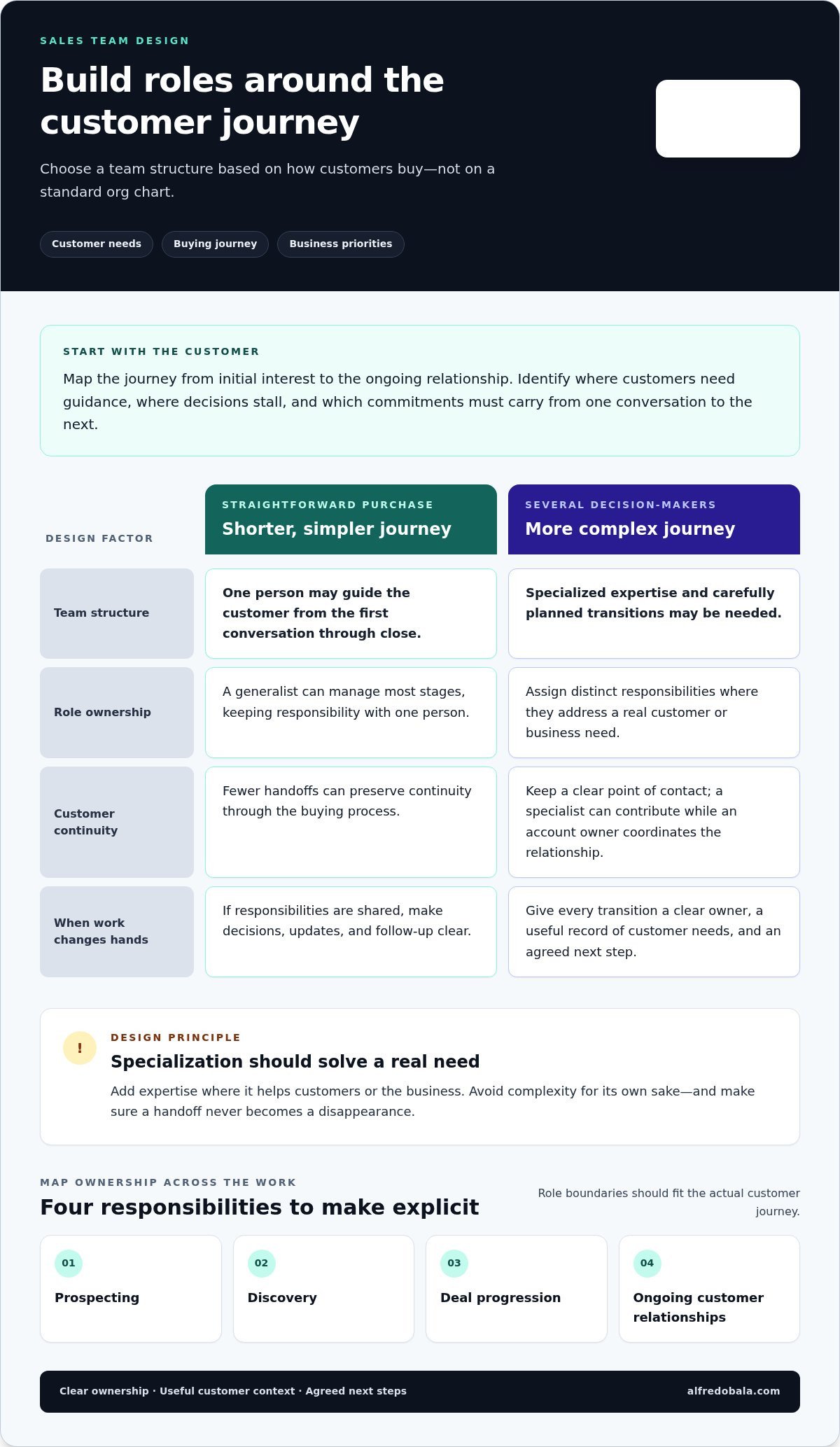
Design the team by working backward from the customer. Start by defining who you serve, what those customers need to decide, how they buy, and what your business must deliver. A straightforward purchase with a short sales cycle may call for one person to guide the customer from first conversation through close. A more complex journey involving several decision-makers may require specialized expertise and carefully planned transitions.
Map the real customer journey, from initial interest to the ongoing relationship. Note where customers need guidance, where decisions tend to stall, and which commitments must carry from one conversation to the next. This map gives you a stronger basis for deciding team size and role boundaries than copying a popular structure. It also connects sales design to broader executive leadership development strategies, because organizational alignment shapes how well teams deliver on shared priorities.
Translate the sales strategy into team responsibilities
Make ownership explicit at each stage: prospecting, discovery, deal progression, and ongoing customer relationships. In a simpler sales process, a generalist may manage most stages, preserving continuity and reducing handoffs. Where the journey is more involved, distinct responsibilities can help, provided every transition has a clear owner, a useful record of customer needs, and an agreed next step. Specialization should solve a real customer or business need, not add complexity for its own sake.
Before assigning roles, ask where expertise matters most and where customers benefit from a consistent point of contact. For example, a specialist might support a technical evaluation while an account owner remains responsible for coordinating the relationship. That distinction prevents a handoff from becoming a disappearance. If responsibility is shared, define how decisions, updates, and follow-up are managed so the customer doesn’t have to navigate internal boundaries.
Hire for role fit, curiosity, and contribution
Define the outcomes of a role before drafting candidate requirements. Describe the customer challenges the person will address, the decisions they’ll influence, and how their contribution connects to colleagues’ work. Then assess curiosity, communication, willingness to learn, and relevant experience through examples of how candidates listen, investigate needs, and respond to new information. A résumé matters, but it can’t show the whole pattern of contribution.
Build for complementarity, not uniformity. A team may benefit from people with different strengths, such as thoughtful discovery, disciplined follow-through, or confidence explaining complex ideas. Shared standards keep those strengths focused on the same customer and business outcomes, while varied approaches can broaden the team’s capability. Role fit depends on both individual aptitude and how a person will contribute to the wider sales effort.
Review the structure as the strategy or customer journey changes. If the same handoff repeatedly creates confusion, clarify ownership before assuming you need more people. If a role is overloaded with unrelated responsibilities, separate the work only when the customer experience or business priorities justify it. Leaders looking to strengthen this alignment can explore Alfredo Bala’s leadership insights on organizational direction and team contribution.
Measure Sales Performance Without Confusing Activity with Results
Good measurement does more than report a number. It helps leaders see what the team is doing, where opportunities are progressing, and whether that work is producing the outcomes the business needs. Activity, pipeline movement, and business results are connected, but they answer different questions. Track them as separate signals, then interpret them together.
Leading indicators show the actions and progress that may shape future performance; lagging outcomes show what those efforts have already produced. Neither category tells the whole story alone. A full calendar of calls doesn’t prove customers are moving toward a decision, and a strong quarter doesn’t reveal whether the team’s approach is repeatable.
| Measure type | What it shows | Examples |
|---|---|---|
| Activity indicators | Whether planned selling work is happening | Customer conversations, follow-ups completed, discovery meetings held |
| Pipeline indicators | Whether opportunities are progressing and where they may be stalled | Qualified opportunities, stage movement, next steps agreed with customers |
| Business outcomes | What the sales effort has delivered | Revenue, wins, renewals, customer retention |
Choose measures that reflect the sales model
Start with a priority, then choose the measure that gives you useful evidence about it. If the priority is stronger discovery, review whether reps identify customer needs and agree on meaningful next steps. If the focus is deal progression, examine pipeline movement alongside customer decisions. If the goal is sustainable growth, consider outcomes such as wins and retention in the context of the sales cycle and customer relationship.
A measure that helps diagnose progress is not automatically a final measure of success. Activity shows whether the work is taking place; pipeline signals reveal whether opportunities are advancing; business outcomes confirm what was achieved. The right mix depends on role, customer, sales cycle, and business priorities. Avoid applying universal quotas or conversion benchmarks without considering those differences.
Turn performance conversations into useful feedback
Make the numbers the start of a conversation, not the verdict. Replace a general judgment such as “your pipeline is weak” with a specific observation: “Several opportunities have no agreed customer next step.” Then explore what’s behind the pattern. Is the rep unsure how to progress a conversation, facing an obstacle, or working with opportunities that aren’t well qualified?
Agree on a practical next action and a follow-up point. The seller might practise asking for a clear customer commitment, while the leader reviews how that approach worked in a later opportunity. Be explicit about who owns each action and how progress will be assessed. This keeps accountability fair and gives coaching a clear purpose.
Leaders who want to strengthen the connection between team expectations and development can explore Alfredo Bala’s leadership insights. Strong measurement isn’t about tracking everything. It’s about choosing signals that help people make better decisions and improve the work.
Develop Sales Capability with a Repeatable Coaching and Learning Rhythm
Training creates value when it changes what a seller does in a real customer conversation. Make learning a continuous cycle, not an event that ends when a course or onboarding session is over. This gives managers a practical way to turn observed gaps into focused development, then check whether new skills are showing up in the work.
- Identify a capability need. Use a specific moment, such as a discovery conversation that missed a key customer concern.
- Practise the skill. Rehearse a better question or response through role-play before using it with a customer.
- Apply it. Agree on an upcoming conversation where the seller can test the approach.
- Review progress. Discuss what happened, how the customer responded, and what to practise next.
Keep the sequence focused. If a seller needs to improve discovery, broad advice to “listen more” is difficult to act on. Practise asking a follow-up question that clarifies the customer’s priorities, then review whether it helped move the conversation forward. A clear development loop helps leaders understand how to build a high-performing sales team by strengthening the behaviors that support its goals.
Make onboarding specific to the role and customer
Give new hires a clear picture of the customers they serve, the sales process they’ll follow, their responsibilities, and the communication standards expected across the team. Set early learning objectives around what they need to understand and demonstrate, rather than promising a fixed ramp time. For example, a new seller might first learn to explain the customer’s decision process, then practise discovery before leading those conversations with increasing independence.
Pair instruction with observation and practice. Let new hires listen to customer conversations, discuss what worked, and rehearse relevant scenarios. Then create opportunities to apply the learning and receive specific feedback. This connects onboarding to the role while helping managers spot where more guidance is needed.
Build coaching into the manager’s routine
Make coaching a consistent part of managing current work. In a focused one-to-one, review a live opportunity or recent conversation, invite the seller’s perspective, and agree on one clear development priority. Recognize an effective behavior, such as summarizing a customer’s needs accurately, then identify a single next step to strengthen. Too many improvement points at once can blur the focus.
Keep the conversation collaborative. Ask what the seller would repeat, what felt difficult, and what they’ll try next. The manager should contribute evidence and guidance, while the seller takes ownership of practising and applying the skill. The Motivation Equation offers a leadership framework for thinking about motivation and leadership. To bring these ideas into your organization’s development approach, explore Alfredo Bala’s leadership and team development insights.
Lead a High-Performing Sales Team Through Change and Sustainable Accountability
Strong performance doesn’t require constant pressure or a roster of star sellers. It requires a team that understands its priorities, trusts colleagues to do their part, and knows how progress will be assessed. Accountability and trust aren’t opposites: clear commitments make expectations fair, while respectful support helps people meet them.
Change will test that balance. Customer needs shift, business priorities evolve, and a sales structure that once worked may create friction later. Revisit roles and routines when you see repeated confusion, stalled decisions, or gaps in customer ownership. Explain what is changing and why, invite relevant perspectives, and clarify how responsibilities will work going forward. Keep the team’s purpose steady even as its practices adapt.
Respond to underperformance with clarity and support
Address a performance concern directly, but first understand what may be driving it. Match the response to the cause, not just the symptom:
- Unclear expectations: Restate the responsibility and describe what effective execution looks like.
- A capability gap: Identify the skill to strengthen and agree on a practical way to practise it.
- A situational barrier: Discuss what is obstructing progress and what support or adjustment may help.
Then agree on one specific improvement action and a reasonable follow-up conversation. For example, if a seller is struggling to advance opportunities, clarify the expected next step with customers, identify one conversation in which to practise, and set a time to review what happened. The follow-up isn’t a threat. It’s a commitment from both leader and seller to assess progress, adjust support, and decide what comes next.
Respect matters throughout. Focus on observable work and its impact, not assumptions about someone’s character or motivation. Give the employee a chance to explain their perspective, and listen carefully. Support doesn’t mean lowering expectations; accountability doesn’t require blame. A fair leader makes the standard clear, offers appropriate guidance, and addresses continued gaps honestly.
Turn the framework into the next leadership action
Start with one question: what is the most important gap limiting your team’s performance right now? Choose one focused change that addresses it, such as clarifying ownership at a handoff or making a team review more useful. Tell the team what you’re testing, what you hope to learn, and when you’ll review its effect. A deliberate adjustment gives people a clearer path than changing everything at once.
Building a high-performing sales team is ongoing leadership work. Alfredo Bala brings experience in the networking profession since 1980, including serving as CEO of Mannatech Inc. and COO of Britt World Wide. His work as an author, professional speaker, and executive advisor connects leadership responsibility with developing people who contribute to a shared purpose. For further perspective on developing leaders and teams, explore Alfredo Bala’s leadership insights.
Make Your Next Leadership Decision Count
Progress doesn’t require a sweeping redesign. It begins when you choose one decision that will make the work clearer for your team: what deserves focus, what support people need, or what commitment you’ll revisit together. Give that decision room to take hold. Ask your team what’s helping, what’s getting in the way, and what they’re learning from customers. Their answers can reveal where your next leadership move will have the greatest value.
That is the practical heart of how to build a high-performing sales team: keep learning, adjust with purpose, and create an environment where people can contribute and grow. Strong leadership isn’t a single intervention. It’s the steady practice of helping people connect their effort to shared progress.
Explore Alfredo Bala’s leadership insights, professional speaking, and executive advisory through Alfredo Bala’s website. Choose one action, bring your team into the conversation, and lead the next step with confidence.
Frequently Asked Questions
Should a sales team be organized by territory, customer segment, or sales role?
Choose the structure that best supports how customers buy and how your business serves them. Territory-based teams can make sense when location shapes coverage or relationships; segment-based teams can help when customer groups have distinct needs; role-based teams can suit a sales journey with specialized stages. Consider a hybrid if needed. For example, group sellers by customer segment but assign regional coverage where proximity matters, while keeping account ownership clear.
How can a sales leader tell whether a performance dip is temporary or more serious?
Look for a pattern across time, opportunities, and people before deciding what the dip means. Compare current results with the team’s usual sales cycle and consider factors such as seasonal demand, changes in lead quality, or delayed customer decisions. Then inspect a sample of active deals: are customers still engaging, or are opportunities repeatedly stalling at the same point? A dip that persists across different indicators deserves a deeper diagnosis than one isolated result.
Should a company promote its top salesperson into sales management?
Not automatically. Selling well and leading sellers require different strengths: a manager must coach others, set expectations, make decisions fairly, and take responsibility for team performance. Before promoting a top rep, discuss whether they want that work and give them a chance to practise leadership, such as mentoring a new colleague. A strong individual contributor may create more value by continuing to sell, so consider a career path that recognizes expertise without requiring management.
How can managers motivate salespeople without relying only on commission?
Give people a meaningful view of their contribution, room to build skill, and recognition tied to specific effort or customer impact. For example, acknowledge a rep who clarified a buyer’s needs and helped colleagues understand the account, not only the person who closed the deal. Invite sellers to shape how they pursue agreed goals, and follow through when they raise obstacles. Motivation is more durable when people feel their work matters and their progress is noticed.
Can a small business build a high-performing sales team without specialist roles?
Yes. A small business can learn how to build a high-performing sales team with generalists, provided each person knows which customers and tasks they own. One seller might handle outreach, conversations, and follow-up, while colleagues contribute product or service expertise as needed. Keep track of work that gets delayed or depends on a single person. If a recurring bottleneck emerges, first clarify the process; specialize only when the workload and customer needs justify it.
Does adopting a CRM automatically improve sales team performance?
No. A CRM can make customer and opportunity information easier to organize, but it won’t improve performance if the team doesn’t use it consistently or the information is unreliable. Start with a practical purpose, such as making the next customer commitment visible to whoever owns the follow-up. Keep required fields relevant, show how the system supports daily work, and review whether the information helps people make decisions. Technology is useful when it reinforces a sound sales process.
How often should sales leaders review targets and performance measures?
Review progress often enough to act while an opportunity or skill gap can still be addressed, and revisit targets when business assumptions change. A weekly team check-in may help surface immediate issues, while a broader monthly or quarterly review can reveal patterns across a longer sales cycle. These are starting points, not universal rules. If customer decisions take longer, avoid judging performance solely by short-term closes; include progress signals appropriate to the role.
 ES
ES  EN
EN
Comentarios recientes