
What if a career plan could create real momentum without promising a promotion the organization can’t guarantee? Learning how to create a career development plan for employees starts with that balance: take each person’s ambitions seriously while connecting growth to skills and opportunities the business needs.
A plan can easily become a generic document, filed away after one conversation. Consistent, collaborative follow-through is what makes it useful. Employees need ownership of their goals; managers need to make space for honest discussion, practical development, and changing priorities. Career planning is both an individual practice and a leadership responsibility that can strengthen teams and support organizational growth.
This guide explains how to build plans around employee aspirations and future workforce needs, turn goals into achievable development actions, and review progress so each plan stays useful. Drawing on leadership experience that includes serving as a CEO, Alfredo Bala explores how to keep development purposeful, realistic, and motivating, without treating a career plan as a guaranteed path to a particular role.
Key Takeaways
- Learn how to create a career development plan for employees by starting with an open conversation and evidence from the employee’s current work, not assumptions about their ambitions.
- Separate career development from performance management, succession planning, and required training so each plan has a clear purpose.
- Match development methods, such as mentoring, stretch assignments, and job shadowing, to the skills and experience the employee wants to build.
- Keep plans active by reviewing completed actions, skills practised, feedback received, and barriers that need manager support.
- Build leadership habits that make development conversations consistent and equitable across teams.
What Is an Employee Career Development Plan, and What Should It Achieve?
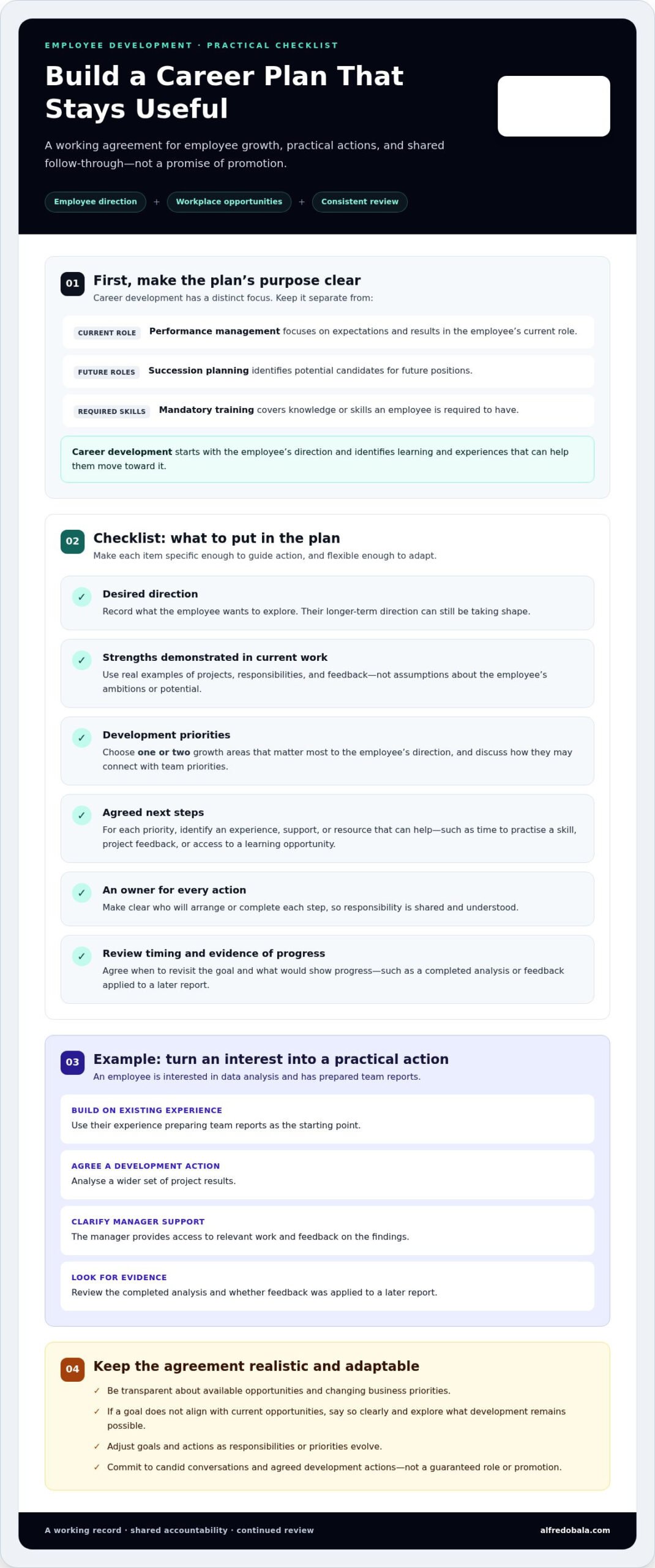
An employee career development plan is a working agreement between an employee and manager about the employee’s growth, actions that can support it, and how they’ll review progress. It is not a fixed promise of promotion, a guarantee of a particular role, or a form to complete once and file away. Its purpose is to make development concrete while leaving room for ambitions, opportunities, and business priorities to change.
This distinction matters. Performance management focuses on expectations and results in the current role. Succession planning identifies potential candidates for future positions. Mandatory training covers required knowledge or skills. Career development, by contrast, starts with the employee’s direction and identifies learning and experiences that can help them move toward it. The Personal Development Planning approach also emphasizes turning goals into actions; a workplace plan adds shared accountability between employee and manager.
That balance is central to how to create a career development plan for employees: take individual aspirations seriously while exploring how they connect with organizational capabilities and evolving team needs. Alignment should create shared value, not turn an employee’s career into a tool for filling a vacancy.
What belongs in a useful employee development plan?
Keep the plan specific enough to guide action and flexible enough to adapt. Record the employee’s desired direction, strengths demonstrated in current work, development priorities, and agreed next steps. For each priority, identify the experience, support, or resources that would help, such as feedback on a project, time to practise a skill, or access to a learning opportunity. Assign an owner to each action so it’s clear who will arrange or complete it.
For example, an employee interested in data analysis might build on experience preparing team reports. A practical next step could be analysing a wider set of project results, with the manager providing access to relevant work and feedback on the findings. Agree when to revisit the goal and what evidence would show progress, such as a completed analysis or feedback applied to a later report.
Use the plan as a working record, not a contract. Goals may shift, and actions may need to change as responsibilities or priorities evolve. The commitment is to have candid conversations and follow through on agreed development actions, not to guarantee a promotion or a specific outcome.
Why align employee growth with organizational needs?
Alignment connects a person’s motivation to work the organization needs done. If a team’s priorities are changing, employees may be able to practise relevant capabilities through current responsibilities or new experiences. Managers can explain which skills matter and where there may be room to apply them, while employees clarify which directions interest them and why.
That conversation must be transparent. An employee may want to lead a team while the organization has no immediate management opening. A manager can acknowledge the ambition, discuss leadership skills the employee can build, and identify ways to practise them without implying that a role is promised. If there’s little overlap between the employee’s goals and current opportunities, say so clearly and explore what development remains possible.
When both parties understand the plan’s purpose and limits, expectations are less likely to drift apart. The employee gains a more realistic view of available paths; the organization gains a clearer understanding of the capabilities and support that may help its people contribute as needs evolve.
How to Create a Career Development Plan for Employees in Six Collaborative Steps
Build the plan together, one clear conversation at a time. To understand how to create a career development plan for employees, managers need to pair what employees want to explore with evidence from their work and a realistic view of team needs. The National Career Development Association’s perspective on career development plans likewise emphasizes manager support and realistic expectations.
- Open with a career conversation. Employee: Describe interests, strengths, and work you’d like to explore, even if your longer-term direction is still taking shape. Manager: Ask open questions and listen before proposing a path. Don’t assume a strong performer wants management, or that uncertainty means a lack of ambition.
- Ground the discussion in current work. Employee: Bring examples of projects or responsibilities that felt engaging or challenging. Manager: Share specific observations and feedback. Discuss what the examples suggest about skills to build, rather than treating a gap as a judgment about potential.
- Choose one or two priorities. Employee: Identify which growth areas matter most to your direction. Manager: Explain where those capabilities could contribute to team priorities and what opportunities may be practical. Make trade-offs explicit if a goal doesn’t align with available work right now.
- Define the skill behind each goal. Employee: Turn a broad ambition, such as “lead projects,” into skills you want to practise, such as setting milestones or coordinating contributors. Manager: Help make the skill observable and connect it to appropriate work.
- Agree on actions and support. Employee: Take ownership of preparation and follow-through. Manager: Identify the experience, feedback, learning resource, or access needed, and clarify who will arrange each item.
- Set evidence and review dates. Employee: Track what you tried, what you learned, and where you need help. Manager: Agree on a date to review progress and adjust the plan if responsibilities or priorities change. A review should lead to a decision or next action, not simply a status update.
Keep the written plan simple and useful. Record the employee’s direction, current strengths, selected priorities, actions, owners, manager support, evidence of learning, and the next review date. This shared structure makes the conversation practical without implying a guaranteed role or promotion.
For example, an employee who wants to improve project leadership could coordinate milestones for an upcoming team assignment. The employee tracks decisions and lessons learned; the manager observes a planning discussion and offers feedback afterward. At the agreed review, they look for evidence such as clear milestone communication and feedback applied to the next project.
Strong development planning depends on managers who can listen, clarify expectations, and follow through. Explore leadership and team development insights for perspectives on building those habits into everyday leadership.
Which Employee Development Methods Fit Different Career Goals?
Choose the development method that gives an employee a relevant way to practise, not simply the one that’s easiest to arrange. Growth doesn’t have to mean promotion or a move into management. An employee may want to deepen expertise, understand another part of the organization, or become more effective in their current role. The right approach depends on the goal, the demands of the job, and the opportunities available.
Use this comparison to guide the discussion. A method can stand alone or pair with another, such as combining formal learning with a project where the employee can apply new knowledge.
| Method | Suitable goals | Manager support | Practical limitations |
|---|---|---|---|
| Stretch assignment | Practise a skill just beyond current responsibilities, such as presenting recommendations or coordinating a deliverable. | Set clear boundaries, provide guidance, and agree what the employee should learn. | Extra work can strain capacity if existing priorities aren’t adjusted. |
| Mentoring | Gain perspective, reflect on challenges, or learn how experienced colleagues approach a role or skill. | Help establish a relevant match and clarify the mentoring relationship’s purpose. | Advice alone may not build practical ability without opportunities to apply it. |
| Formal learning | Build defined technical or subject knowledge through a course, workshop, or structured study. | Identify how the learning relates to the employee’s goals and discuss application afterward. | Completion doesn’t automatically demonstrate the ability to use new knowledge at work. |
| Job shadowing | Explore an unfamiliar role, process, or function before deciding on a longer-term direction. | Arrange purposeful observation and a chance to discuss what the employee noticed. | Observation offers limited hands-on practice and depends on access to relevant work. |
| Cross-functional project | Understand connected teams, build collaboration skills, or develop adjacent capabilities. | Coordinate expectations with the teams involved and protect time for the agreed contribution. | Competing priorities or unclear ownership can limit the learning experience. |
Match the method to the work
Stretch assignments and cross-functional projects are most useful when employees can practise skills in real situations with clear boundaries. For example, someone developing stakeholder communication could present a project update to a partner team. The manager should define the employee’s responsibilities, identify what success looks like as a learning outcome, and adjust workload where needed. Don’t let a development opportunity become an unbounded extra assignment.
Mentoring is a strong fit when reflection, perspective, or guidance from someone with relevant experience can help. Formal learning makes sense when there’s a specific knowledge gap that calls for structured study. Connect either method to workplace application: after a course, the employee might use a new technique on an appropriate task; after mentoring, they might test an agreed approach and discuss what happened.
As you consider how to create a career development plan for employees, select methods with the employee, not for them. A thoughtful mix can build capability in more than one direction, including deeper expertise or stronger contribution in a current role. The goal is meaningful growth, supported by realistic opportunities and follow-up.
How to Keep Employee Career Plans Realistic, Active, and Measurable
A development plan stays useful only when people return to it. Agree on a review rhythm that fits the employee’s goals and work: an active project may call for brief check-ins as it unfolds, while a longer-term skill goal may need a less frequent but focused conversation. Set the next date before the meeting ends, then adjust the cadence if circumstances change.
Use reviews to ask what has moved forward, what the employee has practised, and what support is still needed. Record actions completed, skills used in real work, feedback received, and barriers that require manager involvement. This creates a practical record of learning without turning development into a scorecard.
How can managers measure progress without reducing growth to a score?
Look for evidence, not a single rating. An employee developing analytical skills might bring an example of a report they improved, explain how they applied feedback, and identify what they would do differently next time. The manager can add specific observations from the work. Together, they can recognize increased capability without claiming that one course, task, or conversation caused every change.
Invite the employee to reflect: What helped? What stalled? What would make the next step more effective? Keep these discussions distinct from short-term performance ratings and promotion decisions. Development progress can be real even when a role change isn’t available, and a promotion decision depends on more than completing learning actions. This clarity keeps the plan credible and motivation grounded in meaningful progress.
For a perspective on sustaining effort and motivation, explore The Motivation Equation masterclass in leadership and human performance. Consistent follow-through matters: agreed actions should lead to practice, feedback, and a next decision, not just another entry in a document.
What should happen when goals or business priorities change?
Revisit the plan when an employee’s responsibilities, interests, or team needs materially shift. A change doesn’t make the original effort worthless. Identify which learning commitments still serve the employee, then renegotiate actions that no longer fit the work or available opportunities.
For example, if a project that offered new technical experience is paused, the manager and employee can preserve the learning goal while choosing a different task to practise the same capability. Write down what changed, what remains relevant, who owns the revised actions, and when you’ll review them. A brief, shared update prevents either person from relying on outdated assumptions.
That flexibility is part of how to create a career development plan for employees that remains realistic over time. The plan should guide action, not lock either party into a path that no longer makes sense. To build the leadership habits behind consistent development conversations, explore Alfredo Bala’s leadership insights.
How to Make Career Development Planning Part of Leadership Practice
Career development becomes credible when leaders make it part of how they lead, not an annual exercise delegated to a form. Employees notice whether managers listen carefully, explain which opportunities are realistic, and follow through on agreed support. Those habits turn individual plans into a leadership practice that can strengthen teams and connect employee growth with organizational direction without taking ownership of career choices away from employees.
How can leaders build a consistent development culture?
Set an expectation that managers make space for regular career conversations, while letting each discussion respond to the person and their work. Help managers practise open questions, such as “What kind of work would you like to do more of?” and “What would you like to learn from your current responsibilities?” Coach them to distinguish a genuine commitment from a possibility, and to explain clearly when a desired opportunity isn’t available now.
Consistency also depends on fairness. Managers should have shared guidance on discussing strengths, development priorities, and access to growth experiences. They don’t need to offer every employee the same route. They do need to apply comparable care and transparency when exploring options. Make room for growth through deeper expertise, broader responsibilities, or cross-functional work, not only upward promotion. This helps employees see meaningful routes forward even when management isn’t their ambition.
How can organizations begin without overengineering the process?
Start with a short conversation guide and a simple shared plan format. Give managers a few prompts, a way to record employee goals and agreed actions, and space to note needed support and the next discussion. Keep the process light enough to use in real working relationships. A complicated system can shift attention from the quality of the conversation to completing fields.
Test the approach with a group of managers and employees. Ask what made conversations useful, where expectations were unclear, and whether agreed actions were practical alongside day-to-day work. Use their feedback to refine the guide before extending it more broadly. Leaders can also compare how teams are putting plans into practice, looking for gaps in access to feedback, learning experiences, or manager follow-through.
To understand how to create a career development plan for employees at scale, connect the process to the organization’s direction without treating people as interchangeable resources. Clarify the capabilities the organization needs, then invite employees to identify where their interests and strengths intersect with those needs. Where they don’t align, managers should discuss that honestly and explore development options that preserve employee agency.
Leadership experience can help organizations make this connection thoughtfully. Explore executive leadership development strategies for global growth for a broader view of how leadership capability supports organizational progress. For practical perspectives on stronger teams and employee growth, explore Alfredo Bala’s leadership and team-development insights.
Turn Career Conversations Into a Culture of Growth
The next step doesn’t need to be a company-wide program. Start with one thoughtful conversation, then create the conditions for employees and managers to keep learning from what they try. That steady commitment can help development become part of how your organization prepares for change, not a promise that every path leads to promotion.
Understanding how to create a career development plan for employees is ultimately a leadership practice: it asks leaders to make room for ambition, connect growth with meaningful contribution, and build trust through honest follow-through. Alfredo Bala brings experience as a former CEO of Mannatech Inc. and COO of Britt World Wide to his work on leadership and organizational growth. His book, The Motivation Equation, explores motivation and leadership.
Take your next step with ideas you can put into practice. Explore Alfredo Bala’s leadership and team-development insights, and keep building a workplace where people can grow with purpose. Start with one conversation, and let consistent action create momentum.
Frequently Asked Questions
Is a career development plan the same as a performance improvement plan?
No. A career development plan explores future interests and capabilities, while a performance improvement plan addresses specific concerns about current performance and the expectations for improvement. If a skill appears in both conversations, explain why it’s being discussed in each context. For example, presentation skills might be a growth interest in one discussion and a performance expectation in another. Keeping the purpose clear helps employees speak openly about their ambitions.
Can a career development plan guarantee an employee a promotion?
No. A plan can support preparation for future opportunities, but it can’t guarantee that a position will become available or that an employee will be selected. Be direct about this before agreeing on actions. A manager can still commit to things within their control, such as arranging feedback on a presentation or identifying a project where the employee can practise leading work. Clear commitments build trust without creating promises about outcomes.
What if an employee does not know what career goal to set?
Begin with exploration, not a job title. Ask the employee to name a recent task they found absorbing, a skill they’re curious about, or a responsibility they’d like to observe. If they’re interested in client-facing work, for example, they could join a planning discussion and reflect afterward on what appealed to them. This small experiment offers useful evidence and helps managers learn how to create a career development plan for employees without forcing premature decisions.
Should employees who want to remain individual contributors have a career plan?
Yes. Career growth can mean becoming a deeper subject-matter resource, taking on more complex assignments, or helping colleagues develop expertise. Ask what greater mastery or influence would look like in the employee’s role. For instance, an experienced analyst might want to improve how they explain findings to decision-makers without pursuing a management track. Recognizing these goals makes development more relevant and avoids treating a manager title as the only sign of progress.
How often should managers review a career development plan?
Agree on a cadence that matches the work and the employee’s learning opportunity, then bring the conversation forward if a major change occurs. A project-based goal may benefit from a check-in near a key deliverable, while a longer-term learning goal may need a different rhythm. Before each review, invite the employee to identify one action they tried and one question they want to resolve. Keep the discussion useful rather than meeting simply to update paperwork.
Should a career development plan be shared with HR?
Share the plan only in line with the organization’s development process and privacy practices. Before recording personal reflections, the manager and employee should understand who can access the document, what details are necessary, and how the information may be used. A practical record might capture agreed work actions while leaving private reflections in the conversation. If HR needs information to coordinate a learning opportunity, share the relevant details rather than unrelated personal context.
How can remote employees access meaningful development opportunities?
Make growth opportunities visible regardless of where employees work. A remote employee could lead a virtual project update, contribute to a cross-team task, observe a colleague’s client meeting online, or take part in structured learning followed by a practical assignment. Managers should clarify how participation and feedback will work across locations and time zones. Review evidence from completed work, not office visibility, so remote employees can demonstrate learning through their contributions.
 ES
ES  EN
EN
Comentarios recientes