
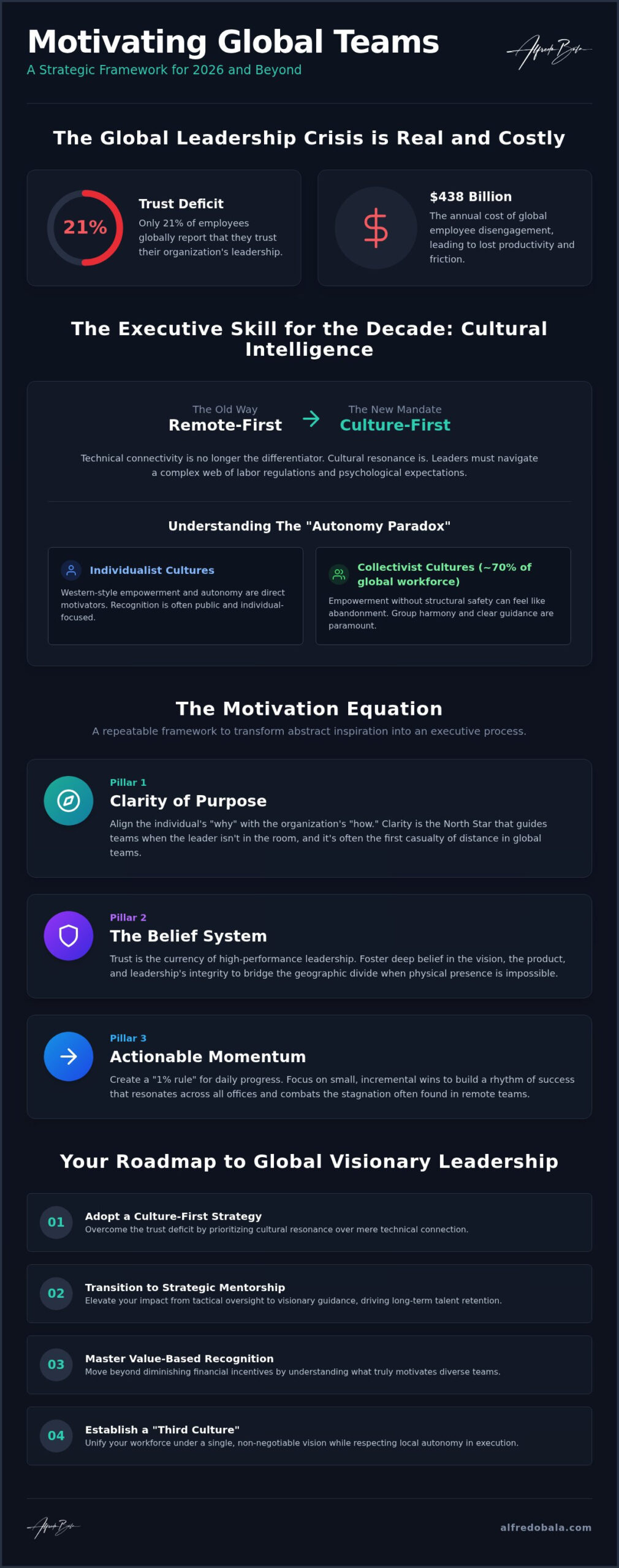
Did you know that only 21% of employees globally report that they trust their organization’s leadership? In a year defined by sweeping labor reforms across India and the EU, the challenge of motivating global teams has moved from a tactical necessity to a strategic mandate. With global disengagement costing $438 billion annually, you’ve likely felt the friction of cultural misunderstandings or the difficulty of standardizing performance across diverse regions. It is frustrating to lead a workforce that feels disconnected despite being hyper-connected.
This article promises a repeatable framework for global leadership that transforms you from a manager into a visionary mentor. We will explore the Motivation Equation to help you achieve higher retention and productivity in international markets. By mastering the structural frameworks and cultural intelligence required for peak organizational growth, you will learn to align diverse workforces under a unified purpose. This is your roadmap to building a high-performance culture that thrives across borders and time zones.
Key Takeaways
- Adopt a culture-first leadership strategy to overcome the trust deficit and productivity loss currently impacting the 2026 global workforce.
- Apply the Motivation Equation variables of clarity, belief, and action to create a repeatable framework for international growth and performance.
- Master the deep cultural intelligence required for motivating global teams by balancing individualist autonomy with collectivist alignment.
- Transition from tactical oversight to strategic executive mentorship to elevate your professional impact and drive long-term talent retention.
- Establish a “Third Culture” that unifies diverse workforces under a single, non-negotiable organizational vision while respecting local execution.
The New Reality of Motivating Global Teams in 2026
Technical connectivity is no longer the differentiator for international organizations; cultural resonance is. By 2026, the baseline for global business has shifted from simply providing remote access to navigating a complex web of new labor regulations and psychological expectations. With Japan overhauling its Labour Standards Act and Brazil enforcing strict mental health protections under NR-1, the administrative burden on leaders has intensified. However, the true executive challenge of motivating global teams lies in rebuilding the shattered psychological contract between leadership and the workforce.
We’ve moved past the “remote-first” era into a “culture-first” mandate. In this environment, 80% of organizations are now implementing AI-enhanced employee recognition programs to bridge the distance. Yet, technology cannot replace the gravitas of a seasoned leader. Traditional, one-size-fits-all motivational tactics are failing because they ignore the specific regional pressures your teams face. When you fail to account for these nuances, you don’t just lose productivity; you lose the trust of the very people tasked with driving your global expansion.
Beyond Time Zones: The Cultural Intelligence Gap
Cultural Intelligence (CQ) has emerged as the primary executive skill for the current decade. It’s the ability to function effectively across national and organizational boundaries, and it requires more than just a passing familiarity with local customs. Research into cross-cultural leadership reveals that roughly 70% of the global workforce operates within collectivist frameworks. This creates an “Autonomy Paradox” where Western-style empowerment can feel like abandonment to a team member in a high-context culture. You must learn to provide the structural safety that collectivist members require while still fostering the individual drive necessary for high-performance sales.
Why Traditional Incentives Fail Across Borders
Financial incentives are hitting a wall of diminishing returns, particularly as the EU Pay Transparency Directive and similar laws in the United States become standard. When compensation is transparent, money becomes a hygiene factor rather than a motivator. The real differentiator in 2026 is value-based recognition. You have to bridge the “recognition gap” by understanding that a public award might energize a manager in Silicon Valley but cause genuine social friction for a team in Shanghai. To lead effectively, you must transition toward a model of motivation that aligns the company’s global mission with the personal identity and values of each local team member.
Decoding the Motivation Equation for International Success
Stop treating motivation like a mysterious spark that appears by chance. It is a predictable outcome of specific inputs. To master the art of motivating global teams, you must first master the science of human performance. In The Motivation Equation book, I provide a definitive framework that transforms abstract inspiration into a repeatable executive process. This isn’t just theory. It’s a practitioner’s roadmap developed over 40 years of leading thousands across different cultures and continents.
The Three Pillars of Alfredo Bala’s Framework
Pillar 1: Clarity of Purpose. In a global context, clarity is often the first casualty of distance. You must align the individual’s personal “why” with the organization’s overarching “how.” If a sales director in Brazil doesn’t see how their local targets fuel the global mission, their engine stalls. Clarity acts as the North Star that keeps teams moving when the leader isn’t in the room.
Pillar 2: The Belief System. Trust is the currency of high-performance leadership. Executives must find ways to motivate their teams by fostering deep belief in the vision, the product, and the leadership’s integrity. Without belief, even the clearest instructions are ignored or executed with mediocrity. Belief is what bridges the geographic divide when physical presence is impossible.
Pillar 3: Actionable Momentum. Large, abstract goals can paralyze even the best talent. Successful leaders create the “1% rule” for daily progress. By focusing on small, incremental wins, you build a rhythm of success that resonates whether your team is in London or Lagos. Momentum is the antidote to the stagnation often found in remote global offices.
How do you know where your leadership is failing? You must calculate your “Motivational Deficit.” If clarity is high but belief is low, you have a trust problem. If belief is high but action is low, you have a process problem. Identifying these variables allows you to scale this equation from a single direct report to a global organization of ten thousand. It turns a manager’s guesswork into an executive’s precision tool.
Moving from Transactional to Transformational Motivation
Transactional leadership asks what can be done today. Transformational leadership asks who we are becoming as a global entity. High-retention teams aren’t built on bonuses alone. They’re built on a shared identity that transcends local borders. When you apply the Motivation Equation, you stop managing tasks and start engineering a culture of excellence. As you look to refine your approach, you can explore more leadership and team development insights to sharpen your competitive edge.
Motivation is not a feeling you find; it is a result you engineer through clarity and belief.
Overcoming the Individualist vs. Collectivist Trap
Empowerment is a double-edged sword. To a sales lead in Silicon Valley, being told “I trust you to handle this” sounds like a vote of confidence. To a manager in Shanghai, that same phrase can feel like abandonment. This is the “Autonomy Paradox.” If you want to succeed at motivating global teams, you must recognize that your best intentions can be misread if they aren’t filtered through the lens of cultural intelligence. High-performance leadership requires you to bridge the gap between individualist drive and collectivist loyalty without losing your executive edge.
I often hear leaders complain that their teams are too diverse to foster a single, unified culture. This is a myth born of tactical fatigue. You don’t need to adopt twenty different local cultures. Instead, your goal is to engineer a “Third Culture” that belongs to the company itself. This shared space respects local nuances while providing a consistent framework for success. It’s about creating a environment where a high-context communicator from Japan and a low-context driver from the United States can both find the clarity they need to perform.
Navigating Hierarchy and Autonomy in Global Markets
Successful global executives use a framework I call “Adaptive Autonomy.” This isn’t about giving everyone the same level of freedom; it’s about providing the right amount of structure to create safety. In collectivist regions, structured processes aren’t viewed as micromanagement. They are seen as a safety net. You must know when to be a directive leader who provides clear, hierarchical boundaries and when to step back into the role of a facilitative coach. This fluidity is what separates a regional manager from a global visionary.
Building Psychological Safety Without Losing Authority
Psychological safety looks different across borders. In face-saving cultures, “frank speaking” in a group setting can be deeply damaging to morale and authority. You must master the art of the private feedback loop. While public recognition is a staple of Western motivation, it can cause social friction in more modest, group-oriented societies.
To lead effectively, you need proven strategies for managing global teams that account for these emotional undercurrents. Establishing psychological safety means creating a space where team members feel safe to fail without losing face. When you protect the dignity of your people, you earn a level of loyalty that no financial incentive can buy. This is the foundation of a high-retention, high-output international workforce.
A Step-by-Step Guide to Scaling Motivation Globally
Scaling your impact is not a matter of volume; it’s a matter of structural integrity. When you move from leading ten people to leading ten thousand, the “noise” in your organizational communication increases exponentially. To succeed at motivating global teams, you must implement a system that remains rigid in its values but fluid in its application. This is how you ensure the energy of the boardroom reaches the furthest remote office without losing its potency.
Follow these five steps to build a scalable motivational infrastructure:
- Step 1: Audit your engagement levels. Use the variables of the Motivation Equation, clarity, belief, and action, to identify exactly where the disconnect lies in each specific region.
- Step 2: Standardize the vision. The “What” and “How” of your organization must be non-negotiable. However, you must empower local leaders to define the “Why” in a way that resonates with their specific cultural drivers.
- Step 3: Bridge silos with mentorship. Pair high-potential leaders from different continents. Cross-border mentorship destroys the “us vs. them” mentality and fosters a global identity.
- Step 4: Establish a global rhythm. Motivation dies in silence. You need a communication cadence that ensures every team member feels seen and heard, regardless of their time zone.
- Step 5: Prioritize professional growth. Mastery is a universal human desire. Providing a clear path for personal elevation is the most effective way to ensure long-term retention in competitive markets.
Standardizing Strategy, Localizing Execution
Consistency is the bedrock of trust. You cannot have different sets of values for different offices. While the global mission remains the North Star, you must allow for local flavor in how that mission is celebrated. This is where the 1% rule, mentioned earlier, becomes a powerful tool. Whether a team is in a large market like India or a smaller hub in Belgium, focusing on daily, incremental progress provides a shared language of success. To see how this practitioner-led approach outperforms academic theory, you should learn why your team needs The Practitioner’s Edge when choosing your next leadership guide.
Communication Rhythms That Drive Engagement
Results follow rhythm. If your communication is sporadic, your team’s motivation will be too. Implement a “Sun Never Sets” meeting cadence that rotates times to ensure no single region always bears the burden of late-night calls. Use video for high-stakes emotional alignment and asynchronous tools for tactical updates. Effective global communication is 20% information and 80% cultural translation. When you master this balance, you turn a disjointed group of offices into a singular, high-performance entity. If you are ready to transform your leadership approach, you can find more resources and book a consultation at alfredobala.com.
Elevating Your Leadership: From Manager to Global Visionary
Lead from the front. Strategy is merely a skeleton; your leadership is the breath that gives it life. As you reach the upper echelons of corporate influence, your role undergoes a fundamental transformation. You are no longer a manager of processes or a supervisor of tasks. You must become the “Chief Motivation Officer.” In this capacity, you serve as the critical bridge between abstract corporate strategy and the individual ambitions of your workforce. By motivating global teams through a clear, shared vision, you turn a collection of disparate offices into a unified powerhouse of growth.
The transition from tactical management to strategic executive mentorship is essential for your own longevity. With 56% of managers reporting burnout in 2025, the old way of “hands-on” micromanagement is a path to exhaustion. A visionary leader understands that their greatest output is not a spreadsheet, but the development of other leaders. You must elevate yourself to a position where you shape the dynamic of the entire organization from the top down, often utilizing board-level advisory to influence the cultural fabric of the company.
The Role of Executive Mentorship in Retention
Top talent rarely leaves a mission; they leave a lack of mentorship. In high-growth international markets, your best people stay because of who you are and who you are helping them become. You must develop a “Success Story” archetype within your leadership team, showing your sub-leaders a clear roadmap for their own elevation. By instilling the principles of the Motivation Equation into your directors and VPs, you create a self-sustaining ecosystem of high performance. When your sub-leaders master clarity and belief, the need for constant oversight vanishes, allowing you to focus on the horizon rather than the trenches.
Leveraging Professional Speaking and Advisory for Growth
High-impact communication is the primary tool of the global visionary. During times of massive change, such as the sweeping labor law reforms occurring across the EU and Asia-Pacific in 2026, a single keynote can do more to align a workforce than a thousand emails. Professional speaking isn’t just about delivery; it’s about the strategic alignment of thousands of minds toward a single objective.
Similarly, executive advisory seats provide the broad “Global Perspective” required to stay ahead of the curve. These roles allow you to see patterns across industries and regions that others miss. You can bring this high-level intelligence back to your own organization, ensuring your team remains resilient and motivated regardless of external market shifts. It’s time to stop managing and start inspiring. Elevate your team’s performance by bringing Alfredo Bala’s insights to your next global summit and begin your journey from manager to visionary today.
Mastering the Art and Science of Global Influence
The landscape of 2026 demands more than administrative competence. It requires a leader who can engineer trust across continents and bridge the gap between corporate strategy and individual ambition. You’ve seen how the Motivation Equation provides the structural integrity needed for motivating global teams at scale. By moving beyond the autonomy paradox and standardizing your vision while localizing the “why,” you create a culture that transcends borders. This is how you transition from being a manager of regions to a visionary guide for a high-performance organization.
My insights are forged from 40+ years of global leadership and my tenure as the CEO of a multi-national corporation. I’ve distilled these hard-won lessons into a framework that works. It’s time to stop guessing and start leading with precision. Order ‘The Motivation Equation’ to transform your global leadership today and secure your legacy as a Chief Motivation Officer. The world is waiting for your vision. Step into your role and lead with the confidence of deep experience.
Frequently Asked Questions
How do you motivate a team with different cultural backgrounds?
Standardize your organizational vision while localizing your delivery through the Motivation Equation. You must identify whether a specific region’s barrier is a lack of clarity, a deficit in belief, or a stall in action. Western teams often respond to individual recognition, but Eastern teams find deeper motivation in collective success and group harmony. Successful leaders bridge these gaps by anchoring everyone to a shared “Third Culture” that belongs to the company rather than any single country.
What is the biggest challenge in managing global teams?
Navigating the “trust deficit” across geographic and cultural divides is the most significant hurdle for modern executives. Only 21% of employees report trusting their leadership, and this gap is amplified when teams are spread across different time zones and regulatory environments. Managing these complexities requires high Cultural Intelligence to ensure your leadership intent isn’t lost in translation. Without a foundation of trust, even the most sophisticated strategy will fail to drive meaningful engagement or long-term productivity.
Can the Motivation Equation be applied to remote workers?
Yes, the Motivation Equation is the ideal framework for motivating global teams in remote environments. Remote work often erodes clarity and belief because of the lack of physical presence. By intentionally engineering these two variables, you create the momentum necessary for consistent action. You’ve got to replace the “hallway chat” with structured communication rhythms that reinforce the company’s mission and the individual’s value within that mission. This turns isolated workers into a unified force.
How do you build trust in a team that has never met in person?
Trust is built through radical transparency and reliable consistency rather than just social interaction. You must demonstrate that your actions align with your words every single time. Use video calls to establish a human connection, but rely on documented processes to provide the professional safety remote workers need. When team members see that you’re personally invested in their elevation and professional growth, trust begins to form naturally. It’s about being a predictable, supportive presence regardless of the distance.
Is psychological safety culturally dependent?
The concept is universal, but its execution varies wildly across borders. In individualistic societies, safety is often established through “frank speaking” and open debate. In face-saving cultures, however, public disagreement can be seen as a direct attack on authority or group harmony. To maintain safety, you must adapt your feedback loops to respect these nuances. This often means moving critical conversations to private, one-on-one settings to protect the dignity of your team members while still driving performance.
How often should global teams have synchronous meetings?
Synchronous meetings should be reserved for high-stakes emotional alignment and complex problem-solving. A “Sun Never Sets” cadence, where meeting times rotate to share the burden of inconvenient hours, is most effective. For tactical updates, use asynchronous tools to respect local time zones and prevent burnout. Over-scheduling synchronous calls leads to “meeting fatigue,” which accounts for a significant portion of the manager burnout currently affecting 56% of the workforce. Focus on quality of connection over quantity of calls.
What are the best incentives for international sales teams?
The best incentives move beyond financial rewards to focus on professional development and personal mastery. While competitive pay is a baseline, top performers in 2026 value mentorship and career elevation. You should offer incentives that align with local values, such as extra time off in regions with a strong work-life balance focus or public recognition in individualistic markets. Value-based motivation that respects local economic realities always outperforms a one-size-fits-all bonus structure that ignores cultural context.
How does leadership style need to change for collectivist cultures?
You must shift from being a hands-off coach to a directive leader who provides clear, hierarchical safety. In collectivist frameworks, which govern 70% of the global workforce, “empowerment” without structure can feel like a lack of support. Leaders succeed at motivating global teams when they emphasize collective goals and provide high degrees of clarity in their expectations. This approach fosters a sense of belonging and loyalty that is the bedrock of high performance in these regions.
 ES
ES  EN
EN
Comentarios recientes