
Innovation rarely stalls because a team has no ideas. It stalls when people stay quiet, promising suggestions lose momentum, or nobody knows how decisions will be made. If you’re asking how to foster innovation in your team, start by making it safe to speak up and clear what happens next.
Creativity needs room to grow, but freedom without focus can leave people brainstorming without follow-through. Tight control can shut down useful challenges to the status quo. Connect psychological safety with disciplined experiments and clear accountability so ideas can be explored without losing sight of business priorities.
This practical guide shows you how to invite candid input, assess ideas fairly, and give promising ones a manageable path to testing. You’ll also find routines that make innovation part of everyday work rather than a one-off event. We’ll look at the leadership habits that help teams turn contributions into meaningful outcomes.
Key Takeaways
- Start with a clearly defined challenge so new ideas address a real need and create meaningful value.
- Learn how to foster innovation in your team by setting decision criteria that balance usefulness, feasibility, strategic fit, and learning potential.
- Give each step from idea generation to testing a named owner and a visible next action.
- Track lessons applied and improvements made, not just the number of ideas your team produces.
- Use a repeatable process to make innovation part of everyday work, not a one-off brainstorming event.
How to Foster Innovation in Your Team Starts With Defining the Real Problem
A team can generate a long list of ideas and still see little change in its work. The gap usually isn’t a shortage of creativity. Ideas haven’t been connected to a real need, chosen for action, or carried through. To understand how to foster innovation in your team, begin by defining what innovation should improve.
Team innovation means applying new or improved ideas to create meaningful value. That value might come from a smoother customer experience, a clearer decision, a more reliable product, or a process that wastes less time. The improvement doesn’t have to be dramatic. It should make a worthwhile difference to someone and address a genuine need.
What counts as innovation on an everyday team?
Look at recurring work. Could a handoff between colleagues be simplified? Could the team redesign a weekly workflow that routinely creates delays? These are practical innovation challenges, even if the solution is a small adjustment rather than a breakthrough. Incremental improvements can make everyday work more effective when they solve a clearly understood problem.
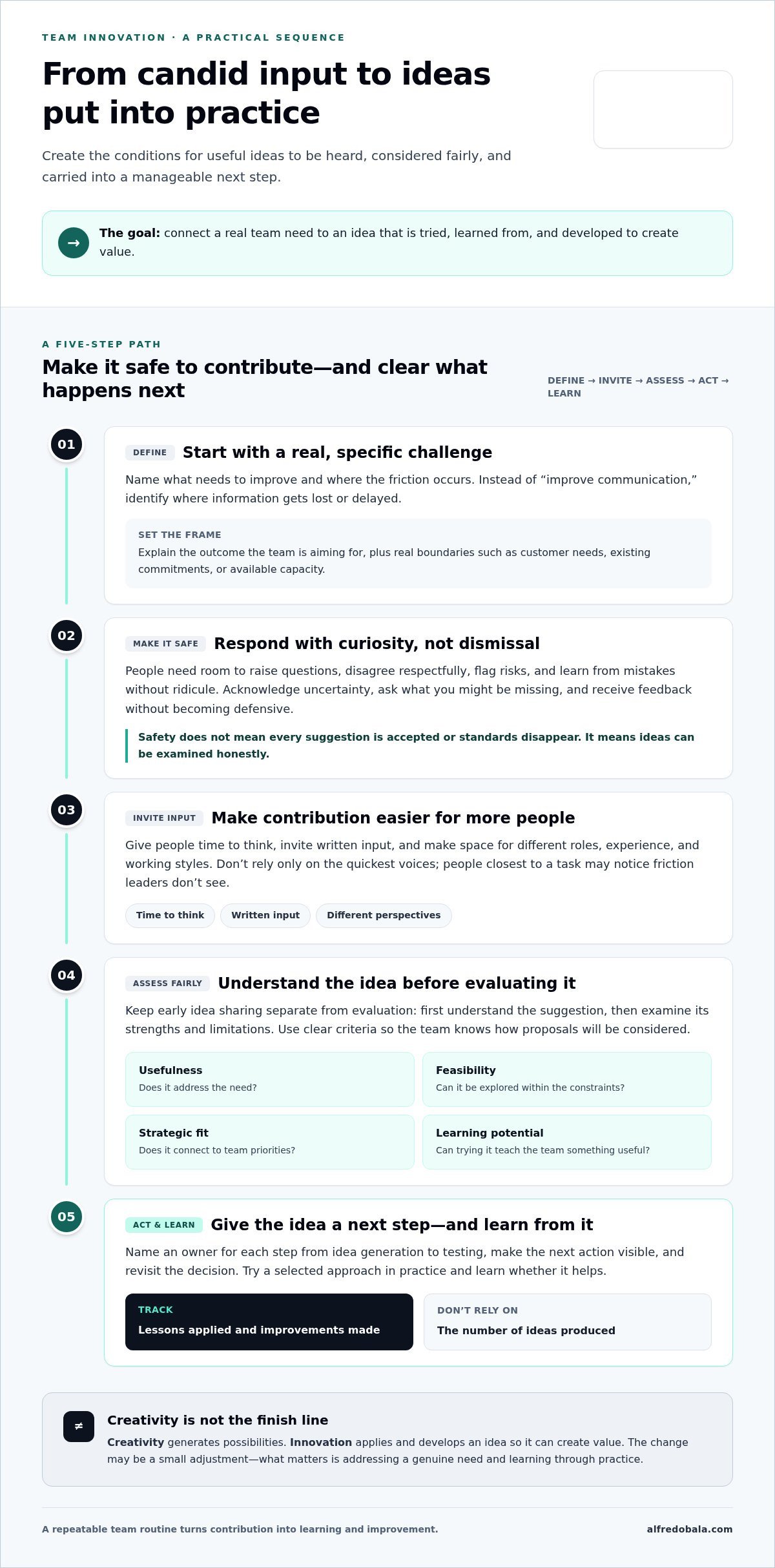
Creativity and innovation are related, but they’re not interchangeable. Creativity generates possibilities; innovation applies and develops an idea so it can create value. A team may brainstorm several ways to improve a handoff, for example. The work becomes innovation when members select an approach, try it in practice, and learn whether it helps. For a broader overview of the processes and conditions involved, see Innovation Management Principles.
Innovation isn’t the number of ideas a team produces; it’s the learning and value created by putting ideas into practice. This is a more useful starting point than asking people to “think creatively” without specifying what needs to change.
Why promising ideas stall before they create value
Ideas often lose momentum for reasons leaders can influence. Priorities may be unclear, leaving people unsure which problems matter most. Team members may fear criticism, especially if past suggestions were dismissed or treated as distractions. Even a promising proposal can fade when nobody owns the next step. These are signals about the environment and process, not proof that employees lack initiative.
An idea session can feel productive, then stall as soon as the meeting ends. If no one decides whether an idea should be explored, who will take it forward, or when the team will revisit it, enthusiasm has nowhere to go. Suggestions repeat, contributors stop speaking up, and leaders are left wondering why participation is low.
Start by making the challenge specific. Instead of asking for ideas to “improve communication,” identify where information gets lost or delayed. Then explain how suggestions will be considered and what the next decision will be. That shift connects people’s contributions to organizational priorities and gives useful ideas a fair chance to move forward.
Build the Team Conditions That Make Innovation Possible
People rarely offer their best thinking when they expect a sharp response, a public put-down, or silence after they speak. Psychological safety means people can raise questions, disagree respectfully, flag risks, and learn from mistakes without being ridiculed. It doesn’t mean every suggestion is accepted or that standards disappear. It means the team can examine ideas honestly without making contribution feel personally risky.
A leader’s response to the first idea tells the team what to expect from every idea that follows. When a suggestion is met with curiosity, people are more likely to keep contributing. When it’s dismissed before anyone understands it, the room learns a different lesson. Leaders set the tone in small moments: acknowledge uncertainty, ask what they might be missing, and respond to feedback without becoming defensive.
Make it easier for people to speak up
In meetings, don’t rely only on the quickest voices. Give people time to think, invite written input, and ask quieter participants for their perspectives without demanding an immediate answer. Make space for different roles, levels of experience, and working styles. People closest to a task may notice friction that leaders don’t see. Inclusion is deliberate; it shouldn’t be assumed that everyone has the same chance to contribute.
Keep early idea sharing separate from evaluation. First, help the group understand the suggestion; then consider its strengths and limitations. Thank someone for raising a concern, even if the team chooses another direction. This recognizes the value of speaking up without promising that every proposal will be adopted.
Give creativity direction without prescribing every answer
Openness works best with a clear frame. Before inviting ideas, explain the problem, the outcome the team is aiming for, and any real boundaries, such as customer needs, existing commitments, or available capacity. Then give people room to explore solutions within those boundaries. This connects creative effort to organizational priorities while leaving space for perspectives and approaches leadership may not have considered.
For example, a leader might ask the team to reduce confusion during a recurring handoff, clarify what a successful handoff should enable, and identify constraints that can’t be ignored. The leader shouldn’t dictate the exact fix before hearing from the people involved. Instead, establish how the team will share perspectives, surface concerns, and decide what to examine further. These choices reflect executive leadership development strategies that shape the conditions for contribution.
That balance is central to how to foster innovation in your team: provide enough direction to focus effort, but not so much control that people only repeat the leader’s preferred answer. For further perspective on guiding teams with clarity and purpose, explore Alfredo Bala’s leadership and team development insights.
Turn Team Ideas Into Experiments With Clear Decision Criteria
Once a team has surfaced ideas, the next leadership task is to evaluate them fairly and practically. Too much emphasis on open exploration can leave every suggestion competing for attention; premature judgment can shut down possibilities before their value is understood. Separate the stages: first clarify what an idea proposes, then compare it against criteria the team agrees on in advance.
A simple comparison grid can make trade-offs visible without pretending that every idea is equally strong. Assess each proposal against four questions:
- Value: Would it make a meaningful difference for a customer or colleague?
- Feasibility: Can the team try it with the skills, time, and resources available?
- Strategic fit: Does it support a priority the organization is responsible for?
- Learning potential: Could testing it answer an important question, even if the idea needs revision?
Agree on what each criterion means before discussing individual proposals. Otherwise, the team may shift the standard to favor a familiar idea or the most senior person’s preference. A shared grid doesn’t remove judgment; it helps people explain their reasoning and see why options involve different trade-offs.
Evaluate ideas without shutting down creativity
Keep evaluation curious, not dismissive. A proposal that seems weak may depend on an assumption nobody has tested. Ask what would need to be true for it to work and what evidence would help the team decide. This distinguishes an idea with little value from one whose value is still uncertain. The first may be set aside; the second could warrant a focused test.
Design a useful, low-risk experiment
When evidence is incomplete but the risk can be contained, choose a small, reversible experiment rather than debating the idea indefinitely or committing to a full rollout. Before starting, make the test concrete:
- Assumption: What does the team believe may be true?
- Learning goal: What question should the test answer?
- Audience and scope: Who will take part, and what will the test affect?
- Observation period: When will the team review what happened?
- Decision evidence: What would support adapting, stopping, or expanding the approach?
For example, if a team believes a revised customer response template could reduce repeated clarification, it might trial the draft with a defined set of interactions while keeping the existing process available. The team can observe whether responses are clearer and note any new friction without changing the workflow for everyone at once. Protect core responsibilities and consider the effect on people involved before launching the test.
A test isn’t a promise of success. It’s a disciplined way to learn. A useful result may be evidence to expand an approach, a reason to adjust it, or a clear signal to stop. That mindset makes how to foster innovation in your team a matter of responsible decision-making: give promising ideas room to prove themselves while keeping the next step proportionate to what’s known.
Use a Repeatable Team Routine to Move From Ideas to Action
Innovation becomes part of team work when there’s a dependable way to move from a challenge to a decision. A lightweight routine gives ideas somewhere to go without turning every discussion into a major project. Keep the cycle visible, assign an owner at each stage, and make the next action clear. A simple innovation routine is a repeatable path from challenge to evidence-based decision.
Use this six-step cycle as a practical starting point:
- Define a challenge. Name a specific issue the team can influence and assign someone to frame it clearly.
- Generate options. Invite contributions, capture them in a shared place, and name a facilitator to organize the discussion.
- Select an idea. Agree on which option to explore and assign a decision owner to record the choice and rationale.
- Test the idea. Give a test owner responsibility for coordinating the experiment and sharing progress.
- Learn from the evidence. Ask the owner to summarize what happened, what the team learned, and what remains uncertain.
- Decide what happens next. Name who will choose whether to adapt, stop, or build on the idea, and record the next action.
Ownership doesn’t mean one person does everything. It means no stage depends on an unspoken assumption that someone else will follow up. A visible note, shared task, or simple decision log can capture the challenge, owner, learning question, next action, and review date. That record also helps the team pick up where it left off instead of restarting the conversation each time.
Launch the first innovation cycle with one focused challenge
Choose a concrete issue the team can affect within its normal responsibilities, such as a recurring delay or unclear handoff. Before group discussion, invite people to submit ideas independently so initial contributions aren’t shaped only by the first voices in the room. Then select one experiment and record its owner, learning question, and review date. Start small and make the follow-through visible.
Keep experiments connected to everyday work
Build a brief progress check into an existing team meeting instead of relying on occasional innovation events. Ask what moved forward, what’s blocked, and what the next action is. Treat an unsuccessful test as information about the approach or its assumptions, not a verdict on the people involved. Recognizing contribution and supporting motivation can help sustain participation; The Motivation Equation offers a related perspective on leadership and human performance.
Make the routine easy to maintain. If your team is ready to strengthen the leadership habits that support consistent contribution, explore The Motivation Equation.
Sustain Team Innovation by Measuring Learning and Acting on Results
Innovation needs more than a good idea and a completed test. Leaders also need to understand what changed, what the team learned, and whether that learning should shape the next decision. Measurement keeps innovation connected to the challenge, but it should guide judgment rather than turn every experiment into a performance score.
What should a team measure when fostering innovation?
Start with a small set of measures tied to the challenge and intended value. Separate activity, outcomes, and learning. The number of ideas discussed or experiments run shows activity, not whether the work helped. A team improving a handoff might examine whether key information reaches the next person more clearly, while recording what the test revealed about the process.
Useful measures can include:
- Activity: Which ideas moved into a test, and which decisions were made?
- Outcomes: What changed for the customer, colleague, or workflow connected to the challenge?
- Learning: What assumption was supported or challenged, and what lesson has the team applied?
Use the team’s own starting point rather than relying on an unsupported benchmark. If the result is mixed, record what may have influenced it and what the team would change next time. A test that doesn’t deliver the intended outcome can still be useful if it produces actionable learning and informs a clear decision.
Match review depth to the risk
Speed matters, but so does care. For a small, reversible change with limited impact, a brief review may be enough to decide what to adjust. If an experiment could affect customers, colleagues, or essential work more substantially, take more time to assess the evidence and possible consequences. Use enough rigor to make a responsible decision without burdening every modest test with unnecessary process.
Make innovation a leadership practice, not a one-time initiative
Return to the measures in regular team reviews. Ask what the team learned, what changed as a result, and which barrier keeps interrupting follow-through. If the same obstacle appears repeatedly, address it rather than asking people to compensate through extra effort. Revisit priorities, recognize thoughtful contribution, and make it visible when a team member’s insight shapes a decision.
These habits reinforce trust: people can see that raising an idea or concern leads to a fair hearing, even when the proposal isn’t selected. They also support motivation by connecting individual effort to progress the team can understand. That’s a practical foundation for how to foster innovation in your team over time: learn openly, act on what the evidence shows, and choose the next challenge with purpose.
As a final leadership reflection, ask yourself: Have I made learning visible? Have I recognized the contribution behind it? Have I helped the team take a clear next step? For more perspective on the leadership behaviors that sustain contribution, explore Alfredo Bala’s leadership insights.
Make Your Next Team Idea the Starting Point
Choose one challenge your team can influence, then create a clear opportunity to act on it. The first cycle doesn’t need to be perfect. It needs to show people that useful questions are welcome, decisions have owners, and learning can shape what the team does next. That’s how to foster innovation in your team as a lasting leadership practice, not a separate initiative competing with daily work.
Keep asking what would help people contribute their best thinking and turn it into progress that matters. Alfredo Bala brings leadership experience shaped by CEO and COO roles and work in the networking profession since 1980. As the author of The Motivation Equation, he explores the connection between motivation, leadership, and human performance.
Take your next leadership step. Explore Alfredo Bala’s leadership insights and find fresh perspective for guiding your team’s growth. A stronger culture of innovation begins with the choices you make every day.
Frequently Asked Questions
Is innovation only important for product or technology teams?
No. Any team can improve a process, service, customer interaction, or internal decision. To explore how to foster innovation in your team, look at recurring friction within the group’s responsibilities, such as duplicated data entry or unclear approval steps. A practical improvement can be incremental rather than transformative. Identify a real opportunity, try a suitable change, and use what happens to guide the next decision.
Can a small team foster innovation without a large budget?
Yes. A small team can start with its existing knowledge and a clearly framed question. For example, colleagues could map the steps in a frustrating process, identify where work gets stuck, and test a simple adjustment before investing in a larger change. Leaders should make room for the work and consider who could be affected. Keep the experiment within the team’s capacity and avoid introducing risks it can’t manage.
How can introverted employees contribute to team innovation?
Give employees more than one route to share their thinking. Send the challenge in advance, invite written suggestions, and allow time for people to reflect before discussion. A colleague who prefers careful analysis might spot an overlooked assumption or clarify how a proposed change affects another role. Don’t judge contribution by who speaks first or most often. Thoughtful input can strengthen an idea before the team decides what to pursue.
What is the difference between creativity and innovation at work?
Creativity produces original or useful possibilities; innovation applies an idea and learns whether it creates value in practice. For instance, suggesting a new way to organize project updates is creative thinking. Trying that approach with a team and assessing whether it makes information easier to use moves the idea toward innovation. A promising suggestion is a starting point, not proof that the change works.
How often should a team hold innovation sessions?
There’s no single schedule that suits every team. Use a rhythm the team can sustain alongside core responsibilities, such as a short recurring check-in to review active work and a focused session when a specific challenge needs fresh thinking. Avoid holding sessions simply to fill a calendar. Every discussion should connect to a real need and leave the group clear about who will follow up and when the team will revisit the work.
What should a leader do when an innovation experiment fails?
Start by clarifying what the experiment was meant to find out, then compare that question with what the team observed. Keep the discussion focused on the approach and evidence, not personal blame. The next move may be to adjust the idea, try a different approach, or stop. Share relevant learning with colleagues who face a similar challenge. Ruling out an assumption can prevent the team from repeating an unhelpful approach.
 EN
EN  ES
ES
Recent Comments