
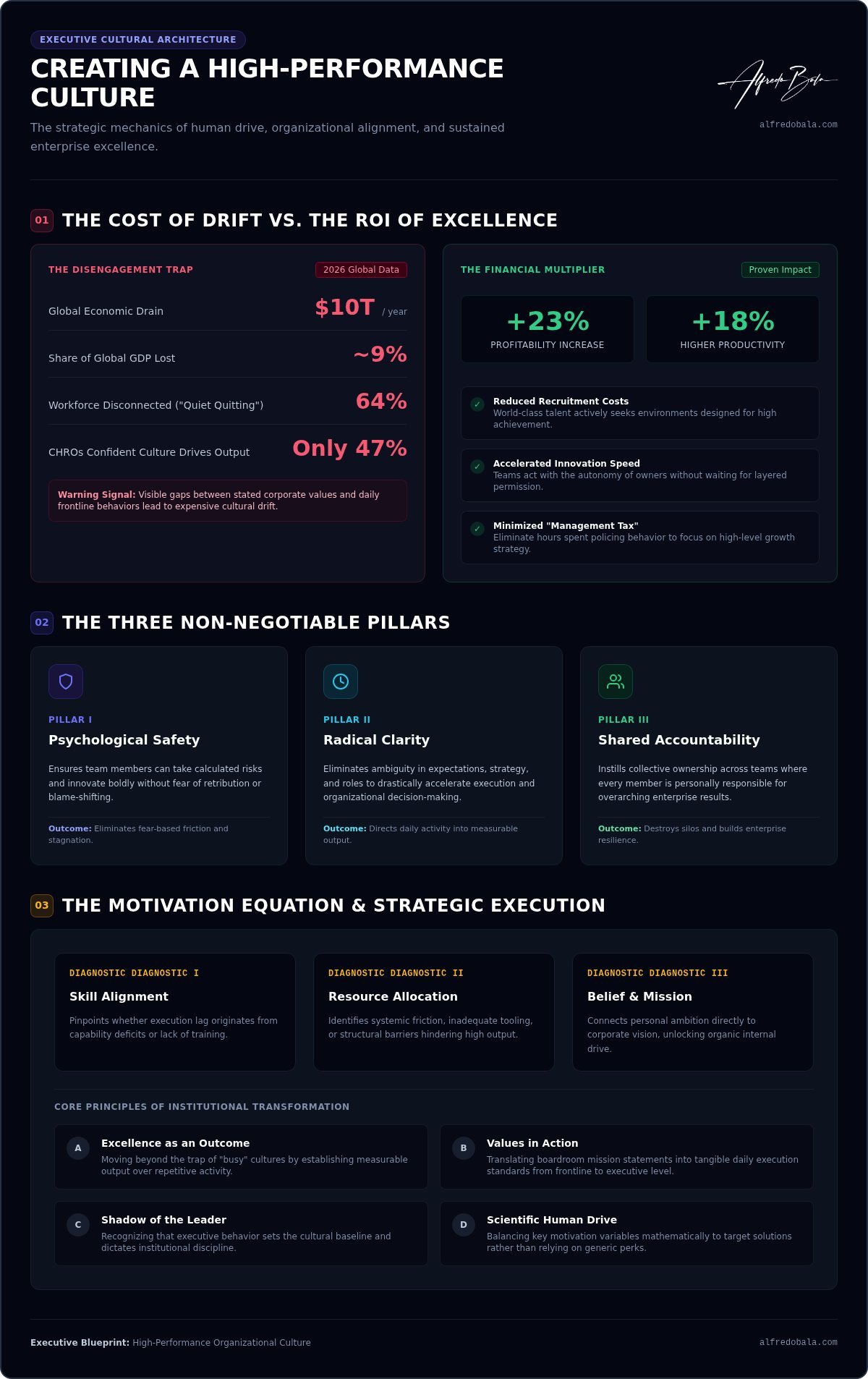
Employee disengagement is currently draining a staggering $10 trillion from the global economy every year, a figure that represents nearly 9% of global GDP according to 2026 data. You’ve likely felt this friction within your own organization, watching top talent exit despite competitive salaries or seeing a brilliant vision stall during daily execution. It’s a common executive frustration, but it doesn’t have to be your reality. Understanding how to create a high-performance culture is not about adding office perks or drafting another values statement; it’s about mastering the strategic mechanics of human drive.
You can move beyond the generic wellness buzzwords and build a team that’s both resilient and self-motivating. By applying the proven Motivation Equation framework, you’ll learn to align your corporate vision with measurable output while navigating the complexities of modern AI regulations and manager burnout. This guide offers a seasoned executive framework for 2026, providing a five step plan to bridge the engagement gap, increase profitability by 23%, and transform your culture into a magnet for world class talent.
Key Takeaways
- Move beyond the trap of “busy” cultures by defining excellence as a measurable outcome rather than a series of repetitive activities.
- Utilize the Motivation Equation to decode the scientific balance required to sustain peak performance across your entire organization.
- Implement a rigorous five step plan on how to create a high-performance culture that remains resilient against turnover and market volatility.
- Bridge the gap between corporate vision and daily execution by establishing “values in action” that resonate from the boardroom to the frontline.
- Recognize the “Shadow of the Leader” to understand how executive behavior dictates the cultural floor and drives long term institutional success.
What is a High-Performance Culture? Moving Beyond the Buzzwords
True high-performance is not a frantic sprint; it’s a sustainable rhythm where excellence becomes the baseline. Many leaders mistake a “busy” office for a productive one, yet 2026 market data suggests that activity without alignment is merely expensive noise. To understand how to create a high-performance culture, you must look past superficial perks and examine the foundations of organizational culture. It’s the operating system of your business. In a high-performance environment, every individual understands their role in the larger mission. Excellence is the natural byproduct of their daily habits, not a forced exception.
This level of execution rests on three non-negotiable pillars. First, psychological safety ensures that team members can take calculated risks without fear of retribution. Second, radical clarity eliminates the ambiguity that slows down decision-making. Finally, shared accountability creates a sense of ownership where everyone feels responsible for the collective outcome. When these elements align, culture becomes your ultimate competitive advantage, allowing your organization to pivot faster than any competitor.
The ROI of Cultural Excellence
Culture is your most potent financial multiplier. Organizations that master this discipline see a 23% increase in profitability and 18% higher productivity. When excellence is ingrained, recruitment costs plummet because world-class talent seeks out environments where they can do their best work. Innovation speed accelerates because teams don’t wait for permission; they operate with the autonomy of owners. A strong culture significantly reduces the “management tax.” You’ll spend less time policing behavior and more time on the high-level strategy that drives global growth.
Signs Your Culture is Underperforming
Watch for the subtle erosion of standards. Silos and blame-shifting are early indicators that your cultural foundation is cracking. “Quiet quitting” often signals a lack of connection to the corporate mission, a feeling currently shared by 64% of the global workforce. In 2026, global teams face the added risk of cultural drift, where decentralized units begin to develop their own conflicting norms. If there’s a visible gap between your stated values and the lived behaviors of your staff, your culture is underperforming. Only 47% of CHROs believe their current culture drives performance, proving that most organizations are operating well below their potential.
The Motivation Equation: The Engine of Cultural Excellence
Stop treating motivation as a fleeting emotion; it’s a disciplined science. Alfredo Bala’s framework provides the precision needed to understand how to create a high-performance culture that lasts beyond a single quarter. While most organizations rely on generic recognition or seasonal bonuses, the Motivation Equation serves as a rigorous diagnostic tool to identify exactly where drive is leaking from your system. It moves the conversation from vague “vibes” to a structured methodology. By balancing key variables, you can ensure that energy is directed toward outcomes rather than just activity.
Research into Gallup’s drivers of a high-performance culture highlights that leadership communication and values are critical, but the Equation takes it further by balancing these variables mathematically. It allows you to pinpoint whether a performance lag is due to a lack of skill, a lack of resources, or a breakdown in belief. This removes the guesswork from executive decision-making. Instead of throwing broad, expensive incentives at a problem, you can apply targeted solutions that address the specific variable causing the friction. For those ready to master these mechanics, The Motivation Equation book offers the definitive framework for the 2026 landscape.
Solving for the Individual within the Collective
Performance peaks when personal ambition aligns perfectly with the organizational mission. In 2026, employees demand more than competitive compensation; they demand meaning. If you can’t articulate how their daily tasks contribute to a grander vision, they’ll find an organization that can. For founders who want to master this level of organizational alignment, Founder Freedom offers expert coaching designed to bridge the gap between vision and execution. The Motivation Equation is the intersection of clarity and drive. It ensures every team member knows what’s expected and feels the internal pull to achieve it. When you solve for the individual, the collective output takes care of itself.
Scaling Motivation Across Global Teams
Consistency is your greatest ally when managing decentralized or global teams. A shared leadership language prevents cultural drift and ensures that a manager in Tokyo and a director in London are operating from the same playbook. Board level decisions regarding resource allocation and strategic focus directly impact the motivational climate of the entire organization. If you’re looking for leadership and team development insights, remember that a motivated culture starts with executive clarity. Scaling excellence requires a framework that remains robust regardless of geography or time zone.
The Three Pillars of Cultural Alignment
Align your organization around three non-negotiable pillars to turn strategic intent into operational reality. While structural changes provide the framework, true alignment is a psychological endeavor. Understanding how to create a high-performance culture requires an unwavering focus on Vision, Values, and Velocity. Your Vision serves as the “North Star,” providing a sense of purpose that must resonate from the boardroom to the front line. Values must transition from static wall posters to “values in action,” becoming the behavioral standards that guide every decision. Finally, Velocity establishes a rhythm of execution that prevents organizational stagnation and ensures momentum is maintained even during market shifts.
Research from Bain & Company demonstrates the power of this alignment. Companies that successfully pair performance standards with inspirational leadership deliver 10x the revenue growth and 5x the total shareholder return compared to their low-alignment peers. To master these complexities, you may need to revisit your Executive Leadership Development Strategies to ensure your team is equipped for global competition. Scaling this alignment across a decentralized workforce is the hallmark of a seasoned leader.
Clarity as a Performance Catalyst
Ambiguity is the silent killer of high-performance teams. When employees are unsure of their priorities, they default to “busy work” rather than high-impact execution. You must establish a clear “line of sight” where every individual understands exactly how their daily output impacts the broader corporate mission. In a digital-first workspace, this requires over-communication. Use precise, consistent language across all platforms to ensure your message isn’t lost in the noise of digital channels or virtual meetings. Clarity isn’t just about what to do; it’s about what to stop doing to protect your team’s focus.
Accountability Without Fear
Build a “fail-forward” culture that encourages calculated risk-taking. High performance is impossible without innovation, and innovation requires the safety to stumble. There’s a sharp distinction between healthy pressure, which drives growth, and toxic stress, which leads to the burnout currently affecting 75% of middle managers. Implement feedback loops that are frequent, fair, and focused on development rather than punishment. By normalizing regular performance dialogues, you remove the anxiety often associated with reviews and create a culture where accountability is viewed as a tool for personal and professional mastery.
How to Create a High-Performance Culture: A 5-Step Plan
Executing a cultural shift requires more than a visionary speech; it demands a tactical sequence of actions that produce immediate momentum. While many global consultancies argue that transformations take years, you can accelerate the process by focusing on the mechanics of human drive. Learning how to create a high-performance culture is a discipline of precision. Follow this five step plan to turn your organizational vision into a self sustaining reality.
- Step 1: Conduct a Cultural Audit. You can’t lead a journey if you don’t know your starting coordinates. Measure the current reality using eNPS and alignment surveys to identify where your stated values clash with daily execution.
- Step 2: Define the Non-Negotiables. Establish the three to five specific behaviors that define “winning” in your organization. These are the standards that every employee must meet to remain part of the collective mission.
- Step 3: Empower Cultural Champions. Identify the internal influencers who naturally set the pace for their peers. These individuals act as the bridge between executive strategy and frontline adoption.
- Step 4: Align Incentives with Outcomes. Ensure your recognition and compensation structures actually reward the behaviors you’ve defined as non-negotiable. This is where you balance the variables of the Motivation Equation to ensure effort leads to meaningful results.
- Step 5: Iterate and Reinforce. Culture is a living system that requires constant calibration. Establish monthly feedback loops to catch “cultural drift” before it erodes your standards.
Managing the Transition Period
Resistance to change is a natural human response, not a sign of failure. Don’t attempt to overcome it through sheer executive force. Instead, apply the “1% Rule,” where tiny, consistent shifts in behavior outperform massive, disruptive pivots. This gradual approach allows the team to build confidence in the new norms without triggering burnout. A Cultural Champion is typically the individual whom others look to for cues during times of uncertainty, regardless of their official rank on the organizational chart. By winning over these key influencers, you create a ripple effect that pulls the rest of the organization forward.
Tools for Cultural Maintenance
Ritual and storytelling are your most powerful tools for reinforcing excellence. Share “war stories” of team members who embodied your non-negotiables in high pressure situations. To reset momentum during periods of organizational fatigue, a keynote speaker for organizational growth can provide the external spark needed to re-energize the vision. Finally, develop leadership pipelines that prioritize cultural alignment as much as technical mastery. This ensures your high-performance environment survives natural turnover and continues to scale. If you’re ready to begin this journey, explore our leadership and team development insights to start your transformation today.
The Executive Role: Leading the Culture from the Top
Leadership is a mirror. What you do in the boardroom reflects in the breakroom. The “Shadow of the Leader” isn’t a vague theory; it’s the operational reality that executive behavior sets the cultural floor for the entire organization. If you demand radical clarity but operate in silos, your team will follow your actions rather than your memos. Mastering how to create a high-performance culture requires you to be the primary practitioner of your own standards. Every interaction you have is an opportunity to either reinforce the vision or erode the foundation you’ve worked to build.
In the 2026 landscape, culture has moved from the HR department to the board’s permanent agenda. It’s now recognized as a material asset that requires rigorous, high level oversight. Global governance standards increasingly demand transparency regarding human capital and organizational health. To navigate these complexities, many visionary leaders utilize Corporate Board Advisor services to bridge the gap between high level strategy and frontline reality. This external perspective ensures that your cultural health is measured with the same precision and accountability as your quarterly earnings.
The CEO as Chief Culture Officer
The most successful executives treat culture as a strategic priority rather than an administrative task. You must model the Motivation Equation in every executive decision, demonstrating exactly how personal mastery and organizational discipline intersect. This requires a delicate balance. You must maintain genuine empathy for the challenges of global growth while upholding the high stakes demands of world class execution. When the CEO takes personal ownership of the culture, it signals to the entire organization that excellence is the only acceptable baseline. To ensure your executive decisions remain sound and avoid common pitfalls, check out Robin Lohmann for a philosophical approach to strategic sovereignty.
Sometimes, the most effective way to break through cultural stagnation is to bring in an outside voice that speaks with the authority of experience. A leadership speaker for corporate events can serve as a powerful catalyst, providing the perspective needed to reset momentum and realign the team around a shared purpose. Similarly, a board seat advisor offers the seasoned wisdom required to shape global cultural strategy at the highest levels of governance. Don’t wait for a crisis to evaluate your environment. Start your cultural transformation today by mastering the Motivation Equation and building a legacy of excellence that sustains itself long after you’ve left the room.
Master the Mechanics of Organizational Excellence
The journey toward organizational excellence is a disciplined science, not a matter of chance. You now possess the strategic framework for how to create a high-performance culture by balancing the variables of the Motivation Equation and aligning your team around the pillars of vision, values, and velocity. Your executive behavior sets the absolute floor for your organization’s potential. By moving culture from an HR initiative to a board level priority, you ensure that your business remains resilient against the global disengagement crisis currently draining trillions from the global economy.
Alfredo Bala brings over 40 years of global leadership experience and a proven track record in scaling world class teams to help you navigate this transition. As the author of The Motivation Equation, he provides the seasoned wisdom needed to turn abstract strategy into measurable results. Elevate your leadership with Alfredo Bala’s strategic advisory and speaking services. The future of your organization depends on the standards you’ve established today. Step into your role as a visionary guide and build a culture that attracts and inspires the world’s best talent. Your legacy of excellence starts now.
Frequently Asked Questions
What is the first step in creating a high-performance culture?
The first step is conducting a comprehensive cultural audit to measure your current reality against your ideal standards. You cannot lead a transformation without an objective baseline of where your organization stands today. This involves utilizing tools like eNPS and alignment surveys to uncover the gap between your stated values and lived behaviors. Establishing this clarity allows you to identify the specific friction points that hinder execution and talent retention.
How long does it take to see results from a cultural transformation?
While deep cultural shifts often require sustained effort, you can see initial results within the first ninety days by focusing on quick wins. These immediate shifts occur when you define non-negotiables and align incentives with specific outcomes. However, a full institutional transformation typically takes twelve to eighteen months of consistent reinforcement. Success depends on the cadence of your feedback loops and the commitment of your leadership team to model the new behaviors daily.
Can a high-performance culture exist in a remote or hybrid team?
A high-performance culture absolutely thrives in remote or hybrid environments when built on a foundation of radical clarity and trust. Performance in a digital workspace is driven by outcomes rather than physical presence. You must be more intentional with communication and ritual to prevent cultural drift. By establishing a clear line of sight where every remote employee understands their impact on the global mission, you maintain high velocity regardless of geographic location.
What is the difference between culture and engagement?
Culture is the underlying operating system that dictates behavioral norms, while engagement is a measurable symptom of that system’s health. Think of culture as the “how” of your organization and engagement as how your people feel about that process. Understanding how to create a high-performance culture involves building a system where excellence is the default. When the culture is healthy, high engagement follows naturally as a byproduct of alignment and purpose.
How do you measure the success of a cultural initiative?
Success is measured through a combination of qualitative sentiment and quantitative performance metrics. Key indicators include a measurable increase in your Employee Net Promoter Score (eNPS), a reduction in the turnover of top tier talent, and improved speed to market for new initiatives. You should also track business outcomes like the 23% increase in profitability that research links directly to high engagement. Consistent monitoring ensures your cultural initiatives deliver a tangible return on investment.
What role does the CEO play in building team culture?
The CEO acts as the Chief Culture Officer, setting the behavioral floor through the “Shadow of the Leader” effect. Your actions carry more weight than any corporate manifesto. By modeling the Motivation Equation in every executive interaction, you signal that the standards apply to everyone, starting at the top. The CEO’s primary responsibility is to protect the vision and ensure that cultural health remains a permanent fixture on the board’s strategic agenda.
How does the Motivation Equation help in creating high-performance teams?
The Motivation Equation serves as a precise diagnostic tool that helps leaders identify exactly where drive is leaking within their system. It moves the conversation from vague feelings to a disciplined science of human performance. By balancing variables like skill, resources, and belief, you can understand how to create a high-performance culture that is both resilient and self sustaining. This framework ensures that individual ambition remains perfectly aligned with your broader organizational goals.
 EN
EN  ES
ES
Recent Comments