
By 2026, the defining characteristic of a successful executive isn’t how well they manage a physical office, but how effectively they master the invisible architecture of a distributed workforce. The greatest threat to your organization isn’t a technical glitch; it’s the quiet erosion of human connection and the loss of team synergy across time zones. You’ve likely felt the weight of this shift, watching your culture thin out and your best people drift toward the edge of burnout while you search for ways to measure performance without resorting to micromanagement.
Mastering leadership strategies for managing remote teams requires a transition from monitoring activity to architecting motivation. This guide provides the strategic frameworks and executive precision you need to lead high-performing, global teams with confidence. We’ll dismantle the myths of the “always-on” culture and replace them with a grounded, results-oriented methodology. You’ll learn how to apply The Motivation Equation to bridge the distance, restore your team’s drive, and transform your distributed organization into a cohesive, high-output engine built for the future of work.
Key Takeaways
- Discover why modern leadership strategies for managing remote teams must pivot from tracking hours to architecting purpose to prevent cultural erosion.
- Learn how to apply the Motivation Equation to bridge the psychological distance and drive performance across distributed global workforces.
- Shift your focus from activity monitoring to high-value outputs, unlocking a superior executive ROI through high-trust management frameworks.
- Establish clear rules of engagement that cut through digital noise and build high-trust communication loops across every time zone.
- Master the roadmap for scaling your organization’s culture and building a robust leadership pipeline that transcends international borders.
Beyond Visibility: Redefining Remote Leadership in 2026
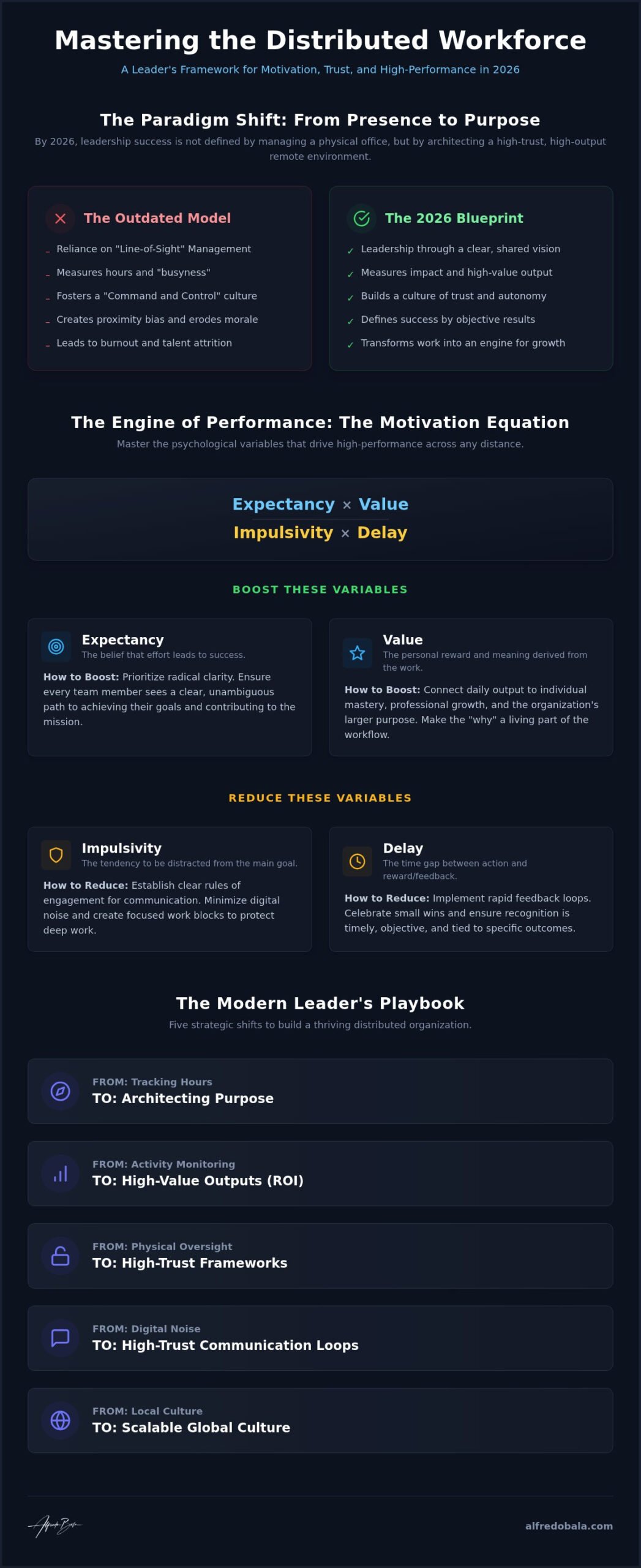
Stop measuring hours and start measuring impact. In 2026, the office is no longer a physical destination; it’s a state of strategic alignment. Leaders who cling to the outdated belief that “if I can’t see them, they aren’t working” are presiding over the slow death of their organizations. This “line-of-sight” management style is the single greatest killer of remote productivity. It forces employees into a cycle of performative busyness rather than meaningful value creation. Effective leadership strategies for managing remote teams today require a total shift in identity, moving from the management of presence to the management of purpose.
The 2026 landscape has made hybrid and distributed models a structural necessity. You aren’t just competing for talent in your zip code; you’re competing with every visionary company on the planet. This shift has exposed the “Trust Gap,” the primary obstacle for modern executives. If your leadership relies on physical oversight, you aren’t leading; you’re hovering. Bridging this gap is the first step toward building a high-performing global team that can execute with precision from anywhere on the globe.
The Death of the ‘Command and Control’ Model
Physical proximity was a crutch for weak leadership. It allowed managers to ignore the hard work of clear communication and motivational psychology because they could rely on the “vibe” of the office to keep things moving. That era is over. You must now transition from a traditional supervisor to a visionary guide. This requires a digital-first leadership mindset where your influence is felt through the clarity of your vision rather than the weight of your presence. When you lead through purpose, you empower your team to operate with autonomy, which is the ultimate fuel for organizational growth and individual mastery.
Identifying the Remote Performance Paradox
We are currently navigating the Remote Performance Paradox. Remote workers are often significantly more productive than their in-office peers, yet they frequently feel less “seen” and less appreciated. This disconnection is often caused by proximity bias, the unconscious tendency for leaders to favor those they encounter in the hallway. It’s a toxic dynamic that destroys morale and drives away top performers. To combat this, your leadership strategies for managing remote teams must be rooted in a results-oriented framework. Success must be defined by objective outputs and value created, not by who was the first person to log into a chat app in the morning. By focusing on ROI rather than activity, you create a culture of high-trust and high-performance.
Applying the Motivation Equation to Distributed Global Teams
Leadership is not a function of proximity; it’s a discipline of influence. While most guides focus on which video conferencing tool to buy, they often ignore the fundamental engine of performance. To lead effectively in a digital-first world, you must master the variables found in The Motivation Equation book. This framework posits that motivation is the result of Expectancy and Value, divided by Impulsivity and Delay. In a distributed environment, these variables are under constant pressure. Distance amplifies ambiguity, which directly erodes Expectancy. If your team doesn’t clearly see the path to success, their drive will vanish. Leadership strategies for managing remote teams must therefore prioritize radical clarity to keep the numerator of this equation high.
Value represents the personal reward and meaningful impact of the work. In a physical office, social pressure can sometimes mask a lack of individual value. In a remote setting, that mask is stripped away. You must connect the team’s daily output to their individual mastery and professional elevation. Motivation acts as the singular psychological bridge that unites disparate individuals across time zones into a cohesive, focused force.
Clarifying the ‘Why’ Across Time Zones
Vision alignment is the anchor of a distributed team. Without it, people drift into silos and lose sight of the collective mission. Global leaders use the Motivation Equation to drive sales growth by ensuring every team member, regardless of their coordinates, understands how their specific contribution moves the needle. Use asynchronous communication, such as recorded executive briefings, to reinforce core values. This ensures that the “Why” isn’t just a slide in an onboarding deck but a living part of the daily workflow. If you want to see a transformation in your results, master the mechanics of influence within your organization.
Reducing the ‘Impulsivity’ and ‘Delay’ in Remote Work
The digital environment is a minefield of impulsivity. Home distractions and the “always-on” notification culture fracture focus and drain mental energy. Even more dangerous is the “Delay” of feedback. When a team member completes a critical task and waits days for a response, their momentum dies. You can counteract this by architecting “Micro-Wins”-small, recognizable milestones that provide immediate psychological reward. Balancing autonomy with the human need for recognition is a nuanced art. To sustain high performance, you must ensure your feedback loops are tight and your recognition is frequent enough to keep the engine of motivation running at full capacity.
Outcome-Based Management vs. Micromanagement: A Strategic Analysis
Stop policing time and start architecting value. In a distributed world, the traditional obsession with “inputs”-how many hours someone sat at their desk or how quickly they responded to a chat-is a relic of a bygone era. Micromanagement in a remote setting doesn’t just stifle creativity; it signals a fundamental lack of trust that erodes the Motivation Equation. High-performing executives understand that their role is to manage outcomes, not activities. This shift from activity tracking to value creation is the hallmark of sophisticated leadership strategies for managing remote teams.
The Executive ROI of high-trust, low-interference management is immense. When you stop acting as a digital hall monitor, you reclaim your most precious resource: your time. This allows you to focus on high-level executive leadership development strategies that drive global growth rather than getting bogged down in tactical minutiae. The anxiety of “not knowing what people are doing” is solved through data-driven transparency. By establishing clear visibility into project progress and output quality, you replace surveillance with accountability.
Defining Clear Deliverables and KPIs
Clarity is the antidote to micromanagement. To lead effectively from a distance, you must set SMART goals specifically tailored for remote workflows. This means moving away from “Hours Worked” as a metric and replacing it with “Milestones Achieved.” Every team member should know exactly what a “win” looks like for the week. When deliverables are clearly defined, accountability becomes radical and objective. You don’t need to check in constantly if the milestones are being met on schedule. This framework creates a culture where results speak louder than status icons, ensuring your leadership strategies for managing remote teams are built on a foundation of proven performance.
The Psychology of Autonomy in Remote Success
Autonomy is the highest form of motivation for your high-performers. These individuals don’t need a boss; they need a vision and the space to execute it. Suffocating a superstar with constant check-ins is the fastest way to drive them toward the exit. However, the challenge lies in managing the underperformer without penalizing the entire team. The solution is a framework where trust is the default setting, not a reward to be earned over years. If someone fails to meet their milestones, the transparency of your outcome-based system will highlight the issue immediately. This allows for targeted intervention and coaching based on actual performance gaps rather than vague suspicions of “slacking off.”
5 Steps to Building High-Trust Communication Loops
Communication is the currency of leadership. In a distributed environment, the absence of physical cues creates a vacuum that is too often filled with anxiety or misinformation. Implementing effective leadership strategies for managing remote teams requires a deliberate overhaul of how information flows through your organization. You must move from accidental communication to an intentional architecture of trust. This process begins with five non-negotiable steps.
- Step 1: Audit current communication ‘noise’ vs. ‘signal’. Most teams are drowning in a deluge of notifications that offer zero strategic value. Identify which channels drive results and eliminate those that only create distraction.
- Step 2: Establish ‘Rules of Engagement’. Define the purpose of every tool. Use Slack for urgent updates, Email for formal records, and Video for nuanced, complex discussions. This clarity prevents digital exhaustion.
- Step 3: Implement Radical Transparency. Share the “Why” behind every company pivot and strategic goal. When your team understands the vision, they can operate with autonomy and precision.
- Step 4: Create Social Spaces. Human connection is not a luxury; it’s a necessity for team synergy. Build non-transactional environments where your global team can bond as people rather than just avatars.
- Step 5: Standardize the One-on-One as a coaching session. Stop using this time for status reports that could have been an email. Use it to mentor, remove obstacles, and solve for the individual’s motivation.
Mastering Asynchronous Communication
Meeting fatigue is a leadership failure. It is the result of a “presence-based” mindset trying to survive in a “results-based” world. To scale excellence, you must master asynchronous decision-making. Use shared documents, recorded briefings, and collaborative threads to keep momentum moving without interrupting the flow of deep work. Protecting your team’s focus is one of the highest forms of respect you can show as a leader, allowing for high-level execution across every time zone.
Leading with Empathy and Emotional Intelligence (EQ)
High-authority leadership requires the ability to read between the lines of a digital message. You must develop the EQ to identify signs of burnout through digital patterns, such as a sudden drop in engagement or a shift in communication tone. Empathy is not “soft” leadership; it is the strategic foundation of human performance. These leadership strategies for managing remote teams succeed because they prioritize the person behind the screen. By integrating these insights, you transform a group of individuals into a unified, high-performing force. To further elevate your executive impact, explore leadership and team development insights designed for the global stage.
Scaling Remote Excellence: Your Roadmap to Global Team Mastery
Mastery is the final stage of the leadership journey. It’s the point where your systems and culture become self-sustaining, allowing your organization to thrive without your constant presence in the digital “room.” Scaling a distributed workforce requires more than just better software; it demands a robust leadership pipeline built on intentionality. When you successfully implement leadership strategies for managing remote teams at scale, you transform your remote-first status into a massive competitive advantage. You’re no longer limited by your local talent pool. You can recruit the best minds on the planet because you’ve mastered the art of managing them with executive precision.
Scaling culture across borders is the most difficult challenge a global executive faces. It’s about ensuring that a developer in Berlin and a sales lead in Tokyo share the same drive and alignment. Leveraging keynote speaker organizational growth insights can provide the external spark needed to unify these disparate teams. These moments of collective focus serve as an anchor, reinforcing the vision and values that keep the Motivation Equation balanced for every individual in the company.
Developing Future Leaders Remotely
Mentorship doesn’t require a physical office, but it does require a plan. You must create opportunities for high-potential employees to gain visibility and take on high-stakes responsibilities. Using a leadership speaker for corporate events is an effective way to align your global leadership team around a unified set of principles. These events shouldn’t just be about data; they should be about identity. When you invest in the professional elevation of your people, you create a self-sustaining culture of motivation that persists across every time zone.
The Visionary Executive’s Next Steps
As you scale, your role naturally shifts from managing to advising. You move from the engine room to the bridge. This transition allows you to apply your hard-won wisdom at a higher level, perhaps through board-level advisory or strategic consulting. The future of work is not just about where we work, but how we unlock the full spectrum of human performance. By solving the Motivation Equation for your organization, you’ve built something that transcends geography. You’ve created a legacy of excellence that operates without limits, proving that true leadership is a force that knows no boundaries.
Leading Without Limits: The Future of Distributed Excellence
The era of managing by proximity has ended; the era of leading through purpose has begun. To thrive in 2026, you must abandon the crutch of line-of-sight supervision and embrace a results-oriented framework where trust is the default. We’ve explored how architecting high-trust communication loops and prioritizing outcome-based management can transform a fragmented group into a unified force. These leadership strategies for managing remote teams are not just tactical adjustments. They represent a fundamental shift in how we understand human performance across borders.
Success in this new landscape requires more than just digital tools. It requires a mastery of the psychological drivers that sustain long-term momentum. As a former Global CEO, author, and high-impact keynote speaker, I’ve seen firsthand how distance can either dilute a culture or act as a catalyst for unprecedented growth. It all comes down to the math of human drive. Are you ready to elevate your executive impact and lead a high-performing global team with precision? Master the science of motivation with Alfredo Bala’s ‘The Motivation Equation’ and start building your roadmap to global mastery today. Your journey to visionary leadership starts now.
Frequently Asked Questions
What are the most effective leadership strategies for managing remote teams in 2026?
The most effective strategies pivot from monitoring presence to architecting purpose. You must master the invisible architecture of your distributed workforce by applying frameworks like The Motivation Equation. By focusing on value creation and individual mastery, you empower your team to execute with executive precision regardless of their coordinates. This approach ensures that your leadership strategies for managing remote teams are built on a foundation of human performance rather than just digital activity.
How do I measure the productivity of remote employees without micromanaging?
Measure productivity by tracking specific milestones and high-value outputs rather than hours logged. You should establish clear, data-driven transparency where every team member knows exactly what a “win” looks like for their role. This outcome-based management style provides a superior executive ROI by removing the need for surveillance. When deliverables are met on schedule, you don’t need to check status icons; the results provide all the accountability required for a high-performing organization.
How can I build trust and culture in a 100% remote team?
Build trust by establishing radical transparency regarding company goals and implementing non-transactional human connections. You must move beyond accidental communication to an intentional architecture where trust is the default setting. Create digital social spaces where your global team can bond as people. By standardizing one-on-ones as coaching sessions rather than status reports, you reinforce a culture of mutual respect. This ensures that your organizational vision remains vibrant across every international border.
What is the best way to prevent remote work burnout?
Prevent burnout by protecting deep work time and setting strict rules of engagement for communication channels. You should audit your current communication noise to ensure your team isn’t drowning in low-value notifications. Leading with empathy allows you to read between the lines of digital messages and identify exhaustion before it leads to turnover. By reducing the psychological cost of an “always-on” environment, you sustain the long-term momentum of your high-performing distributed workforce.
How do I handle time zone differences when leading a global team?
Handle time zone differences by mastering asynchronous communication and prioritizing high-signal updates. You shouldn’t force global teams into late-night meetings that cause fatigue. Instead, use recorded executive briefings and shared documents to keep the mission moving forward. This allows your team to operate with autonomy while staying aligned with the core vision. Effective leadership strategies for managing remote teams depend on respecting the biological clocks of your international talent to maintain peak performance.
Can the Motivation Equation be applied to remote sales teams?
Absolutely. The Motivation Equation is particularly effective for remote sales teams because it addresses the core variables of expectancy and value. In a distributed sales environment, you must reduce the delay of feedback and recognition to maintain drive. By clarifying the path to success and connecting individual targets to organizational growth, you create a self-sustaining engine of performance. This framework ensures that your sales force remains aggressive and focused without requiring physical oversight.
How do I identify a remote leader for my organization?
Look for individuals who demonstrate high emotional intelligence and a proven ability to lead through influence rather than proximity. A remote leader must be a visionary guide who can maintain alignment and drive performance across digital channels. They should be self-starters who prioritize results over activity and have a deep understanding of motivational psychology. Identifying these success-story archetypes is critical for building a robust leadership pipeline that can scale your organization’s excellence globally.
What are the essential tools for remote team management?
The most essential tools are those that facilitate clarity, async decision-making, and psychological alignment. While software like Slack or Zoom handles the logistics, your most powerful tool is a proven framework like The Motivation Equation. You need systems that track milestones, protect deep work, and provide tight feedback loops for recognition. By integrating these strategic frameworks with your digital stack, you transform a collection of disparate tools into a holistic system for global team mastery.
 EN
EN  ES
ES
Recent Comments