
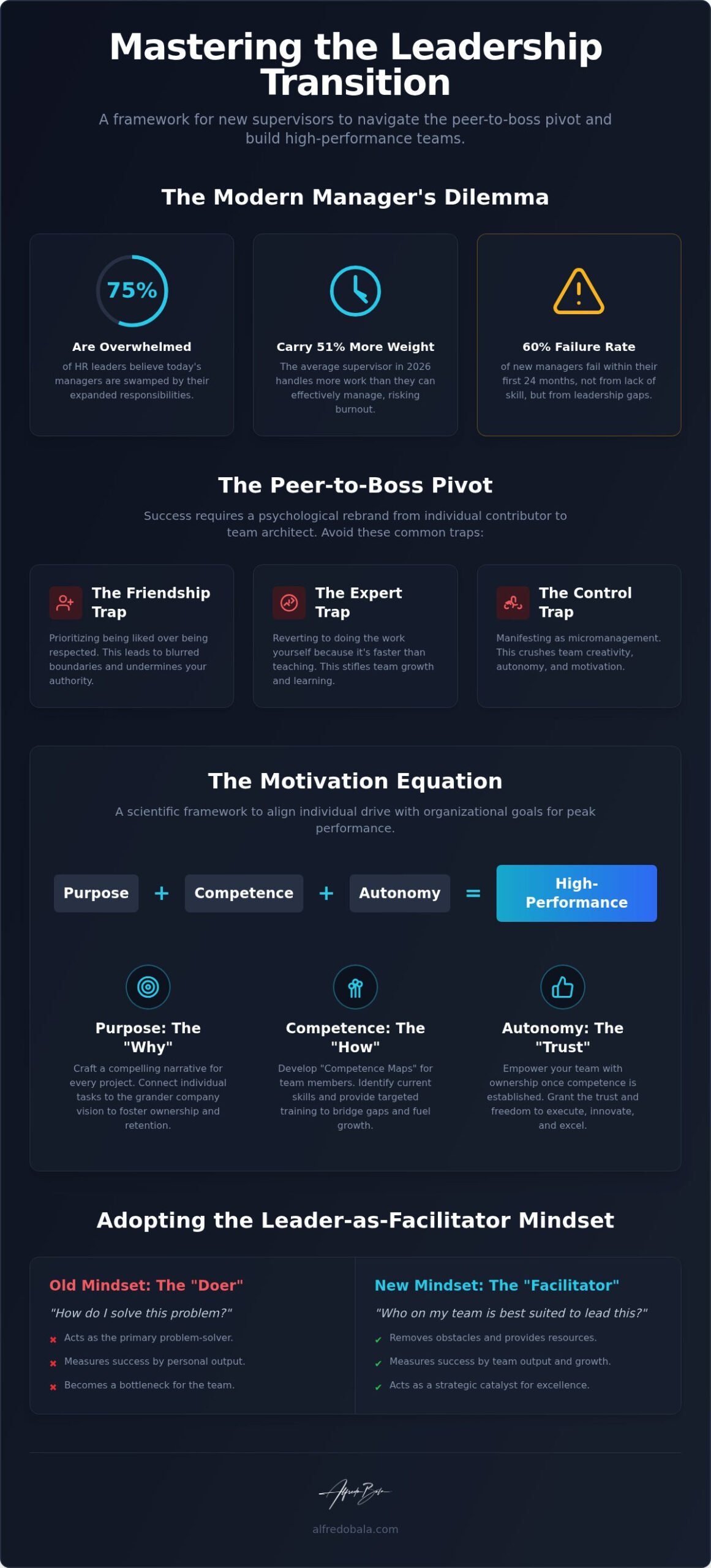
Did you know that 75% of HR leaders believe today’s managers are completely overwhelmed by their expanded responsibilities? In 2026, the average supervisor carries 51% more weight than they can effectively handle, often leading to burnout before their first anniversary. This pressure is most acute during the peer to boss pivot, where the technical skills that got you promoted suddenly feel insufficient. Effective leadership training for new supervisors must go beyond basic HR checklists. It requires a fundamental psychological shift and a mastery of the science of influence.
You likely feel the tension of wanting to remain liked by your former peers while needing to drive results as their leader. It’s natural to struggle with delegating tasks you once owned or to feel anxious about your new authority. This guide will show you how to master that transition using executive level strategies designed to build high performance teams. You’ll move from being a doer to a visionary driver by solving the Motivation Equation. We will explore a practical system to earn immediate respect, delegate with precision, and apply a proven framework to ensure your team hits every target with confidence.
Key Takeaways
- Rebrand your professional identity to successfully navigate the peer-to-boss pivot and avoid the common pitfalls that derail early management careers.
- Unlock “The Motivation Equation” to systematically align your team’s Purpose, Competence, and Autonomy for peak organizational performance.
- Leverage specialized leadership training for new supervisors to transform daily communication into a high-performance operating system that earns immediate respect.
- Build a culture of psychological safety that empowers global teams to innovate, take calculated risks, and exceed complex operational goals.
- View your current supervisory role as a strategic proving ground, developing the executive-level presence required to transition from management to the C-suite.
The Peer-to-Boss Pivot: Redefining Leadership in 2026
Stepping into a supervisory role isn’t just a promotion; it’s a total psychological rebrand of your professional identity. Most new leaders mistake their new title for a license to do more of what they were already doing, just with more authority. This is a recipe for burnout. True leadership training for new supervisors focuses on the internal shift from being an individual contributor to becoming the architect of a collective outcome. You’re no longer the star player; you’re the coach responsible for the scoreboard.
Statistics show a sobering reality: approximately 60% of new managers fail within their first 24 months. They don’t fail because they lack technical skill; they fail because they fall into three common traps. The Friendship Trap occurs when you prioritize being liked over being respected, leading to blurred boundaries. The Expert Trap happens when you revert to doing the work yourself because it’s faster than teaching others. Finally, the Control Trap manifests as micromanagement, which stifles team autonomy. Avoiding these requires a fundamental mindset shift: your success is now measured solely by the output and growth of your direct reports, not your own personal task list.
The Psychology of Authority
Establishing authority doesn’t require an iron fist, but it does demand professional distance. You can maintain personal rapport while clearly signaling that the nature of your relationships has changed. Within your first 30 days, sit down with your former peers to communicate the “New Normal.” Be transparent about your new responsibilities and how you’ll support their goals. This transition involves significant emotional labor. You’re now responsible for the culture of the team, and investing in continuous leadership development is the only way to manage the stress of being “the boss” for the first time.
Letting Go of the “Doer” Mentality
Your technical expertise, while valuable, can actually hinder your team’s growth if you use it as a crutch. If you’re always the one with the answers, your team never learns to think for themselves. You must shift your internal dialogue from “How do I do this?” to “Who on my team is best suited to lead this?” This is a core pillar of effective leadership training for new supervisors. It forces you to delegate and trust the systems you’ve put in place. The Leader-as-Facilitator model for 2026 defines the supervisor as a strategic catalyst who removes operational obstacles and provides the resources necessary for their team to achieve autonomous excellence.
The Motivation Equation: The Science of Leading High-Performance Teams
Alfredo Bala’s “The Motivation Equation” isn’t a theoretical exercise; it’s a strategic framework for supervisors who need to drive results in a high-stakes environment. Many traditional models rely on outdated carrots and sticks. In contrast, this equation offers a precise methodology for aligning individual drive with organizational objectives. It’s a core component of modern leadership training for new supervisors because it moves beyond intuition and into the science of human performance. By breaking down motivation into Purpose, Competence, and Autonomy, you can pinpoint exactly where a team member is disengaged. This alignment is a precursor to mastering executive leadership development strategies that scale across international borders.
Purpose: The “Why” Behind the Work
Purpose is the “Why” behind the work. It’s the connective tissue between a spreadsheet and a global vision. In the 2026 labor market, talent doesn’t just work for a paycheck; they work for a mission. As a leader, your job is to craft a compelling narrative for every project, no matter how mundane it seems. When people see how their specific contribution moves the needle for the company, they stop punching a clock and start owning their outcomes. This sense of meaning is your most powerful retention tool.
Competence and Autonomy: The Engine of Growth
Building a high-performance team requires you to view Competence and Autonomy as the dual engine of growth. You can’t expect elite results if a team member lacks the tools or the trust to succeed. Start by building “Competence Maps” for your direct reports. These maps identify current skill levels and highlight the exact training needed to reach the next tier. Once competence is established, you must navigate the “Autonomy Spectrum.” New employees require more guidance, while veterans need the space to operate independently. High-performance leadership training for new supervisors teaches you to balance this tension. You must provide enough room for team members to fail safely and learn from those mistakes, as this is where true mastery is forged.
Spotting “Motivation Gaps” early is the hallmark of a seasoned leader. If a team member has high competence but low output, they likely lack purpose or autonomy. If they have high purpose but struggle with delivery, the gap is in competence. Use this framework to have candid, data-driven conversations that resolve these bottlenecks. If you want to dive deeper into these frameworks, exploring The Motivation Equation directly can provide the roadmap you need for your next career leap.
Core Competencies for New Supervisors: Communication and Delegation
Communication is the operating system of high-performance leadership. Without a robust communication strategy, even the best technical plans fail. High-impact leadership training for new supervisors recognizes that every interaction is an opportunity to build or erode trust. This is especially true for feedback. Stop viewing feedback as a correction for past mistakes. Instead, frame it as a gift, a strategic investment in a team member’s future competence. When you shift this perspective, you move from being a critic to being a mentor who actively shapes the success of others.
Success in a leadership role depends on your ability to move from doing to directing. This requires a mastery of the Strategic Delegation process: Task, Context, Timeline, and Support. By providing the “why” (Context) alongside the “what” (Task), you empower your team to make better decisions. Clear timelines and a commitment to support ensure that you’re not just offloading work, but creating a structured environment where your team can excel without constant intervention.
Mastering the Strategic 1:1
The 1:1 meeting is the sanctuary of development. In 2026, the most effective leaders use a 10/10/10 framework: ten minutes for the employee’s agenda, ten minutes for your priorities, and ten minutes for future-focused growth. This structure ensures that administrative updates don’t crowd out long-term strategy. During these sessions, resist the urge to provide immediate solutions. Ask “The Coaching Question” instead: “What is the real challenge here for you?” This empowers your direct reports to solve their own problems. These meetings are the perfect time to apply the principles found in The Motivation Equation book, ensuring every individual feels aligned with the team’s broader purpose.
Delegation as a Development Tool
Delegation is often misunderstood as dumping unwanted tasks. In reality, it’s a primary tool for developing talent. Every assignment should be a deliberate step toward increasing a team member’s competence. To manage effectively in hybrid environments, utilize the 5 Levels of Delegation. These range from “Level 1: Do exactly what I say” to “Level 5: Decide and act independently.” Matching the level of delegation to the individual’s current competence is a core skill taught in leadership training for new supervisors. It allows you to monitor progress without micromanaging, fostering an environment where autonomy thrives alongside accountability. This strategic approach transforms delegation from a time-saver into a growth engine for your entire organization.
Building and Scaling High-Performance Global Teams
In 2026, a high-performance team is defined by its collective intelligence and its capacity for rapid adaptation. It’s no longer enough to manage tasks; you must curate an environment where diverse talents can synchronize toward a unified vision. This level of alignment is often the primary goal of specialized keynote speaker organizational growth sessions, which help bridge the gap between individual effort and corporate strategy. For a new supervisor, this means looking beyond your local office to understand how your team fits into a broader global machine.
Psychological safety is the invisible engine of innovation. When team members feel safe to take risks and admit errors without fear of retribution, the speed of learning accelerates. Effective leadership training for new supervisors must emphasize that your role is to be the guardian of this safety. If you punish honest mistakes, you effectively kill creativity. Instead, treat failures as data points that inform the next strategic pivot. Scaling this mindset across a distributed team requires intentionality and a rejection of the “command and control” styles of the past.
Fostering Psychological Safety
The best teams are the ones where it is safe to admit a lack of knowledge. As a supervisor, you must model this vulnerability. When you openly share your own continuous learning journey, you give your team permission to do the same. In a digital workspace, trust isn’t built by accident. Implement simple rituals, such as a “Lessons Learned” segment in your weekly syncs, where the focus is on the insight gained rather than the error made. These small, consistent actions build the foundation for a resilient team culture.
Leading Across Borders and Cultures
Supervising a global team requires high Cultural Intelligence (CQ). You’ll encounter vastly different communication styles, from direct feedback cultures to those that prioritize harmony and indirect suggestion. Navigating these nuances is a core part of leadership training for new supervisors. Don’t view these differences as obstacles. Instead, leverage diversity as a strategic advantage. A team with varied cultural backgrounds brings a wider array of solutions to complex problems, provided you have the skills to facilitate those conversations effectively. By respecting different communication norms, you unlock the full potential of your international workforce.
Building a team that can scale globally requires a roadmap based on real-world application. If you are ready to transform your team’s performance and drive measurable results, explore how to implement these frameworks by visiting AlfredoBala.com today.
From Supervisor to Executive: The Long-Term Leadership Roadmap
Your first management role isn’t a destination; it’s the ultimate proving ground for the C-suite. While many view middle management as a plateau, the most ambitious leaders recognize it as the laboratory where executive skills are forged. Effective leadership training for new supervisors must prepare you for this long-term trajectory. It isn’t just about surviving your first year. It’s about developing the strategic foresight and high-level influence required to one day serve as a corporate board advisor. This path requires a shift from operational oversight to strategic advisory, where your value is found in your ability to navigate global complexity and drive governance.
Bridging the gap between a supervisor and an executive involves more than just time. It requires a deliberate expansion of your perspective. Seeking external executive perspectives through mentorship is non-negotiable. You need to see the world through the eyes of those who’ve already navigated the highest echelons of business. This exposure helps you understand the nuances of board-level decision-making and the mechanics of large-scale organizational growth. You’re moving from managing people to managing systems, and eventually, to managing the vision itself.
Investing in Your Own Development
The most successful leaders don’t go it alone. They invest in their own development by securing coaches and mentors who challenge their assumptions, or by participating in transformational programs like those from Inspired Leadership. Start developing “Executive Presence” now. This isn’t about wearing a suit; it’s about the gravitas you bring to every room and the clarity of your communication. By building a personal brand as a “Leader of Leaders,” you signal to the organization that you’re ready for greater responsibility. You stop being the person who manages tasks and start being the visionary who inspires entire departments. This shift is the hallmark of those who rise quickly through the ranks.
Next Steps: Implementation and Mastery
Mastery is a continuous process. Your immediate priority should be crafting a personal 90-day leadership development plan. This plan should identify specific milestones for improving team performance and personal influence. Use the frameworks provided in Alfredo Bala’s resources to accelerate this growth. Leadership training for new supervisors is the foundation, but your commitment to implementation is what determines your ceiling. Success is a disciplined science, and the tools are already in your hands. Take the first step by applying the Motivation Equation to your own career path today.
Ready to elevate your team? Bring Alfredo Bala to your next event and give your organization the executive-level strategies they need to master the future of leadership.
Owning Your Future as a Visionary Leader
The journey from a technical expert to a strategic leader is the most significant leap you’ll take in your professional career. It requires more than just a new title; it demands a total psychological rebrand of how you view your value. By mastering the Motivation Equation, you move beyond basic oversight and begin building high-performance global teams that thrive on psychological safety and clear purpose. This level of impact is exactly why modern leadership training for new supervisors must focus on the science of influence rather than just administrative checklists.
Alfredo Bala brings 40+ years of global executive experience to help you redefine leadership for the 2026 economy. These practical frameworks are used by top-tier global teams to drive measurable results and sustainable growth. You have the potential to transition from a frontline manager to a visionary executive. It’s time to take control of your professional trajectory. Master the Science of Success with The Motivation Equation and start leading with the clarity of a veteran. Your path to the top starts with the decision to master your current role today.
Frequently Asked Questions
What is the most important skill for a new supervisor to learn first?
The most critical skill is the ability to shift your focus from individual output to collective team results. You must learn to stop being the “doer” and start being the “facilitator.” This involves mastering the psychological transition from peer to leader, which is a cornerstone of effective leadership training for new supervisors. Without this shift, you’ll likely struggle with micromanagement and burnout while failing to empower your team to achieve their full potential.
How do I handle a former peer who is now my direct report?
Address the transition directly and early through a strategic 1:1 meeting. You don’t need to sacrifice your professional rapport, but you must establish clear boundaries and a “new normal.” Be transparent about your responsibilities to the organization and how you intend to support their individual growth. Consistency is key; treating all team members with the same level of professional objectivity will earn you the long-term respect required for effective supervision.
What are the three components of the Motivation Equation?
The Motivation Equation consists of three vital pillars: Purpose, Competence, and Autonomy. Purpose connects daily tasks to a larger vision, giving the work meaning. Competence ensures that team members have the specific skills and resources needed to succeed. Autonomy provides the freedom for individuals to own their processes and outcomes. When these three elements align, you create a high-performance environment where motivation is self-sustaining rather than dependent on external rewards or constant oversight.
How can I delegate effectively without losing control of the quality?
Effective delegation requires you to provide clear context, timelines, and support while matching the task to the individual’s level of competence. Use the 5 Levels of Delegation to gradually increase autonomy as trust and skill grow. Instead of just assigning a task, explain the “why” behind it. This empowers your team to make quality-focused decisions independently. Regular check-ins ensure alignment without the need for suffocating micromanagement, keeping the project on track and high-quality.
What is the difference between management and leadership for a supervisor?
Management is about the systems, processes, and tactical execution required to hit targets. Leadership is the art of influence, vision, and human development. While a supervisor must manage the workflow, they must also lead the people. Leadership training for new supervisors emphasizes that you manage projects but you lead individuals. One focuses on the “how” and “when,” while the other focuses on the “why” and “who,” ensuring both operational efficiency and team engagement.
How do I manage a team that is geographically dispersed?
Managing a global or distributed team demands intentionality and high cultural intelligence. You must prioritize building psychological safety through digital rituals, such as dedicated time for non-task-related connection. Clear, asynchronous communication channels are essential to ensure that team members in different time zones feel equally informed and valued. Focus on outcomes rather than hours spent at a desk. This approach fosters a culture of trust and accountability that transcends physical borders and traditional office hours.
How much time should I spend on my own professional development as a manager?
You should treat your development as a non-negotiable part of your weekly schedule. Aim for at least two to four hours a week dedicated to learning new frameworks, working with a mentor, or studying executive-level strategies. High-performance leaders never stop being students of their craft. Investing in your own growth signals to your team and your superiors that you’re preparing for the next tier of leadership, moving you closer to your ultimate executive goals.
 EN
EN  ES
ES
Recent Comments