
Most corporate leadership programs are expensive failures because they treat professional growth as a checkbox rather than a disciplined science. You’ve likely seen the symptoms in your own boardroom: leadership gaps that lead to misaligned goals and a revolving door of management talent that erodes your culture. It’s frustrating to invest in traditional training only to see zero ROI, but mastering how to develop leadership in organizations is actually a predictable process when you apply the right mechanics.
I’m sharing the methodical framework I’ve used over decades as a global executive to identify, nurture, and scale high-impact talent. This 2026 executive guide promises to give you the tools to align individual drive with organizational strategy. We’ll explore the Motivation Equation and build a practical roadmap that transforms your management pipeline into a sustainable engine for internal promotion and long-term growth.
Key Takeaways
- Stop viewing professional growth as a one-time event and start building a systemic organizational capability that prevents costly leadership gaps.
- Master how to develop leadership in organizations by integrating the Motivation Equation with the 70-20-10 framework to fuel high-impact learning.
- Identify true high-potential talent by distinguishing between current performance and future leadership potential using modernized assessment tools.
- Create a custom roadmap for your team by conducting a leadership audit and defining the specific competencies that make up your brand’s unique DNA.
- Scale a self-sustaining leadership ecosystem where C-suite behaviors model the standard for every emerging leader in the company.
The Leadership Imperative: Why Organizations Stagnate Without a Development Strategy
Stagnation is a choice. When an organization stops growing, it’s rarely a market failure; it’s a failure of the internal engine. True Leadership development isn’t a one-time event or a weekend retreat. It’s a systemic organizational capability that must be woven into the fabric of daily operations. Without a deliberate strategy, leadership gaps emerge, creating a vacuum where morale withers and innovation plateaus. These gaps are expensive. They lead to strategic misalignment where the C-suite’s vision never reaches the front lines, causing a disconnect that erodes trust and slows execution.
By 2026, the global economy has shifted significantly. We’ve moved past the era of mere ‘Efficiency Management’, where the goal was simply to do things right. Today, we demand ‘Visionary Leadership’, which is the ability to do the right things amidst chaos. Traditional top-down training programs often fail here because they prioritize compliance over authentic influence. If you want to understand how to develop leadership in organizations, you must look beyond the syllabus and focus on the human drive. Real influence isn’t granted by a title; it’s earned through consistent, values-driven action that inspires others to follow.
The Psychology of Leadership Stagnation
Many companies fall into the trap of the ‘Peter Principle’, promoting high-performing technicians into management roles they aren’t equipped to handle. This effectively turns a great asset into a mediocre supervisor, creating a bottleneck that stifles the entire team’s potential. When a fixed mindset takes hold, emerging talent begins to see leadership as a static destination rather than a craft to be mastered. Organizational leadership is the bridge between strategy and execution. Without this bridge, even the most brilliant corporate strategy is just ink on a page, disconnected from the people who must bring it to life.
Leadership as a Competitive Advantage
A robust internal pipeline is your greatest hedge against market volatility. It drastically reduces the astronomical costs of external executive searches while ensuring that your culture remains intact. High-impact leadership fosters the agility needed to pivot during global market shifts, allowing your organization to remain resilient when competitors falter. When you align individual growth with your long-term global goals, you aren’t just filling seats. You’re building a fortress of talent that can withstand any economic storm. Learning how to develop leadership in organizations is the ultimate investment in your company’s future value and long-term sustainability.
The 70-20-10 Rule and the Motivation Equation: A Modern Framework
Don’t mistake activity for progress. Many organizations throw training at their employees and wonder why their leadership pipeline remains empty. Real growth requires a blend of disciplined science and nuanced art. To master how to develop leadership in organizations, you must look toward the 70-20-10 model, a framework that has stood the test of time but requires a modern infusion of human psychology to work in today’s high-stakes environment.
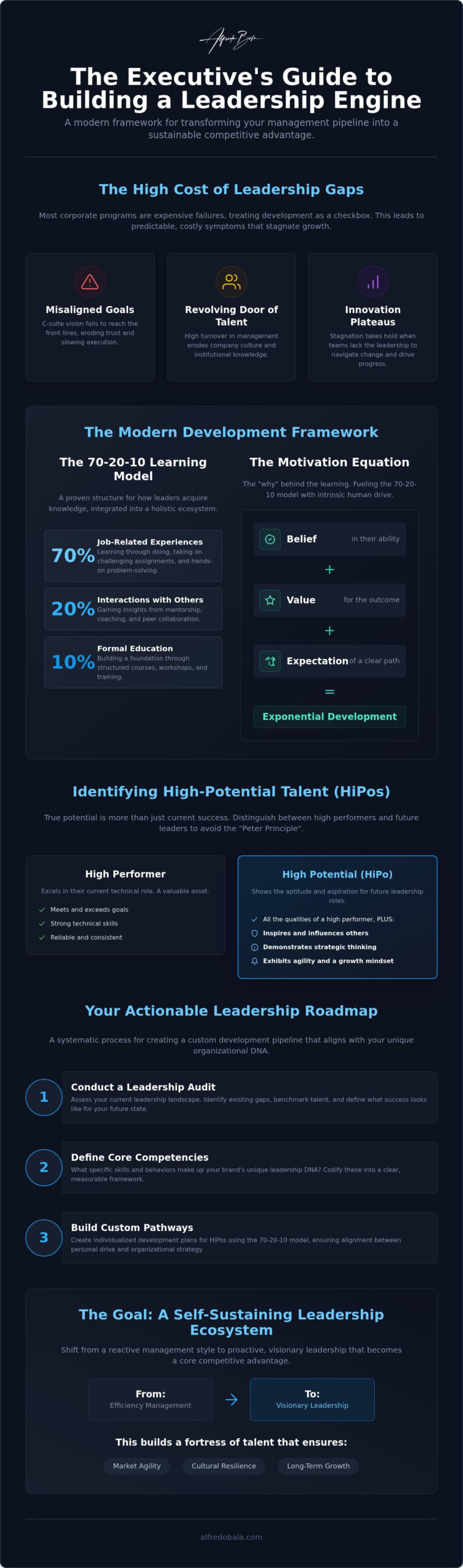
The 70-20-10 rule states that leaders obtain 70% of their knowledge from job-related experiences, 20% from interactions with others, and 10% from formal educational events. While the Federal government’s approach to leadership often highlights the importance of these structured pathways, the missing link in most corporate settings is the “why” behind the learning. Experience is the forge where leaders are made, but without the 20% safety net of mentorship and the 10% foundation of strategic vocabulary, that forge simply leads to burnout. You can gain deep leadership and team development insights by viewing these percentages not as separate silos, but as an integrated ecosystem.
Applying the Science of Motivation to Development
Experience alone is a harsh teacher; the Motivation Equation is what makes it a masterclass. This framework focuses on balancing belief, value, and expectation to fuel the learning process. When you identify the intrinsic drivers of your emerging leaders, you move beyond extrinsic rewards like titles or bonuses. You tap into a desire for intrinsic mastery. The formula is simple yet profound: when a leader believes in their ability, values the outcome, and has a clear expectation of the path, their development accelerates exponentially. It’s about aligning their personal ambition with your organizational strategy.
Exposure: The Power of Executive Mentorship
Exposure is where wisdom is transferred. It’s the 20% of the model that separates the managers from the visionaries. In a healthy organization, senior executives serve as visionary guides rather than just supervisors. There’s a critical distinction here: coaching is about improving specific skills, while mentoring is about transferring hard-won wisdom. To maximize impact, structure shadowing opportunities where high-potentials can witness the nuance of high-level decision-making. This isn’t just about watching; it’s about understanding the “how” and “why” behind the moves that shape the company’s future. When a mentee sees the mechanics of influence in action, they begin to adopt the DNA of the brand.
Identifying and Nurturing High-Potential Talent (HiPos)
Stop confusing high performance with high potential. It’s a common executive trap: promoting your top salesperson or most brilliant engineer into management simply because they’ve mastered their current craft. Performance is what someone did yesterday. Potential is what they can do tomorrow in a completely different context. The science of nurturing high-potential employees requires a pivot from evaluating past results to identifying future capacity. Mastering how to develop leadership in organizations starts with a brutal assessment of your talent pool to ensure you aren’t promoting people into their level of incompetence.
The 9-Box Grid remains a staple of talent management, but for 2026, it must account for the nuances of visibility in remote and hybrid environments. You can’t rely on “water cooler” observations anymore. Instead, look for behavioral indicators that transcend physical presence: emotional intelligence, resilience, and the ability to inspire a team across a digital divide. These are the markers of a leader who can navigate complexity without hand-holding. To keep these individuals from looking elsewhere, conduct stay interviews. Ask your top talent about their long-term aspirations before they hand in a resignation letter. It’s a proactive way to align their personal growth with your strategic roadmap.
The HiPo Identification Framework
Focus on “Cultural Add” rather than just “Cultural Fit.” You don’t need leaders who mirror your current habits; you need leaders who bring the diverse perspectives required to solve tomorrow’s problems. Use peer feedback to identify natural influencers. These are the people your team turns to when things go wrong, regardless of their official title. Learning agility is the single most important trait for 2026 leaders because it determines how quickly an individual can discard obsolete strategies and adopt new, effective behaviors in real-time.
Nurturing the Transition: From Doer to Leader
The psychological shift from “delivering results” to “enabling others to deliver” is the hardest hurdle for most emerging leaders. It requires letting go of the technical tasks that once defined their success. You must provide stretch assignments that test their decision-making under pressure, moving them out of their comfort zone without throwing them into the deep end without a life jacket. Create a safe environment for productive failure. If a high-potential leader is afraid to make a mistake, they’ll never take the calculated risks necessary for innovation. Your role as a mentor is to guide them through these early stumbles so they can build the confidence to lead with authority.
Implementing Actionable Leadership Development Pathways
Execution is the bridge between a vision and a reality. You’ve identified your high-potential talent, but without a structured roadmap, their growth will be accidental at best. To master how to develop leadership in organizations, you must move beyond generic training and implement a tiered system that reflects the unique DNA of your brand. This isn’t just about professional development; it’s about building a predictable engine for success that survives any single leader’s departure.
Start with a comprehensive leadership audit to identify where your pipeline is leaking. Once you’ve identified the gaps, define your ‘Leadership DNA’-the core competencies that are non-negotiable within your specific culture. Your pathways should be tiered, moving from first-line tactical management to executive visionary leadership. Establish measurable KPIs that track outcomes like internal promotion rates and team engagement scores, rather than just attendance. Finally, create a continuous feedback loop. This ensures that the Motivation Equation remains active, keeping mentors and mentees aligned on expectations and results. Gain deep Leadership and Team Development Insights to refine your organizational roadmap.
Tiered Pathways: Developing Leaders at Every Level
Focus your first-level leaders on the mechanics of team dynamics, time management, and clear communication. They are the tactical engine of your company. Mid-level managers require a shift toward strategic alignment and cross-functional collaboration. They must learn to navigate conflict and build bridges between departments. At the executive level, the focus shifts entirely to global vision, board relations, and the stewardship of organizational culture. Each tier requires a different set of tools and a different psychological approach to influence. The leadership lessons from top executives who have navigated these exact transitions offer a practical blueprint for developing leaders at every stage of this journey.
Developing Leadership in Global and Remote Teams
Proximity bias is the silent killer of remote leadership pipelines. It’s easy to promote the person you see at the coffee machine, but true leadership development must be blind to geography. Use digital platforms for asynchronous mentorship and peer learning to ensure that your global talent has the same access to “exposure” as those in the home office. Strategies for building trust across cultural contexts are essential in 2026. Influence in a remote world isn’t about presence; it’s about the clarity of your communication and the consistency of your results across time zones and borders. Bringing in an executive team development speaker who understands the realities of global organizational pressure can provide the cohesive framework your distributed leadership teams need to align and perform at scale.
Scaling a Leadership Culture: From Skills to Organizational DNA
Culture isn’t what you say in an orientation video; it’s what happens when the CEO isn’t in the room. Moving from a series of training programs to a self-sustaining ecosystem is the final step in mastering how to develop leadership in organizations. This transition requires a shift from viewing development as a periodic expense to seeing it as your most vital capital investment. When leadership becomes part of your organizational DNA, every decision and interaction becomes a coaching moment that reinforces your brand’s values. This systemic approach ensures that the “Motivation Equation” is applied at scale, creating a pipeline that remains full even during periods of rapid change.
To truly scale, you must integrate development into your performance management and compensation structures. Reward managers who successfully mentor their teams and hold those accountable who hoard talent for their own department’s gain. This alignment ensures that the principles of growth are baked into the company’s financial and operational reality. By implementing specific Executive Leadership Development Strategies, you create a framework that supports global expansion and long-term sustainability. It moves the needle from individual success to collective mastery.
Modeling Leadership from the Top
The “do as I say, not as I do” mentality is a silent killer of professional progress. If the C-suite doesn’t model the behaviors they expect from emerging talent, the entire system collapses into cynicism. High-authority leadership requires a degree of transparency and vulnerability that might feel counterintuitive to veteran executives. Showing the mechanics of a difficult decision or admitting to a miscalculation builds a culture of trust. It encourages every employee to lead from their current position, knowing that growth is supported at the highest levels of the hierarchy.
The Future of Organizational Leadership
As we look toward the AI-driven workplace of 2026, the value of technical mastery is shifting. Leaders must prioritize human-centric skills like empathy, complex problem-solving, and ethical judgment. Diversity in leadership is no longer a metric to be met; it’s a strategic necessity for driving global innovation. A diverse leadership team brings the varied perspectives required to navigate a fragmented global market. Leadership is not a destination or a title you eventually reach. It’s a disciplined journey of personal and professional mastery. When you understand how to develop leadership in organizations, you’re building a legacy of excellence that will continue to grow long after you’ve left the boardroom.
Mastering the Future of Executive Influence
Building a world-class leadership pipeline is not a project; it’s a permanent strategic commitment. By moving beyond outdated training models and embracing the Motivation Equation, you can transform your management structure into a self-sustaining ecosystem of excellence. We’ve explored the mechanics of identifying high-potential talent and the importance of tiered pathways that reflect your brand’s unique DNA. Understanding how to develop leadership in organizations is the difference between a company that merely survives and one that dominates its industry through 2026 and beyond.
The journey from foundational management to visionary executive mastery requires a guide who’s navigated these high-stakes landscapes firsthand. With decades of global C-suite experience and as the author of ‘The Motivation Equation’, Alfredo Bala provides the proven methodology needed to build high-performance global teams that deliver results. It’s time to stop reacting to leadership gaps and start engineering a culture of internal promotion and strategic agility. Elevate your organization with Alfredo Bala’s Executive Leadership Advisory. Your legacy of leadership starts with the next decision you make today.
Frequently Asked Questions
How do you identify leadership potential in employees who don’t have a management title?
Look for natural influencers who exhibit high learning agility and a proactive approach to problem-solving. These individuals often act as the unofficial “glue” in their teams, guiding peers through complexity without needing formal authority. Identifying these traits early allows you to nurture their potential before they look for opportunities elsewhere. It’s about spotting the person who consistently enables others to succeed.
What are the most critical leadership skills to develop in an organization by 2026?
Priority shifts toward human-centric skills like emotional intelligence, resilience, and the ability to manage global, hybrid teams. In an AI-enhanced landscape, technical mastery is common, but the nuanced art of building trust and driving strategic alignment is rare. Leaders must become visionary guides who can navigate rapid cultural shifts and inspire collective action across digital and physical borders.
Is it better to develop leaders internally or hire them from the outside?
Internal development is the gold standard for maintaining cultural integrity and reducing the high costs of executive search. While external hires provide fresh perspectives, a self-sustaining internal pipeline ensures your unique Leadership DNA remains consistent. It builds a sense of loyalty and shows every employee that there’s a clear, merit-based path to the highest levels of the organization.
How can small organizations with limited budgets develop a leadership pipeline?
Small organizations can master how to develop leadership in organizations by focusing on low-cost, high-impact exposure and experience. Use stretch assignments that challenge high-potentials to solve real business problems under pressure. Direct mentorship from founders or senior leaders provides a masterclass in wisdom that no expensive seminar can replicate. It’s about leveraging your organizational agility to provide hands-on growth.
How do you measure the ROI of a leadership development program?
Measure the ROI by tracking internal promotion rates, management retention, and the speed of strategic execution. When you understand how to develop leadership in organizations, you’ll see a direct correlation between development and reduced turnover costs. True ROI isn’t found in a simple exit survey; it’s found in the resilience and engagement of your team during periods of market volatility.
What is the biggest mistake organizations make when trying to develop leaders?
The most frequent failure is promoting people based on technical performance while ignoring their potential to lead others. This mistake creates a bottleneck of managers who are “doers” rather than “enablers.” Without a fundamental shift in mindset, these managers stifle innovation and drive away high-potential talent who feel their own professional growth is being blocked by a lack of mentorship. Studying the leadership lessons from top executives who have successfully made this transition can help organizations avoid these costly pitfalls.
How does ‘The Motivation Equation’ apply to leadership training?
The Motivation Equation provides the psychological framework to move from compliance-based training to intrinsic mastery. It aligns a leader’s personal belief in their ability with the organizational value of the strategic goal. When you balance these expectations, development becomes a self-driven pursuit of excellence rather than a mandatory checkbox. It turns the process of growth into a disciplined, results-oriented science.
 EN
EN  ES
ES
Recent Comments