
Did you know that 96% of employees state that receiving regular feedback is a key motivator for their daily work, yet less than 30% of workers globally actually receive it? This massive gap represents a staggering loss in potential. As a leader, you’ve likely felt the weight of this disconnect. Perhaps you’ve hesitated because you’re unsure how to give constructive feedback to employees without triggering a defensive retreat or damaging a delicate professional relationship. It’s a common fear. Nobody wants to be the catalyst that causes a high-performer to quit or a steady contributor to disengage.
I understand that fear of conflict. It’s a natural instinct to avoid conversations that feel like they might backfire. However, through forty years of global leadership, I’ve learned that silence is far more dangerous than a difficult conversation. This article provides you with a definitive executive protocol to master the art of high-impact feedback. You’ll learn how to recalibrate performance and fuel team motivation by solving what I call the Motivation Equation. We will explore how to transform these interactions from dreaded disciplinary events into strategic investments that build a culture of accountability and drive your organization toward its highest potential.
Key Takeaways
- Transform feedback from a dreaded disciplinary event into a strategic investment in your team’s long-term growth and alignment.
- Understand how the Motivation Equation uses feedback to clarify expectancy, ensuring every team member sees the direct link between their effort and their success.
- Adopt the SBI Model to replace the ineffective “Sandwich Method,” allowing for objective delivery that focuses on behavior and impact rather than personality.
- Implement a structured five-step protocol on how to give constructive feedback to employees to ensure every conversation drives accountability without triggering a defensive response.
- Scale your leadership influence by building a continuous feedback loop that maintains high performance standards across global teams and diverse cultures.
What is Constructive Feedback in a High-Performance Culture?
Stop viewing feedback as a post-mortem of past failures. In a high-performance culture, constructive feedback is a forward-looking dialogue designed specifically for growth and strategic alignment. It isn’t a list of grievances; it’s a precise tool used to sharpen an individual’s trajectory toward excellence. Understanding Constructive criticism is the first step in moving away from destructive commentary that creates friction without providing a solution. While destructive criticism tears down the individual, constructive feedback builds the professional by focusing on intent and actionable outcomes.
Feedback is the lifeblood of organizational growth. In 2025, low employee engagement cost the global economy an estimated $10 trillion in lost productivity. Leaders who master how to give constructive feedback to employees effectively solve this engagement crisis by making their people feel seen and valued. Constructive feedback is the bridge between current performance and future potential.
The Shift from Correction to Calibration
Traditional annual performance reviews are failing the modern workforce. They’re too slow, too rigid, and often too late to influence real-world results. In the fast-paced global market of 2026, you must pivot toward real-time calibration. This agile approach ensures your team stays on course despite shifting market conditions. Think of feedback as a vital compass within your broader executive leadership development strategies. It allows for micro-adjustments that prevent minor deviations from becoming catastrophic organizational failures.
Psychological Safety: The Foundation of Feedback
Feedback fails in low-trust environments. If your team members are constantly looking over their shoulders, they won’t hear your advice; they’ll only hear a threat. You must build a “safe to fail” culture where honest input is the norm rather than the exception. This requires you to step out of the role of a judge and into the role of a mentor. When you learn how to give constructive feedback to employees through the lens of psychological safety, you create an environment where accountability flourishes. Trust is the currency of influence. Without it, your feedback is just noise. With it, it becomes the catalyst for transformative achievement.
The Motivation Equation: Why Feedback Matters
Mastering the mechanics of motivation requires more than just a charismatic speech or a quarterly bonus. It requires a deep understanding of the psychological drivers that push a human being to excel. In my work, The Motivation Equation book, I outline a framework that moves beyond gut feelings to provide a scientific approach to human performance. For an executive, mastering how to give constructive feedback to employees means solving for three critical variables: Expectancy, Value, and Delay.
Expectancy is the belief that one’s effort will actually lead to success. Without clear, consistent feedback, employees operate in a vacuum of uncertainty. They stop trying because they aren’t sure if their “trying” matters. Strategic feedback clarifies this path. It also increases the “Value” an employee associates with their work. When you take the time to provide precise, high-impact input, you signal that their role is vital to the organization’s mission. Finally, constructive feedback reduces “Delay” by providing immediate course correction. Instead of waiting for a year-end review to find out they were off-course, your team receives the real-time data they need to win now.
Clarifying the Path to Success
Ambiguity is a silent killer of motivation. When expectations are unclear, even your best people will eventually hesitate. You must use feedback to align individual goals with your global corporate vision. As noted in A Manager’s Guide to Giving Feedback, creating a culture where information flows freely is essential for maintaining momentum. Use the Motivation Equation as a diagnostic tool. If a team member is underperforming, ask yourself: do they believe they can succeed? Do they value the outcome? Or is the feedback loop simply too slow? If you’re ready to refine your own approach, you can explore my executive advisory services to build a more robust leadership protocol.
Building Resilience Through Recognition
High-performers don’t just tolerate feedback; they crave it. They want to know where the ceiling is so they can break through it. To build a resilient team, you must balance your delivery. Research suggests a high ratio of positive reinforcement to constructive correction is necessary for optimal performance. However, the magic happens in the “gaps.” Don’t view a performance gap as a failure. View it as a growth opportunity. When you master the nuances of how to give constructive feedback to employees, you transform potential friction into a powerful catalyst for professional evolution.
Beyond the Sandwich Method: Modern Feedback Frameworks
Ditch the “Sandwich Method.” This relic of mid-level management, where you wrap a critique in two layers of praise, often breeds distrust rather than development. High-performers see right through it. They spend the first half of the conversation waiting for the “but,” which renders your praise hollow and your critique defensive. Mastering how to give constructive feedback to employees requires a departure from these manipulative tactics in favor of radical transparency and authentic connection.
Adopt the SBI Model for objective delivery. By focusing on the Situation, the specific Behaviour, and the resulting Impact, you remove personality from the equation. You aren’t attacking the person; you’re analyzing a scenario. Combine this with the principle of Radical Candour: caring personally while challenging directly. This balance ensures the recipient knows the feedback comes from a place of deep investment in their success, not a desire to exert power or control.
Shift your perspective from feedback to “feed-forward.” While feedback looks at the past, feed-forward focuses on future-proof solutions. It asks, “How do we win next time?” This subtle shift in tense changes the emotional register of the conversation from one of judgment to one of partnership. It aligns perfectly with the goal of continuous improvement in a high-stakes corporate environment.
The Impact-First Approach
Focus on the “Why” before the “What.” Explain the ripple effect of an action. If a department head misses a critical deadline, don’t just focus on the clock; focus on how the delay stalled the entire global supply chain. Describe observable behaviours rather than character traits. “You were late” is a fact; “You are unreliable” is an insult. One can be fixed with a process; the other only creates resentment and high turnover.
When to Use Different Feedback Styles
When refining your strategy on how to give constructive feedback to employees, remember that leadership is not one-size-fits-all. You must navigate cultural nuances in global teams, where directness might be valued in New York but seen as aggressive in Tokyo. Balance formal reviews with the power of the “two-minute” hallway check-in. These informal touches keep the Motivation Equation balanced by providing immediate data points. Tailor your delivery to personality types. Some need the hard data of a spreadsheet, while others need a narrative of potential to feel truly inspired.
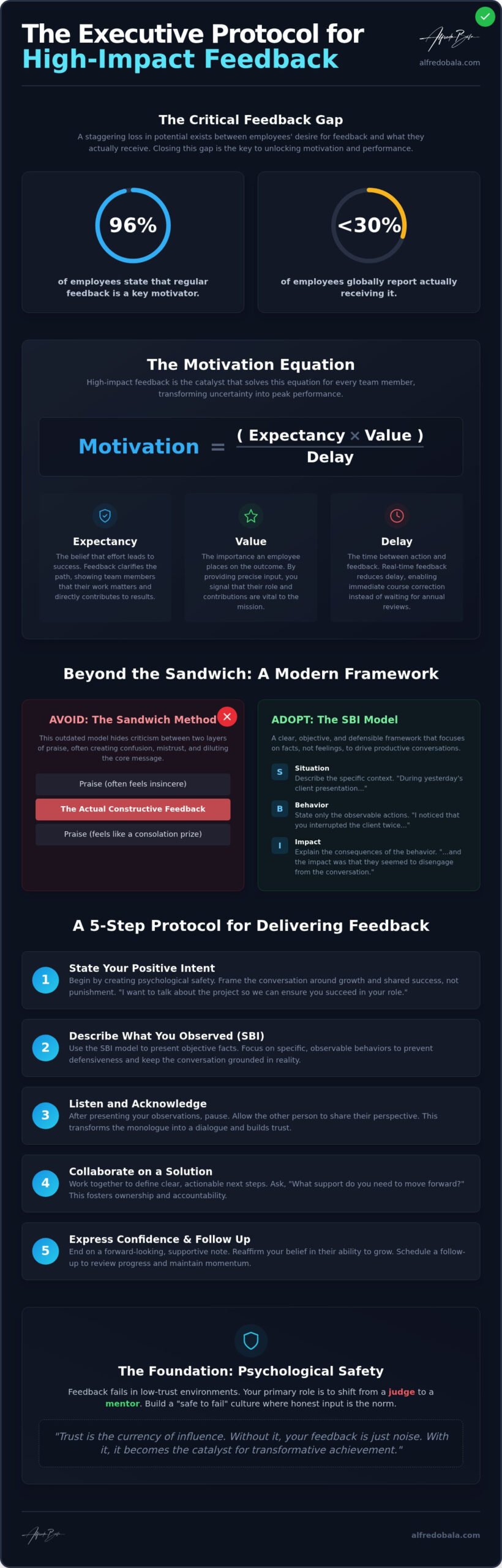
A 5-Step Protocol for Delivering High-Impact Feedback
Execution is where strategy meets reality. To move beyond the theoretical frameworks discussed earlier, you need a repeatable, disciplined system for your one-on-one interactions. Knowing how to give constructive feedback to employees is a skill that distinguishes a veteran leader from a novice manager. This five-step protocol ensures every conversation serves the dual purpose of recalibrating performance and strengthening the professional bond.
- Step 1: Preparation. Never walk into a feedback session cold. Identify the specific, observable behaviour you need to address and define exactly what success looks like for the next phase.
- Step 2: Opening. Set a collaborative tone immediately. State your purpose clearly: you are here to support their elevation, not to perform a post-mortem on their mistakes.
- Step 3: The Observation. Deliver the facts with surgical precision. Use the SBI model to describe the situation and behaviour without adding emotional charge or personal judgment.
- Step 4: The Dialogue. This is the most critical phase. Listen more than you speak. Ask open-ended questions to understand their perspective and uncover any hidden obstacles in the Motivation Equation.
- Step 5: The Action Plan. End with a concrete roadmap. Collaboratively define the next steps, resource requirements, and a specific date for a follow-up check-in.
If you’re ready to elevate your team’s output and master these high-level communication skills, partner with me for executive leadership development.
Mastering the Opening Hook
Defensiveness is the enemy of growth. To bypass the natural human “fight or flight” response, start by asking for permission. A simple phrase like, “I have some observations that might help you hit your quarterly targets; do you have a moment to dive in?” creates an immediate sense of agency for the employee. Choose your timing wisely. High-stakes feedback should never happen when emotions are high or in a public setting. Create a private, neutral space where the focus remains entirely on the solution.
The Art of the Follow-Up
Feedback is a continuous process, not a one-time event. The most common leadership failure is the “set it and forget it” mentality. Schedule “check-back” sessions specifically to celebrate progress. When an employee successfully adjusts their trajectory based on your input, acknowledging that change reinforces their “Expectancy” in the Motivation Equation. Document these conversations for growth. Treat your notes as a roadmap for the individual’s professional evolution rather than just a paper trail for HR files. This level of investment transforms a standard review into a masterclass in how to give constructive feedback to employees.
Scaling Feedback for Global Teams and Organizational Growth
Scaling a high-performance culture across a global footprint is the final frontier of executive mastery. It’s one thing to manage a local team; it’s quite another to maintain a consistent standard of excellence across diverse time zones and cultural landscapes. Mastering how to give constructive feedback to employees in this context requires a nuanced balance of local empathy and uncompromising global standards. You must ensure that the “Expectancy” and “Value” components of the Motivation Equation remain high, regardless of where your team members are located.
Technology and AI now play a pivotal role in maintaining these continuous feedback loops. By 2026, sophisticated analytics allow leaders to spot performance trends before they become systemic failures. However, these tools are merely facilitators. They provide the data, but you must provide the wisdom. Feedback serves as a critical filter for identifying future leaders. Those who lean into correction and use it as a springboard for growth are the ones you want in your succession pipeline. A leader’s legacy is built on the people they develop through honest coaching.
Feedback as a Strategic Leadership Tool
Stop managing tasks and start coaching people. High-level leadership is about creating an environment where innovation and agility are the natural results of clear communication. When feedback loops are tight, teams can pivot with the speed required by global markets. This strategic oversight is a core component of effective corporate board advisory. As a keynote speaker on organizational growth, I often emphasize that the ability to deliver high-impact correction is the primary driver of strategic impact at the highest levels of governance.
Building Your Leadership Legacy
The best leaders are rarely remembered for being “nice.” They are remembered for being “tough but fair” mentors who refused to let their people settle for mediocrity. Investing in your team’s Motivation Equation is your primary ROI. It reduces turnover, fuels engagement, and creates a culture of accountability that outlasts your tenure. Elevate your leadership by mastering the Motivation Equation. Start today by refining how to give constructive feedback to employees, turning every conversation into a building block for a world-class organization.
Mastering the Art of High-Impact Calibration
Leadership isn’t about maintaining the status quo; it’s about relentlessly pursuing the potential within your team. You’ve seen how shifting from correction to calibration transforms the cultural fabric of an organization. By moving beyond outdated methods like the “sandwich” approach and adopting a disciplined 5-step protocol, you replace defensiveness with a shared commitment to growth. Refining how to give constructive feedback to employees is the most direct path to organizational excellence and long-term retention.
Every conversation is an opportunity to solve the Motivation Equation for your people. As a veteran who has led global organizations for over 40 years, I’ve seen these strategies drive measurable impact in high-stakes environments. Your legacy as an executive isn’t defined by the tasks you manage but by the leaders you build through honest, high-impact coaching. It’s time to turn your feedback loops into your greatest competitive advantage.
If you’re ready to drive global team retention and elevate your leadership performance, master the mechanics of team success with The Motivation Equation. You possess the tools to recalibrate performance and fuel deep motivation. Start leading with the clarity and confidence your team deserves.
Frequently Asked Questions
How do you give constructive feedback to a sensitive employee?
Start by establishing psychological safety through an “asking for permission” hook. This gives the individual a sense of agency and lowers their natural defenses. Focus exclusively on observable behaviors rather than personal attributes. When you learn how to give constructive feedback to employees who are more sensitive, your role shifts from a judge to a supportive mentor who is personally invested in their professional elevation.
What is the difference between positive and constructive feedback?
Positive feedback reinforces existing behaviors that align with organizational goals, effectively increasing the “Value” component of the Motivation Equation. Constructive feedback is a recalibration tool designed to bridge the gap between current performance and future potential. While positive feedback validates the past, constructive feedback provides a roadmap for the future. Both are essential for maintaining a balanced, high-performance culture within your global team.
How often should I give feedback to my team members?
Feedback should be a continuous dialogue rather than a rare, scheduled event. In the fast-paced global market of 2026, waiting for an annual review creates a dangerous “Delay” in the Motivation Equation. Aim for real-time calibration. Small, frequent micro-adjustments are far more effective than massive, overwhelming corrections. This agile approach ensures your team stays aligned with corporate strategy while fostering a culture of constant growth.
What should I do if an employee rejects my feedback?
Stay objective and avoid the trap of a defensive argument. Revisit the “SBI” model to ground the conversation in facts, behavior, and impact. Use Step 4 of the executive protocol to listen more than you speak. Ask open-ended questions to uncover their perspective. Often, rejection stems from a misunderstanding of the “Expectancy” variable, where the employee doesn’t believe the suggested change will lead to success.
Can constructive feedback be given over email or Slack?
Avoid using digital channels for high-stakes correction. Email and Slack lack the non-verbal cues and emotional nuances required for a high-trust dialogue. Digital messages are often misinterpreted as more aggressive than intended, which can trigger unnecessary defensiveness. Use these tools for quick praise or logistical check-ins, but always schedule a face-to-face or virtual meeting when you need to address sensitive performance issues or behavioral gaps.
How do I give feedback to a high-performer who has a blind spot?
Frame the conversation around their next level of leadership. High-performers are often driven by a desire for mastery, so position the blind spot as the final barrier to their professional breakthrough. Use precise, high-impact language to describe the ripple effect of their behavior on the organization. When you master how to give constructive feedback to employees at this level, you transform their blind spots into strategic growth opportunities.
What are the most common mistakes managers make when giving feedback?
The most frequent error is using the “Sandwich Method,” which destroys trust by making praise feel like a precursor to an attack. Other common mistakes include being too vague, waiting too long to address an issue, and focusing on personality traits rather than observable behaviors. Many managers also fail to follow up, treating feedback as a one-time event rather than a continuous process of calibration and organizational development.
How do I prepare for a difficult feedback conversation?
Preparation is the first step of the executive protocol. Clearly identify the specific behavior you need to address and define the desired outcome before the meeting starts. Use the Motivation Equation as a diagnostic tool to determine if the performance gap is caused by a lack of clarity, value, or timing. Having a structured roadmap ensures you stay focused on the solution rather than getting bogged down in the emotion of the conflict.
 EN
EN  ES
ES
Recent Comments