
If your strategy for team engagement begins and ends with a Friday afternoon Zoom happy hour, you aren’t leading; you’re just treading water. Most executives feel the slow erosion of culture as digital fatigue and time zone friction turn high-potential talent into transactional contributors. You know that the old playbooks for office-based camaraderie don’t translate to a distributed world. Understanding how to motivate a remote team in 2026 requires more than just optimized technological stacks; it demands a fundamental shift in how we align individual ambition with global corporate strategy.
The frustration of watching spontaneous collaboration vanish, replaced by the mechanical rhythm of scheduled meetings, is a clear signal that your leadership needs a new operating system. This is your opportunity to move from manager to visionary guide. This article provides the definitive executive framework to solve these challenges and reignite momentum. You’ll master the psychological and strategic pillars of the Motivation Equation to drive peak performance across every continent. We will explore a repeatable system for engagement that bridges the gap between daily tasks and high-level vision, ensuring your top talent remains loyal, inspired, and results-oriented.
Key Takeaways
- Transition from traditional visibility-based management to outcome-oriented executive leadership to eliminate digital fatigue and restore team momentum.
- Apply the three pillars of the Motivation Equation—Purpose, Clarity, and Reward—to master how to motivate a remote team while maintaining high-level strategic alignment.
- Balance tactical accountability with adaptive autonomy to give your distributed workforce the psychological safety and space required for high-stakes problem solving.
- Implement asynchronous communication workflows and Cultural Intelligence (CQ) to bridge time zone gaps and foster a unified global company culture.
- Scale your virtual excellence by developing a framework for the next generation of remote leaders, ensuring long-term retention of top-tier global talent.
The Remote Motivation Crisis: Why Traditional Leadership Fails in a Virtual Landscape
Leading a team you cannot see requires a level of psychological sophistication that many executives haven’t yet mastered. In 2026, the novelty of remote work has vanished, replaced by a grueling expectation that drains even the most resilient talent. To understand what is a virtual team in the modern context, we must recognize it as a group of high-performers whose drive is fueled not by proximity, but by clarity, autonomy, and purpose.
Learning how to motivate a remote team is no longer about managing a crisis; it’s about optimizing a permanent strategic advantage. Traditional leadership relied on visibility. If you were at your desk, you were working. Executive leadership today must be outcome-based. It’s about the value delivered, not the hours logged on a status indicator. When you shift your focus from monitoring activity to measuring impact, you create the environment necessary for excellence to flourish.
We face three silent killers of remote drive. First, isolation severs the emotional bond to the company. Second, tactical overload occurs when the “how” of the job consumes the “why.” Finally, goal-blurring happens when individual tasks lose their connection to high-level corporate strategy. Solving this requires moving beyond the reactive tactics of 2020 and adopting a disciplined, scientific approach to human performance.
The Erosion of Spontaneous Culture
Culture used to happen in the hallways. It was spontaneous, messy, and vital. In a distributed environment, those “water cooler” moments are extinct. Without them, professional relationships become purely transactional. This digital-only distance creates a psychological void where team cohesion dies. Leaders can’t leave culture to chance anymore. It must become a strategic priority, built intentionally through structured interactions that go beyond the project roadmap.
Why Micromanagement is the Enemy of Remote Performance
Surveillance isn’t leadership. Tracking keystrokes or demanding green status dots offers a negative ROI; it signals a fundamental lack of trust that kills initiative. When you micromanage, you break the trust-performance loop. High-performers thrive when they own their outcomes. If you want to know how to motivate a remote team, start by giving them the autonomy to succeed without a digital shadow over their shoulder. Digital Trust is the currency of modern leadership.
The Motivation Equation: A Scientific Framework for Remote Engagement
Motivation isn’t a nebulous feeling that fluctuates with the weather; it’s a predictable outcome of specific leadership variables. To master how to motivate a remote team, you must move beyond guesswork and adopt a disciplined framework. Alfredo Bala’s The Motivation Equation provides this foundation, breaking down human performance into three critical components: Purpose, Clarity, and Reward. When these variables are calibrated for a distributed workforce, engagement becomes a sustainable asset rather than a fleeting luxury.
In a global setting, these variables require constant adjustment. You can’t rely on office energy to fill the gaps. Instead, you must architect an environment where every team member, regardless of their time zone, understands their value. By implementing sophisticated leadership strategies for remote motivation, you can ensure that your talent doesn’t just complete tasks but actively drives the company forward. If you’re looking to elevate your team’s output, exploring these leadership insights is the first step toward mastery.
Purpose: Connecting Daily Tasks to the Global Vision
Remote workers frequently fall into the trap of feeling like a cog in a machine. They aren’t just names in a Slack channel; they’re the architects of your corporate future. To maintain drive, you must bridge the gap between their isolated home office and the global mission. Use executive storytelling to illustrate how a single line of code or a customer service resolution impacts the overarching strategy. Purpose-driven check-ins should focus on the “why” behind the work, steering clear of the tactical weeds that often stifle creativity and long-term commitment.
Clarity and Reward: Defining Success in a Borderless Team
Ambiguity is the silent killer of remote productivity. You need ultra-clear KPIs that translate across cultures and languages without losing their meaning. When expectations are crystalline, autonomy becomes possible. This clarity must be paired with a robust reward system. In a virtual environment, public recognition carries immense weight. Celebrate outcomes, not the hours logged on a screen. A reward system that values tangible results over performative presence reinforces the trust-performance loop and ensures your team remains focused on what truly moves the needle.
Tactical vs. Adaptive Performance: Balancing Accountability with Autonomy
High-performance leadership is a delicate act of balancing two distinct types of work: tactical and adaptive. Tactical performance is your team’s ability to execute the plan, follow the process, and hit the milestones. Adaptive performance is their ability to diverge from that plan when the situation changes. In a distributed environment, many executives lean too heavily into the tactical. They prioritize rigid schedules and status updates because it gives them a sense of control. However, when you starve your team of adaptive space, you kill the very innovation required to scale a global business.
Understanding how to motivate a remote team means recognizing that remote workers often die in the “tactical weeds.” Without the spontaneous context of an office, they become order-takers rather than problem-solvers. You must implement a framework of Structured Autonomy. This isn’t a hands-off approach; it’s a leadership style that defines the “what” and the “why” with absolute precision while leaving the “how” to the experts you hired. When people own their methodology, their engagement levels skyrocket.
Executives often ask: “If I don’t monitor them, how do I know they’re working?” This objection is a relic of 20th-century management. If your only way to verify work is through a green status dot or keystroke tracking, your KPIs are insufficient. In 2026, we measure impact and outcome. If the mission is advancing and the targets are being met, the “when” and “where” of the work become secondary. Trust is not a gift you give; it’s a strategic requirement for high-level execution.
The 50/50 Rule for Remote Leadership
Effective remote leaders split their energy. Spend 50% of your time on tactical oversight to ensure the foundation is stable. Spend the remaining 50% on adaptive problem-solving. This requires a shift in your meeting culture. Stop using your limited synchronous time for status updates that could have been an email. Instead, run “Adaptive Meetings” designed to identify bottlenecks and brainstorm pivots. This focus on adaptive performance acts as a hedge against remote burnout. It transforms a repetitive digital existence into a series of meaningful challenges where team members feel their agency is respected.
Building a Culture of Experimentation
Innovation cannot exist without the possibility of failure. To drive true engagement, you must foster a culture of experimentation where “safe failure” is documented and learned from rather than punished. Your role is no longer to be the giver of orders; you are the facilitator of solutions. By removing the fear of making a mistake, you unlock the creative potential of your global talent. This mindset is a cornerstone of modern Executive Leadership Development Strategies for Global Growth in 2026. When your team knows you have their back during a pivot, they will reward you with a level of loyalty and drive that no surveillance software could ever produce.
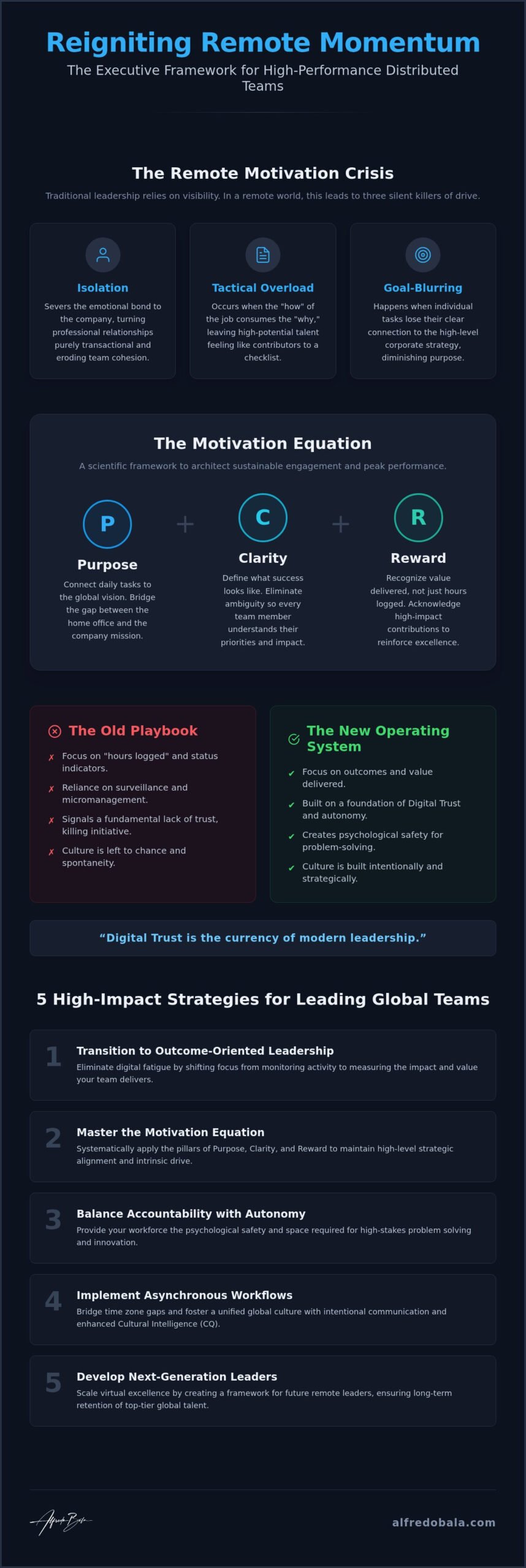
5 High-Impact Strategies for Leading Global Remote Teams in 2026
Scaling a distributed organization requires more than just reliable software; it demands a sophisticated approach to human connection across borders. To master how to motivate a remote team, you must deploy strategies that respect the individual while aligning them with a global mission. These high-impact methods move beyond basic management and into the sphere of visionary executive leadership. They’re designed to bridge the physical gap with psychological precision.
- Implement Cultural Intelligence (CQ): Treat CQ as a core competency rather than a soft skill. Leaders must navigate diverse cultural norms regarding feedback and authority to ensure every team member feels seen and respected within their local context.
- Design High-Touch Virtual Retreats: Replace standard Zoom happy hours with immersive, objective-driven virtual events. These sessions should foster deep interpersonal trust and long-term strategic alignment through collaborative problem-solving.
- Utilize Executive Advisory: Leverage outside expertise to bridge regional silos. An external perspective helps ensure that localized teams don’t become isolated islands of productivity, disconnected from the corporate core.
- Leverage AI Sentiment Analysis: Use advanced tools to monitor the emotional health of your workforce. This allows you to identify digital fatigue and burnout before they lead to attrition, all while maintaining strict privacy standards.
- Prioritize Asynchronous Workflows: Shift the burden of real-time presence to documentation-heavy systems that allow global talent to thrive in their own time zones without the constant interruption of pings.
Mastering Asynchronous Leadership
Leading a team that never works at the same time is a true test of your organizational clarity. You must reduce meeting fatigue by moving status updates to video snippets and shared documentation. This creates a 24-hour momentum cycle where work continues seamlessly as one region hands off to the next. When you eliminate the “always-on” expectation, you give your team the gift of deep work. It’s this focus that drives high-level performance and proves you value their time as much as their output.
The Global Keynote: Realigning the Remote Workforce
Annual resets are vital for maintaining the Motivation Equation across a distributed landscape. A unified leadership message, delivered with the energy and gravitas of a professional speaker, can realign a fractured workforce in a single hour. These virtual events serve as a strategic anchor, reminding every employee of their role in the larger story. If you’re planning your next leadership summit, consulting a Leadership Speaker for Corporate Events: The 2026 Executive Selection Guide will help you find the right voice to inspire your global talent. To ensure your organization is equipped for the challenges of tomorrow, book a consultation for executive advisory today.
Scaling Virtual Excellence: From Management to Executive Vision
Scaling a global organization in 2026 requires more than just adding seats to your digital platform; it requires an expansion of your leadership capacity. You must move beyond the friction of daily task management and embrace a vision that empowers every team member to act as a stakeholder in your success. Understanding how to motivate a remote team at scale means building a culture where excellence is the default, not the result of constant oversight. This transition from manager to visionary is where true growth happens.
Alfredo Bala serves as the bridge between current operational friction and future global growth. By integrating the Motivation Equation into the highest levels of your organization, you can transform a distributed workforce into a unified movement. Whether through a board seat or executive advisory, shaping a remote-first global strategy ensures that your company remains resilient and competitive. It’s time to stop managing remote tasks and start leading a remote movement that transcends geographical boundaries.
Identifying and Mentoring Remote Leaders
Developing the next generation of leaders within a distributed environment requires a specific eye for talent. Look for candidates who demonstrate radical transparency, digital empathy, and an obsession with outcomes over activity. These individuals are the ones who can maintain momentum without the need for physical presence. You must build a pipeline of leadership that thrives on asynchronous communication and high-level strategic alignment. The Remote Visionary is the most critical C-suite role of 2026, serving as the architect of digital culture and the guardian of strategic alignment across every time zone.
The Executive Roadmap to Global Success
Your journey from tactical monitoring to strategic motivation is a path toward professional mastery. By applying the pillars of Purpose, Clarity, and Reward, you create a self-sustaining ecosystem of high performance. Don’t wait for another quarterly review to implement these changes. Apply the Motivation Equation today to see immediate shifts in team engagement and retention. The tools and frameworks shared in this guide are your roadmap to becoming the leader your global team deserves. If you’re ready to elevate your organization’s trajectory, Book Alfredo Bala for your next leadership summit or board advisory session to begin your transformation.
Lead the Movement: The Future of Global Execution
The landscape of leadership has shifted from managing presence to architecting performance. By applying the scientific pillars of Purpose, Clarity, and Reward, you move beyond the friction of digital fatigue and into a sphere of sustained excellence. You’ve learned that how to motivate a remote team isn’t about surveillance; it’s about aligning individual ambition with your high-level corporate strategy. Balancing tactical accountability with adaptive autonomy ensures your global talent stays agile, innovative, and inspired.
Alfredo Bala brings over 40 years of global leadership experience and a proven track record as an expert board advisor to help you scale these frameworks. As the author of the definitive framework for peak performance, he specializes in bridging the gap between regional silos and corporate vision. It’s time to stop reacting to remote challenges and start leading with precision. Master the art of motivation with Alfredo Bala’s “The Motivation Equation”. Your team is ready for a visionary guide. Step into that role today and build the distributed powerhouse your organization deserves.
Frequently Asked Questions
What is the most effective way to motivate a remote team without micromanaging?
The most effective way is to shift from monitoring activity to measuring impact through outcome-based leadership. By applying the Motivation Equation, you provide the clarity and purpose needed for individuals to drive themselves. Micromanagement dies when expectations are crystalline and autonomy is respected. This framework allows you to master how to motivate a remote team by focusing on the “why” and “what” rather than the “how” or “when.”
How do you maintain company culture when everyone is working from home?
Maintaining culture requires moving from spontaneous hallway interactions to intentional, strategic touchpoints. You must build a digital environment where the global vision is constantly reinforced through executive storytelling and shared mission. Asynchronous communication and high-touch virtual retreats replace the physical office. Culture isn’t about where people sit; it’s about the shared belief in the organization’s purpose and the visible recognition of their contributions across borders.
Can the Motivation Equation be applied to international teams in different time zones?
Yes, the Motivation Equation is specifically designed to function across digital and geographical boundaries. Its core components, Purpose, Clarity, and Reward, are universal psychological drivers that transcend time zones. When leading international teams, you simply calibrate these variables to fit local cultural contexts. This scientific approach ensures that a developer in Tokyo and a manager in London remain equally aligned with your corporate strategy without requiring real-time presence.
How often should an executive check in with their remote leadership team?
Executives should focus on the quality of interactions rather than the frequency of pings. A weekly high-level strategic alignment meeting is often more effective than daily tactical check-ins that lead to Zoom fatigue. Use these sessions to address adaptive challenges and remove bottlenecks. Outside of these meetings, rely on asynchronous updates to maintain momentum. This rhythm preserves executive bandwidth while providing your remote leadership team with the support they need to execute.
What are the signs of remote employee burnout that managers often miss?
Managers often miss “tactical overload,” where an employee executes tasks perfectly but stops offering creative solutions or adaptive feedback. Other subtle signs include a sudden shift to purely transactional communication or a decline in spontaneous collaboration. When a high-performer becomes a mechanical contributor, it’s a clear signal of digital fatigue. Identifying these shifts early allows you to recalibrate their Motivation Equation before burnout leads to attrition or long-term disengagement.
Is a professional keynote speaker effective for a remote or hybrid workforce?
A professional keynote speaker is highly effective for realigning a distributed workforce. These sessions serve as a strategic anchor, delivering a unified message that cuts through digital isolation. Alfredo Bala uses his 40 years of experience to transform standard virtual events into high-impact experiences. By resetting the Motivation Equation for the entire organization at once, a speaker can reignite drive and clarify how to motivate a remote team on a global scale.
How do you measure the ROI of remote leadership development?
You measure ROI through tangible metrics like top-talent retention, the speed of project delivery, and the reduction in “tactical friction.” Leadership development should lead to a measurable increase in adaptive performance across your teams. When your managers transition from task-trackers to visionary guides, you see a direct impact on the bottom line. Higher engagement leads to more efficient global operations and a stronger pipeline of leadership talent ready for C-suite roles.
What is the difference between tactical and adaptive performance in remote work?
Tactical performance is the ability to follow a prescribed plan and hit established milestones. Adaptive performance is the capacity to improvise and solve complex problems when that plan is no longer viable. Remote teams often get trapped in tactical work because it feels safer in a virtual environment. However, true scaling requires adaptive space. Balancing these two ensures your team isn’t just busy but is actually moving the needle on high-level corporate goals.
 EN
EN  ES
ES
Recent Comments