
Research indicates that 75% of cross-functional teams are fundamentally dysfunctional, even as global spending on collaboration software reaches $18.2 billion. You’ve likely witnessed this breakdown yourself. Communication silos stall your best ideas, and your remote teams are drowning in “work about work” instead of driving the innovation you hired them for. You know that improving team collaboration requires more than just a new subscription to a project management tool. It demands a shift in how you harness human energy across a global landscape.
You’re right to feel that the current “software-first” approach is failing. Real performance isn’t found in a dashboard; it’s forged through strategic alignment and leadership psychology. This article delivers a scalable executive framework designed to transform fragmented groups into high-impact units. I’ll show you how to use the Motivation Equation to bridge the gap between individual ambition and organizational goals. We’ll explore the mechanics of increasing velocity and morale so you can lead a team that doesn’t just communicate, but actually conquers.
Key Takeaways
- Identify and eliminate “Collaborative Friction” to move your organization from basic transactional cooperation to a state of transformational synergy.
- Master the Motivation Equation to align individual value and expectations with collective goals. It’s the scientific foundation for improving team collaboration.
- Prioritize strategic decision-making frameworks over software acquisition. Don’t let “Tool Fatigue” stall your high-performance global teams.
- Establish a visible “North Star” vision and leverage cultural intelligence to maintain operational velocity across diverse borders and time zones.
- Execute a two-phase implementation roadmap that begins with a deep organizational audit to identify and repair hidden efficiency leaks.
Beyond the Buzzwords: Why Improving Team Collaboration Starts with Leadership
Stop treating collaboration as a technical checkbox. Too many executives believe a new Slack channel or a project management dashboard will magically fix productivity. It won’t. True success in improving team collaboration begins at the top. It requires a leader who understands that “Collaborative Friction” is a silent profit killer. This friction occurs when the mechanics of working together are so cumbersome that they drain the team’s creative energy and stall momentum. We must move beyond transactional cooperation, where people simply swap tasks, toward transformational synergy, where the collective output far exceeds the sum of individual parts.
When we look at defining team collaboration, we see it’s a recursive process where people work toward a common goal. It isn’t just about proximity or shared folders. Industry research from firms like McKinsey consistently shows that 70% of digital transformation initiatives fail. The culprit isn’t usually the technology; it’s the cultural silos and human resistance that leaders fail to address. You can’t buy synergy. You have to architect it. Your role must evolve into that of the Chief Alignment Officer, ensuring every individual understands how their specific pulse contributes to the organization’s heart.
The Psychology of Silos and How to Break Them
Silos aren’t just organizational boundaries; they’re psychological defenses. Information hoarding is the most common symptom of a low-trust environment. When employees feel their value is tied to what they know exclusively, they won’t share. They’ll protect their “turf” at the expense of the company. To break this, you must establish high-authority standards for communication. Transitioning from a “Me” culture to a “We” performance model requires rewarding collective wins over individual accolades. When the incentive structure favors the group, the silos begin to crumble.
Leadership Lessons from Top Executives
The most effective global leaders share a common trait: they listen twice as much as they speak. They don’t just broadcast orders; they seek to understand the friction points within their teams. By practicing strategic transparency, you drive deep buy-in. This involves sharing the “why” behind every major pivot or goal. Improving team collaboration is ultimately an exercise in executive leadership development. You aren’t just managing tasks. You’re cultivating an environment where those tasks can be executed with speed and precision because everyone is moving in the same direction.
The Motivation Equation: The Secret Science of Synergetic Teams
Collaboration isn’t a happy accident. It’s a mathematical outcome of human psychology. To master the art of improving team collaboration, you must first understand the variables that drive individual action. I call this the Motivation Equation. It represents the intersection of value (the perceived benefit), expectation (the belief in success), and impulse (the internal or external distractions that derail us). When you align these forces, you create a “Collaborative Quotient” that measures your team’s actual capacity for synergy. Individual motivation is the high-octane fuel for collective performance. If your people aren’t personally invested, your strategic framework is just paper. You must balance the drive for high-pressure results with a genuine commitment to human development.
Aligning Individual Ambition with Organizational Vision
People don’t work for your vision; they work for their own. The “What’s In It For Me” (WIIFM) factor is the most powerful lever in executive leadership. You must bridge the gap between corporate objectives and personal aspirations. In my book, The Motivation Equation, I outline how to diagnose performance gaps by looking at these specific motivational variables. When you frame the company’s story so that every team member is the hero of their own journey, improving team collaboration becomes the natural path of least resistance. It’s about moving from “have to” to “want to.” This shift is what separates managers from visionaries who inspire deep loyalty.
Creating a Culture of Psychological Safety and Accountability
High-performance teams require a sturdy framework for great teamwork that balances psychological safety with strict accountability. Accountability is the anchor. It ensures that commitments are met and standards are upheld across global time zones. However, accountability without safety breeds fear, and fear kills innovation. You must establish “Safe-to-Fail” zones where rapid experimentation is encouraged and failure is treated as data, not a disaster. This approach empowers middle management to take calculated risks, which is essential for developing leadership in organizations. When your managers feel safe to lead, they create the same environment for their teams, accelerating your organizational velocity. If you’re ready to elevate your leadership, consider how adopting a proven framework can redefine your team’s trajectory.
Software vs. Strategy: Choosing the Right Collaboration Framework
Stop assuming that a larger software budget correlates with higher productivity. It doesn’t. Tool fatigue is a silent drain on your organization’s energy; knowledge workers now spend up to 60% of their time on coordination rather than the skilled work they were hired to perform. When you prioritize software over a clear strategy, you aren’t improving team collaboration; you’re just adding noise. You must define who owns the “Yes” in every project before you ever open a browser. Strategy must always dictate the tool, never the other way around.
Measure your success through organizational velocity. This is the speed at which your team moves from a conceptual vision to a market-ready reality. High-performance teams don’t brag about the number of messages sent; they celebrate the reduction of friction. Consider the 1% Rule: a tiny shift in your own leadership behavior, such as clarifying a single communication protocol, can generate massive improvements in team output over a fiscal quarter. It is the cumulative effect of these small, strategic adjustments that defines an elite organization.
Why Digital Tools Alone Cannot Fix a Broken Culture
Unused collaboration platforms quickly become digital ghost towns. This happens when the tool doesn’t match the organizational DNA or when the culture lacks the trust required to use it effectively. In an AI-driven workspace, human connection remains your most valuable asset. You need a strategic advisory approach to select tools that amplify your existing culture rather than attempting to replace it. Focus on tools that reduce the overhead of “work about work” so your experts can get back to being experts.
Building High-Performance Teams: An Executive Checklist
Start with an audit of your communication flow. Is it synchronous, requiring real-time presence, or asynchronous, allowing for deep work? Successful leaders in 2026 are already refining their executive leadership development strategies to handle these nuances. Use the following checklist to ensure your framework is sound:
- Identify the primary communication mode for high-stakes projects to avoid message fragmentation.
- Establish clear “Rules of Engagement” that define which platform is used for what purpose.
- Audit how often status meetings interrupt skilled tasks and replace them with asynchronous updates where possible.
By setting these boundaries, you ensure that your technology serves your strategy. This disciplined approach is the only sustainable way to keep improving team collaboration as your organization scales across global borders.
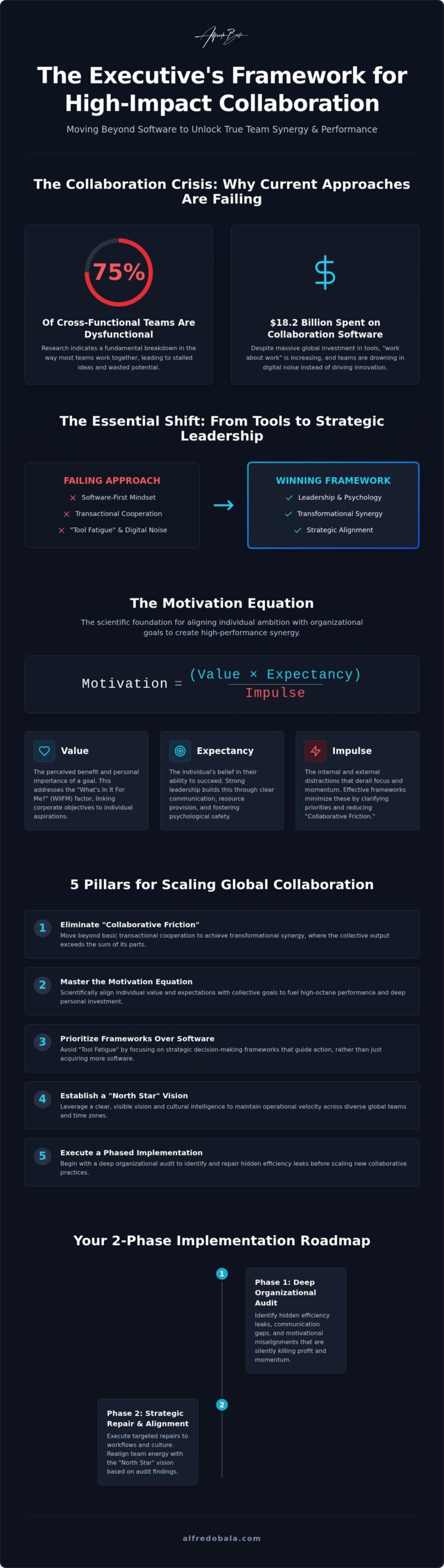
5 Strategic Pillars for Scaling Collaboration in Global Organizations
Scaling a global enterprise requires more than just a map; it requires a set of non-negotiable pillars. When your organization spans continents, the complexity of improving team collaboration increases exponentially. You must move from a centralized control model to a framework of trust and alignment. Each pillar serves as a structural support for the weight of your global ambition, ensuring that your growth doesn’t lead to fragmentation.
First, establish a Unified Vision. This “North Star” must be visible in every time zone to prevent teams from drifting into localized agendas. Second, develop Cultural Intelligence. Leading beyond borders requires a deep understanding of regional nuances that go far beyond simple language translation. Third, embrace Radical Candor. Healthy conflict is the forge in which great ideas are tempered. Fourth, implement Decentralized Command. Empower your local leaders to make decisions without waiting for HQ. Finally, use Continuous Recognition. Celebration isn’t a luxury; it’s the fuel that sustains long-term momentum.
Mastering Cross-Cultural and Remote Synergy
Remote bias, the “Out of Sight, Out of Mind” trap, is a primary reason why global initiatives fail. You must consciously pull remote contributors into the core narrative. The “Follow the Sun” model allows for continuous collaboration, but it only works if your handoffs are precise and your expectations are clear. Mastering the art of motivating global teams in sectors like direct sales requires a balance of high-touch communication and autonomous trust. When the handoff from a team in London to a team in Los Angeles is seamless, your organizational velocity doubles.
High-Impact Leadership Training for C-Suite Teams
Transformation doesn’t bubble up from the bottom; it cascades from the top. Improving team collaboration training must start at the board level to ensure the entire executive suite speaks the same strategic language. Developing the “Executive Presence” required to inspire unity across thousands of employees is a learned skill. Customizing keynote speaker organizational growth sessions allows your leadership to reset their collective focus and drive strategic impact. If you’re ready to align your top-tier talent, explore my executive advisory services to build a truly synergetic organization.
Implementing the Framework: Your Roadmap to High-Impact Collaboration
Execution is the only bridge between a brilliant strategy and a transformative result. Moving your organization toward a high-performance model requires a disciplined, three-phase approach that prioritizes human energy over technical infrastructure. You must start with an honest assessment of your current state before you can hope to scale. Improving team collaboration isn’t a one-time event; it’s a continuous refinement of how your people interact with your vision and with each other.
Phase one begins with the Organizational Audit to identify where your productivity is leaking. Phase two involves integrating the Motivation Equation into your daily operations, which is the most direct path toward improving team collaboration by aligning personal drives with corporate goals. Finally, phase three focuses on scaling that success. You don’t roll out a new framework to ten thousand people overnight. You start with high-impact pilot teams, document the velocity gains, and then use those wins to fuel a global rollout. Engaging an executive board consultant during this transition ensures that the change is anchored in your long-term governance and growth strategy.
Auditing Your Current Team Dynamics
Information is the lifeblood of your company, but silos act as arterial blockages. You can perform a simple “Silo Test” by tracking how long it takes for a critical market insight to travel from the front lines to a decision-maker. If it takes days instead of hours, your communication structure is broken. You must also identify “Collaboration Vampires” within your ranks. These are individuals who consume hours of collective time in unproductive meetings without contributing to the organizational velocity. They drain the energy that your high-performers need to innovate.
In the 2026 corporate environment, Collaborative ROI is the measurable delta between collective output and the total time consumed by coordination friction.
Partnering for Performance: Speaking and Advisory
An external perspective is often the catalyst needed to break old habits. A professional leadership speaker for corporate events can do more than just deliver a speech; they can reset your entire team culture by providing a shared vocabulary for success. This isn’t about temporary excitement. It’s about delivering a masterclass in human performance that sticks. When you combine this infectious energy with the steady hand of board advisory, you create a dual engine for growth. You gain the strategic depth to navigate complex global markets and the tactical agility to outpace your competition. Your next step is to stop managing collaboration and start mastering the science behind it.
Mastering the Art of Organizational Synergy
High-performance organizations aren’t built on digital tools alone. They’re forged through disciplined leadership and a relentless focus on human alignment. You’ve seen how “Collaborative Friction” can stall even the most ambitious global initiatives. By prioritizing the 5 Strategic Pillars and moving beyond transactional cooperation, you can unlock the true potential of your workforce. It’s about creating a culture where every team member is the hero of the company’s story and every process serves a unified vision.
Improving team collaboration is a science of motivation. It requires balancing individual ambition with a unified corporate vision using a proven framework. As a former CEO and strategic advisor with over 40 years of global leadership experience, I’ve seen these principles transform fragmented groups into unified powerhouses across several continents. It is time to stop managing tasks and start leading a movement that drives real organizational velocity. The future of your organization depends on the synergy you build today.
Elevate your team’s performance with Alfredo Bala’s Motivation Equation and discover the strategic frameworks shared by the author of “The Motivation Equation.” You have the tools to bridge the gap between strategy and execution. Take the next step in your journey from manager to visionary. Your team is ready for the elevation you’ve been planning; now, lead them there with clarity and conviction.
Frequently Asked Questions
What is the most effective way to improve team collaboration quickly?
The fastest way to improve team collaboration is to clarify the “North Star” vision and align individual incentives with collective outcomes. When every member understands how their personal success is tied to the group’s victory, resistance vanishes. You must identify and remove “Collaborative Friction” immediately by clarifying who owns the decision-making process. This creates instant momentum and allows your high-performers to focus on execution rather than navigating internal politics.
How do you improve collaboration in a remote or hybrid team?
Improving team collaboration in a remote environment requires a deliberate shift from synchronous to asynchronous communication. You must combat the “out of sight, out of mind” bias by creating intentional touchpoints for strategic alignment. Establish clear “Rules of Engagement” that define which platforms are for urgent tasks and which are for deep work. This structure prevents tool fatigue and ensures that your global teams remain unified across multiple time zones.
Can technology alone solve team collaboration issues?
Technology is a force multiplier, but it cannot fix a broken culture or a lack of strategic direction. Tools like Slack or Zoom are only effective when they sit on a foundation of trust and clear leadership. Research shows knowledge workers spend 60% of their time on coordination tasks. If you don’t have a strategy for how people work together, adding more software will only increase the noise and decrease your organizational velocity.
What are the common barriers to effective team collaboration in large organizations?
Communication silos and information hoarding are the most frequent barriers in large organizations. These are often symptoms of low trust or misaligned incentive structures where departments compete rather than collaborate. You must also watch for “Collaboration Vampires” who drain energy through unnecessary meetings and bureaucracy. Breaking these barriers requires a “Chief Alignment Officer” who can enforce high-authority standards for transparency and reward collective wins over departmental silos.
How does leadership style impact team synergy?
Leadership style is the primary driver of team synergy; it sets the psychological “gravitas” for the entire organization. Effective leaders act as mentors who listen twice as much as they speak. By providing a balance of psychological safety and strict accountability, you create an environment where innovation thrives. Your goal is to transition from a manager of tasks to a visionary who empowers decentralized command at every level of the company.
What is the ‘Motivation Equation’ for teams?
The Motivation Equation is a strategic framework developed by Alfredo Bala that defines performance as the intersection of value, expectation, and impulse. It allows leaders to calculate a team’s “Collaborative Quotient” by diagnosing why individuals may be stalling. By increasing the perceived value of a goal and the expectation of success while reducing distractions, you harness individual ambition as the fuel for collective organizational growth and high-impact synergy.
How do you measure the success of team collaboration efforts?
Success is measured by organizational velocity and the reduction of “work about work” overhead. You should track how quickly your team moves from a conceptual vision to a market-ready reality. While retention and morale are important indicators, the most accurate metric is the “Collaborative ROI.” This is the measurable delta between the team’s total output and the time lost to coordination friction and administrative overhead.
When should a company hire a team development consultant?
You should hire a team development consultant when “Collaborative Friction” begins to stall your global growth or during major organizational pivots. An external perspective from a seasoned executive can reset your team culture and provide a shared vocabulary for success. Whether through keynote speaking or board advisory, professional guidance helps you master the science of human performance and scale your collaborative framework across diverse global markets.
 EN
EN  ES
ES
Recent Comments