
Most leadership training is a relic of a slower era, failing to translate into the high-stakes ROI required for global expansion. As we approach 2026, the gap between theoretical knowledge and the ability to command a multi-billion dollar enterprise has never been wider. You need more than just a certificate; you need executive leadership development strategies that bridge the chasm between boardroom vision and ground-level execution. It is time to move beyond the fluff of traditional self-help and embrace a grounded, results-oriented approach to personal mastery that is rooted in decades of hard-won wisdom.
You likely feel the persistent frustration of managing diverse teams across multiple continents while struggling to maintain a cohesive strategic framework for decision-making. It’s a common struggle for those navigating the complexities of international business, yet it remains a critical barrier to scale. This guide will help you master the high-impact frameworks and motivational strategies required to lead complex organizations with authority. We will explore a clear roadmap for senior-level development, demonstrating how to align your global teams and leverage the science of the Motivation Equation to drive unprecedented growth.
Key Takeaways
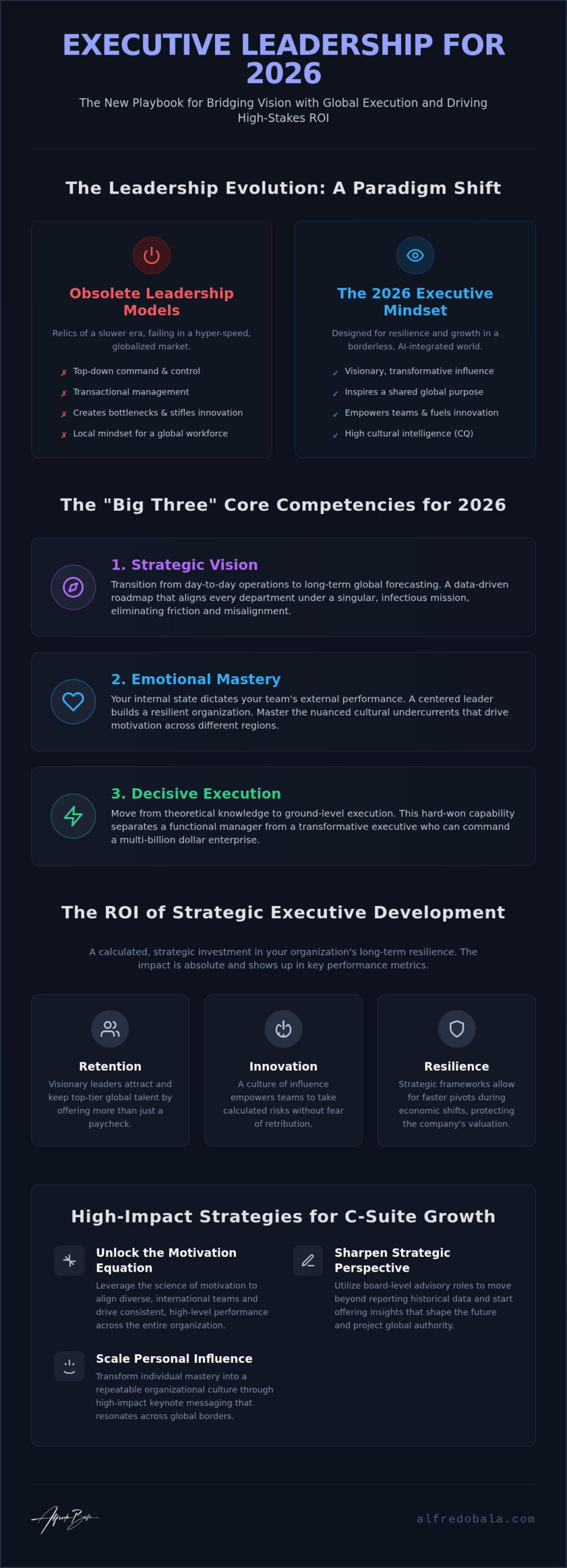
- Navigate the 2026 global landscape by mastering the “Big Three” competencies: Strategic Vision, Emotional Mastery, and Decisive Execution.
- Refine your executive leadership development strategies by leveraging board-level advisory roles to sharpen your strategic perspective and global authority.
- Unlock the science of the Motivation Equation to align diverse teams and drive consistent performance across complex, international organizations.
- Scale your personal influence into a repeatable organizational culture using high-impact keynote messaging that resonates across global borders.
The Evolution of Executive Leadership in a Globalized Market
Executive leadership development isn’t a luxury or a line item for the human resources department. It’s a calculated, strategic investment in your organization’s long-term resilience. As we look toward the landscape of 2026, the variables have changed. We’re operating in an environment defined by deep AI integration, a borderless remote workforce, and market shifts that happen at hyper-speed. In this context, the ability to adapt isn’t just a soft skill; it’s a survival mechanism for the modern CEO.
The link between an executive’s personal growth and the company’s bottom line is absolute. When you sharpen your strategic edge, you aren’t just improving yourself; you’re providing the clarity your entire organization needs to navigate volatility. Effective executive leadership development strategies must move away from the mechanics of management and toward the mastery of visionary influence. If you don’t grow, the business won’t scale. It’s a simple equation of potential versus performance.
Why Traditional Leadership Models Fail in 2026
Traditional top-down management is obsolete. In a globalized economy where talent is mobile and information is instantaneous, command-and-control structures create bottlenecks that stifle innovation. Many executives are still stuck in transactional models, focusing on oversight rather than transformation. This shift is where most leaders stumble. They rely on fluff-heavy training programs that offer abstract theories but fail to address the crushing pressures of the C-suite.
Stagnant leadership is a liability. If your leadership style hasn’t evolved to meet the demands of a diverse, global team, you’re likely losing your best people to more agile competitors. Success in 2026 requires a transition from managing tasks to inspiring a shared purpose across multiple time zones and cultures. You can’t lead a global workforce with a local mindset.
The ROI of Strategic Executive Development
Quantifying the impact of leadership isn’t as difficult as it seems. It shows up in your retention rates, your speed to market, and your ability to innovate under pressure. By building a robust leadership pipeline, you ensure that your organization can survive global market disruptions without losing momentum. High-level executive leadership development strategies focus on creating a culture of decisiveness and psychological safety.
- Retention: Visionary leaders attract and keep top-tier global talent by offering more than just a paycheck.
- Innovation: A culture of influence empowers teams to take calculated risks without fear of retribution.
- Resilience: Strategic frameworks allow for faster pivots during economic shifts, protecting the company’s valuation.
Executive development serves as the primary vehicle for sustainable scaling within a complex international marketplace.
Core Competencies: Beyond Management to Strategic Influence
Leading at the highest levels isn’t about checking boxes on a performance review. It’s about the “Big Three” competencies: Strategic Vision, Emotional Mastery, and Decisive Execution. These aren’t soft skills. They’re the hard-won capabilities that separate a functional manager from a transformative executive. In the context of 2026, where markets shift in seconds, your internal state dictates your team’s external performance. If you’re reactive, your organization becomes fragile. If you’re centered, your organization is resilient.
To command a room at the board level, you need gravitas. This seasoned authority isn’t just about what you say; it’s about the perspective you project. It involves moving beyond reporting historical numbers to offering advisory insights that shape the future. This level of influence requires high cultural intelligence (CQ). Leading a team in Shanghai requires a different nuanced approach than leading one in London or New York. Mastering these nuances is a core pillar of modern executive leadership development strategies. You must understand the cultural undercurrents that drive motivation in different regions to achieve true global alignment.
Mastering the Art of Strategic Vision
Elevate your gaze. You must transition from the comfort of day-to-day operations to the high-stakes world of long-term global forecasting. Strategic vision isn’t just a dream; it’s a data-driven roadmap that aligns every department under a singular, infectious mission. When you provide this level of clarity, you eliminate the friction of misalignment. Your strategy becomes a tool for precision, ensuring that every resource is deployed toward global growth. Decisions shouldn’t be based on gut feelings alone. They must be backed by rigorous analysis and a clear understanding of market shifts.
Emotional Intelligence as a Performance Driver
High-level leadership is 90% psychology and 10% mechanics. Your ability to manage executive stress during high-stakes negotiations is what maintains organizational clarity. If you lose your cool, the team loses its direction. Empathy isn’t a weakness; it’s the bridge that connects you to a multi-cultural workforce. By understanding the psychological drivers of your team, you can unlock levels of motivation that traditional management cannot reach. For those looking to deepen these insights, exploring leadership and team development insights can provide the necessary framework for this transition.
Developing these competencies requires a disciplined approach to personal mastery. You’re not just learning to manage others; you’re learning to master yourself. This internal work is the foundation upon which all external success is built. When you lead with vision and emotional clarity, you don’t just manage a company; you inspire a movement. It’s time to stop managing and start influencing.
High-Impact Strategies for C-Suite and Senior Leadership Growth
The view from the top is often solitary, but it shouldn’t be stagnant. True growth at the C-suite level requires a departure from traditional HR-led training. You need executive leadership development strategies that challenge your assumptions and force you to view your organization from a different altitude. This isn’t about learning how to manage. It’s about refining the mechanics of influence and the science of strategic decision-making in a world that doesn’t wait for consensus.
A critical component of this growth is cross-functional immersion. You can’t lead a global value chain if you don’t understand its ground-level mechanics. Whether it’s deep-diving into supply chain logistics in Asian markets or understanding the nuances of digital transformation in Europe, these experiences ground your vision in reality. This groundedness, combined with aggressive succession planning, ensures your leadership leaves a legacy that survives your tenure. You’re building a pipeline, not just a career. Understanding how to develop leadership in organizations as a disciplined, repeatable science is what separates executives who scale from those who stagnate.
Leveraging Board Advisory for Personal Growth
One of the most effective ways to sharpen your strategic edge is through board service. Serving on an external board provides an “outside-in” perspective that’s impossible to get within your own four walls. It exposes you to different corporate cultures, governance challenges, and market entry strategies without the immediate risk to your own firm. These advisory roles build the high-level network required for successful global expansion, allowing you to see around corners before your competitors do. It’s a laboratory for high-stakes problem-solving. Engaging a seasoned corporate board advisor who brings an external governance perspective can accelerate this development and provide the strategic clarity needed to navigate complex international markets.
Mentorship and Coaching for the C-Suite
When you’re at the top of the pyramid, finding objective feedback is difficult. Most people tell you what you want to hear, not what you need to know. This is why you must seek a mentor who fits the “success story” archetype; someone who’s already navigated the complex professional landscapes you’re currently facing. A seasoned veteran provides the clarity that a peer often cannot, acting as a bridge between your current capacity and your ultimate potential. The leadership lessons from top executives who have already walked this path offer an invaluable shortcut to closing that gap.
Integrating professional speaking into your development routine is another powerful tool. It forces you to distill your vision into a message that resonates globally. This process hones your public influence and builds the authority necessary to lead thousands of employees toward a unified goal. High-impact executive leadership development strategies recognize that your ability to communicate is your greatest leverage. You aren’t just a CEO. You’re the chief storyteller of your organization’s future, and that story must be told with conviction and precision.
Integrating the Motivation Equation into Your Development Roadmap
Potential is merely a baseline; performance is the result of a specific, repeatable formula. Incorporating the Motivation Equation into your executive leadership development strategies provides the bridge that most theoretical frameworks miss. It moves motivation from a vague, “feel-good” concept into a disciplined science of influence. When you lead a global organization, you can’t afford to guess what drives your people. You need a framework that works across cultures, time zones, and industries.
The Motivation Equation is the scientific approach to human drive, balancing three critical variables: Purpose, Precision, and Persistence. Purpose provides the “why” that fuels alignment across diverse teams. Precision ensures the “how” is crystal clear, removing the friction of ambiguity. Persistence is the grit required to maintain momentum when market conditions turn volatile. By auditing your leadership through these three lenses, you can identify exactly why a particular department is underperforming or why a high-stakes initiative has stalled. It is the ultimate diagnostic tool for the modern executive.
The Mechanics of Influence and Motivation
Traditional incentives like bonuses or stock options often fail to move the needle for high-performers in 2026. These leaders crave impact, mastery, and a sense of belonging to something larger than a balance sheet. If your executive leadership development strategies don’t account for these psychological drivers, you’ll struggle with retention in a borderless talent market. High retention isn’t bought; it’s earned through a culture of shared purpose and extreme operational clarity. When you master the mechanics of influence, you stop pushing people and start pulling them toward a shared vision.
Case Study: Scaling Global Teams with Targeted Motivation
Consider the challenge of scaling a multi-national entity through a period of hyper-speed market shift. Without a framework, organizational change often leads to burnout and a loss of momentum. By applying Precision to the new roadmap and reinforcing the Purpose behind the pivot, you provide the psychological safety your teams need to maintain Persistence. This isn’t theory. It’s a proven methodology used to align thousands of employees globally. You can find a deeper analysis of this framework and its real-world applications in The Motivation Equation book.
To see how these frameworks can transform your specific organizational culture, explore The Motivation Equation and begin auditing your leadership roadmap today. Mastery over human performance is the only sustainable competitive advantage in a globalized economy.
Scaling Leadership: From Individual Mastery to Organizational Culture
Scaling is the ultimate test of an executive’s legacy. It represents the shift from personal mastery to the creation of a repeatable, resilient organizational culture. You’ve spent years refining your own executive leadership development strategies, but the true measure of your success is how well those strategies survive without your direct intervention. To achieve global growth in 2026, you must turn your individual vision into a systemic reality that empowers every level of the company. It’s about moving from “I do” to “we are.”
A central tool in this transformation is the Keynote Message. This isn’t a mere corporate update or a scripted speech. It’s a strategic alignment mechanism designed to resonate across borders and cultures. When delivered with precision, the Keynote Message ensures that a manager in Singapore and a director in London are moving toward the same horizon with the same intensity. It’s the frequency that tunes the entire organization to your vision. Without this clarity, global teams drift into silos, and momentum is lost in the friction of misalignment. Engaging a keynote speaker for organizational growth who operates as a framework-driven practitioner — not just a motivational personality — is what transforms this alignment from a one-time event into a sustained strategic breakthrough.
Your leadership brand serves as a magnet for top-tier executive talent. High-performers don’t just look for a paycheck; they look for a mission led by someone who has mastered the duality of success as both a science and an art. By projecting a brand of seasoned authority and visionary guidance, you attract the very leaders who will help you scale. This brand isn’t built on fluff. It’s built on a foundation of proven results and a commitment to the growth of others.
Building a Culture of Continuous Leadership
Model the “1% Rule” to outperform larger, slower competitors. This rule isn’t about massive, overnight shifts; it’s about the compounding power of incremental, daily improvements in strategy and execution. When you commit to getting 1% better every day, you create a culture of relentless excellence. Empower your mid-level managers to think like C-suite executives by giving them the frameworks to make decisive, high-stakes decisions. Transparency and trust are the currencies of this scale. In a globalized market, you can’t oversee everything, so you must build a culture where integrity is the default setting.
Next Steps: Engaging a Visionary Guide
Accelerating your development requires more than just self-study. It requires the perspective of someone who has already navigated the highest echelons of international business. Professional speaking and advisory services provide the infectious energy and hard-won wisdom necessary to spark a transformation within your leadership team. Whether through a corporate board seat or a dedicated advisory role, a visionary guide acts as a bridge between your current results and your global potential. Don’t wait for the market to force your hand.
The transition from a senior executive to a global visionary is a deliberate journey. It requires a commitment to the mechanics of influence and a deep understanding of the Motivation Equation. Now is the time to move from learning to high-impact execution. Discover how Alfredo Bala can elevate your executive strategy and help you build a legacy of global growth that lasts for decades.
Command Your Global Future with Precision
The landscape of 2026 demands a leader who can navigate hyper-speed market shifts with the gravitas of a seasoned veteran. You’ve explored the transition from transactional management to visionary influence and the scientific application of the Motivation Equation. These frameworks aren’t just theories; they’re the mechanics of global expansion. By prioritizing core competencies like emotional mastery and strategic forecasting, you position your organization to thrive in a borderless economy where clarity is the ultimate competitive advantage.
Implementing sophisticated executive leadership development strategies is a continuous journey of personal and organizational refinement. To truly master this path, you need a guide who has already navigated the highest echelons of international business. Alfredo Bala brings over 40 years of mastery, including experience as a former global CEO and COO, to help you bridge the gap between potential and performance. As the author of ‘The Motivation Equation’, he provides the precise roadmap necessary to scale your influence across the globe and build a legacy that lasts.
Elevate your leadership with Alfredo Bala’s Executive Advisory and begin transforming your vision into high-impact execution today. The world is waiting for your leadership.
Frequently Asked Questions
What are the most effective executive leadership development strategies for 2026?
The most effective strategies for the 2026 landscape focus on high-impact frameworks that bridge the gap between AI-driven data and human-centric influence. You must prioritize executive leadership development strategies that move beyond traditional management into the realm of visionary influence and global cultural intelligence. This includes mastering cross-functional immersion and leveraging board-level advisory to gain the outside-in perspectives necessary for navigating hyper-speed market shifts.
How do I develop leadership skills as a senior executive?
Development at the senior level requires seeking feedback from those who have already navigated complex global landscapes. You can sharpen your edge by serving on external boards or engaging a success-story mentor who provides objective, high-stakes critiques. It’s a disciplined transition from operational oversight to strategic forecasting and personal mastery. You don’t just learn new tasks; you refine the mechanics of influence and the science of strategic decision-making. Studying the leadership lessons from top executives who have already made this transition can accelerate your own development significantly.
What is the difference between management and executive leadership development?
Management development centers on tactical execution and operational efficiency, while executive leadership development focuses on strategic influence and organizational culture. Management is about the mechanics of current tasks. Executive growth is about the science of future-proofing the entire organization. It requires a fundamental shift from “doing” to “inspiring” through a shared global vision that aligns thousands of employees across diverse regions.
How can a board advisory seat improve my leadership capabilities?
Serving on a board provides a laboratory for high-stakes problem-solving outside your own corporate walls. It exposes you to different governance models and market entry strategies, which sharpens your own strategic edge. This outside-in perspective allows you to see around corners and refine your internal corporate strategy with newfound global authority. It’s an essential strategy for any C-suite leader looking to build a robust international network. Working with a dedicated corporate board advisor can further amplify these benefits by providing targeted governance expertise and global strategic guidance.
Why is the Motivation Equation important for executive-level growth?
The Motivation Equation is the definitive tool for auditing leadership effectiveness and human performance. It replaces vague “soft skills” with a scientific framework consisting of Purpose, Precision, and Persistence. By applying this equation, you can troubleshoot underperforming departments and align diverse global teams with surgical precision. It provides the clarity needed to turn potential into consistent, high-impact performance across any organization.
How do I scale leadership across a global organization?
Scaling requires transforming your personal mastery into a repeatable organizational culture through high-impact keynote messaging. You must empower mid-level managers to think like C-suite executives by providing them with clear strategic frameworks. True scale is achieved when your leadership brand attracts top-tier talent and fosters a culture of transparency and trust across all borders. It’s about creating a system where your vision survives without your direct intervention.
What is the ROI of executive leadership training for the C-suite?
The ROI of strategic executive leadership development strategies is measured in improved retention, faster innovation cycles, and organizational resilience. When you invest in C-suite growth, you’re building a leadership pipeline that survives global market disruptions. This strategic investment directly impacts the company’s bottom line by reducing the friction of misalignment and accelerating speed to market. It’s a calculated move for long-term organizational health.
How does a keynote speaker help with organizational growth and development?
A seasoned keynote speaker acts as a catalyst for organizational alignment by distilling complex visions into infectious, memorable messages. They bring hard-won wisdom and a global perspective that inspires trust and sparks immediate momentum within your team. This external authority helps bridge the gap between high-level corporate strategy and individual ambition. By providing a unified frequency, they tune the entire organization to your growth objectives. To understand how to select the right keynote speaker for organizational growth who delivers lasting strategic impact rather than a temporary emotional high, it’s essential to prioritize practitioners who ground their message in proven frameworks.
 EN
EN  ES
ES
Recent Comments