
What if the best way to protect results is to stop checking every step? When deadlines are tight or the work matters, delegating can feel risky. Yet constant updates and corrections can pull managers into the details while leaving team members with less room to take ownership. Learning how to stop micromanaging your team isn’t about lowering standards or walking away. It’s about making accountability clear enough that you don’t have to hover.
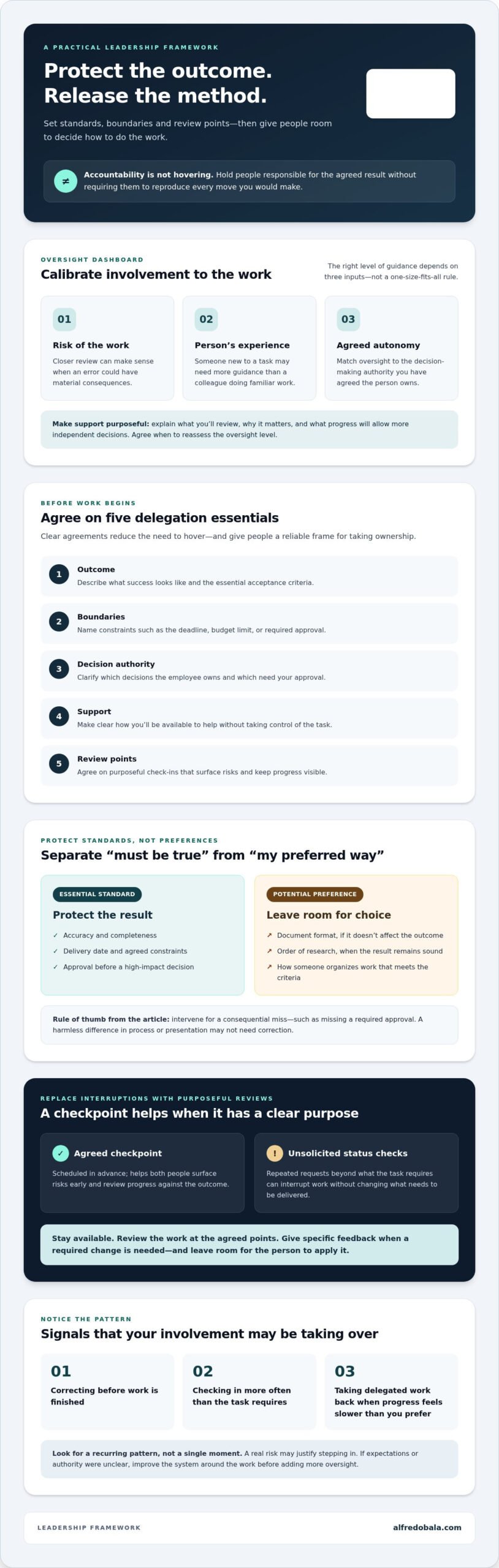
You can stay close to the outcome without controlling every move. Start before work begins: agree on what success looks like, clarify boundaries, and give people authority to choose how they get there. Then replace interruptions with purposeful check-ins that surface risks early and keep progress visible.
In this practical 2026 guide, you’ll learn how to set expectations, match oversight to the work, and build a team that raises concerns and takes responsibility. Al Bala’s leadership perspective, including ideas in The Motivation Equation, emphasizes practical ways to develop ownership while keeping standards and results in view.
Key Takeaways
- Recognize when involvement has become unnecessary control, while staying available to support the work.
- Protect standards by distinguishing essential outcomes and risks from personal preferences about how tasks get done.
- Learn how to stop micromanaging your team by agreeing on the outcome, boundaries, decision-making authority, support, and review points before work begins.
- Test a lighter approach with one recurring task, tracking your interventions, planned check-ins, and results.
- Build lasting ownership through consistent leadership: set direction, clarify responsibility, and review outcomes without taking control back.
How to Stop Micromanaging Your Team Starts with Recognizing the Pattern
You want dependable work, especially when deadlines are tight or a mistake could have serious consequences. That responsibility can make it tempting to monitor every step. But involvement becomes micromanagement when you exert unnecessary control over how someone completes an agreed task, rather than setting direction, staying available, and reviewing the result. For a foundational overview of understanding micromanagement, consider how excessive oversight differs from constructive leadership.
Start with an honest self-check. Do you repeatedly correct work before it’s finished, ask for updates more often than the task requires, or take delegated assignments back when progress feels slower than you prefer? One incident may be a response to a real risk. A recurring pattern deserves attention. The goal isn’t to label yourself; it’s to see where your actions may be limiting the ownership you want your team to develop.
Unnecessary oversight can make people less willing to make decisions or raise ideas if they expect their judgment to be overridden. It can also slow work: every extra approval or correction adds a step. Over time, a capable employee may doubt their judgment while you become a bottleneck. These effects aren’t inevitable, but they’re useful signals to watch for.
What does micromanaging look like in everyday work?
The distinction often comes down to whether oversight was agreed on and serves a clear purpose. A scheduled checkpoint can help both people catch risks early. Repeated, unsolicited status requests may interrupt the work without changing what needs to be delivered.
Standards are necessary; personal preferences aren’t automatically standards. You can require a report to be accurate, complete, and submitted on time without insisting that every employee organize their research exactly as you do. Rewriting a colleague’s draft line by line may feel efficient, but if it meets the agreed criteria, taking over can erase the responsibility you delegated. Give specific feedback, explain any required change, and leave room for the person to apply it.
Why do capable leaders fall into micromanagement?
Often, it begins with pressure, not bad intent. A high-stakes deadline, a previous mistake, or uncertainty about whether expectations were understood can prompt a manager to step in early. Delegation may also be unclear. If an employee doesn’t know which decisions they own, the manager may keep answering questions that could have been settled in advance.
Notice your own trigger before trying to change every habit at once. Ask yourself:
- Which tasks make me check in before the agreed review point?
- What am I afraid might go wrong, and is that risk real or a preference for control?
- Have I explained the result, constraints, and decision-making authority clearly?
These questions turn self-awareness into useful information. If you spot a pattern, improve the system around the work instead of blaming yourself or your team. That’s a practical first step in learning how to stop micromanaging your team while still taking responsibility for results.
Why Letting Go Feels Risky, and How to Protect Standards
Stepping back doesn’t mean lowering the bar. It means holding people accountable for the result without requiring them to reproduce every move you would make. The distinction matters: standards protect the work, while unnecessary control restricts how capable people contribute to it.
Before delegating, separate what must be true from what is simply your preferred way of working. Non-negotiables might include an accurate analysis, a delivery date, a budget limit, or approval before a high-impact decision. Your preferred document format or order of research may be flexible if it doesn’t affect the outcome. Define the boundary, then give the employee room to work within it.
Effective oversight means setting clear expectations and following through in proportion to the work’s risk, the person’s experience, and the autonomy you’ve agreed on. This principle addresses the concern behind how to stop micromanaging your team: you don’t have to choose between hovering and disappearing. You can calibrate your involvement. For further perspective on empowering leadership strategies, see Harvard Business Review’s guidance on shifting toward employee empowerment.
When is closer supervision useful rather than controlling?
Closer guidance can be appropriate when someone is new to a task, learning a process, or handling work with material consequences if it goes wrong. Make the support purposeful and transparent. Explain what you’ll review, why it matters, and what signs of progress will allow the person to make more decisions independently.
For example, a first-time project lead may need an early review of the plan, while an experienced colleague handling familiar work may only need a checkpoint before delivery. In either case, don’t let temporary support quietly become permanent control. Agree when you’ll reassess the level of oversight, and make growing autonomy part of the plan.
How can managers protect quality without demanding perfection?
Set acceptance criteria before work starts. Describe the essential standard, deadline, constraints, and any decisions that require your approval. A consequential error, such as missing a required approval, calls for intervention. A harmless difference in how someone organizes or presents their work may not.
Then match reviews to the risks. Check an early decision that could affect the whole project rather than requesting updates on every task. At each checkpoint, focus on three questions: Is the work on track? Has a meaningful risk emerged? Does the employee need a decision or resource from you? This keeps attention on outcomes and problems that warrant action, not details that simply differ from your approach.
Standards become stronger when people understand them and can meet them without waiting for constant correction. To deepen your approach to purposeful, ownership-centered leadership, explore Al Bala’s practical leadership insights.
How to Replace Micromanagement with Clear Delegation and Check-Ins
Delegation works best as a clear agreement, not a vague handoff followed by a stream of corrections. Before work begins, align on the destination, the limits, and how you’ll stay connected. This gives the employee room to act while keeping you responsible for the conditions that matter. Use this sequence to make the agreement practical:
- Define the outcome. Describe what needs to be delivered, by when, and what quality looks like. For example, specify that a client proposal must be accurate, complete, and ready for review by Friday, rather than prescribing every step used to prepare it.
- Set the boundaries. Clarify relevant constraints, such as budget, required approvals, or decisions that could affect another team. Boundaries should protect the work, not dictate every preference.
- Agree on authority. Name which decisions the employee can make independently and which require escalation. They might choose the format and divide research tasks, while checking with you before changing the scope or committing resources.
- Offer support. Make clear what information, tools, or guidance you can provide. Ask what the person needs to get started, then let them take the lead rather than repeatedly stepping in with unsolicited instructions.
- Set review points. Choose checkpoints tied to meaningful milestones or decisions. Agree on when you’ll reconnect and what should be ready to discuss, so neither person has to guess when an update is expected.
What should a manager clarify before delegating?
Turn the agreement into a short conversation, not a one-way briefing. Summarize the result, deadline, quality standard, and constraints, then ask the employee to explain how they understand their decision-making authority. This gives you a chance to resolve ambiguity before it becomes repeated approval requests. Close by confirming the support available and the next scheduled check-in.
How do useful check-ins differ from constant monitoring?
A useful check-in has a purpose: uncover a blocker, make a decision, or assess progress against an agreed milestone. Invite the employee to lead with what’s on track, what risks need attention, and what support they want. Instead of asking, “What have you done since I last checked?” try: “Are you on track for our milestone, and is there a decision or support you need from me?”
If there’s no emerging risk or decision to make, let the person continue working. If a concern arises, focus on what changed and what response is needed, rather than taking the task back. This balance is central to how to stop micromanaging your team: establish clarity, remain accessible, and follow through at the agreed points. For a broader perspective on executive leadership development strategies, connect delegation with the wider practice of developing capable, accountable teams.
A Practical Plan to Stop Micromanaging Your Team One Habit at a Time
Change a pattern through practice, not a sweeping promise to “let go.” Choose one recurring, manageable task with a clear result, such as preparing a routine report or coordinating a regular team update. Agree on the boundaries, decisions the employee can make, support available, and a milestone for reviewing progress. Keep the experiment focused so you can learn from what happens without putting critical work at risk.
During the experiment, keep a simple record. Note when you intervene, whether the contact was planned or prompted by concern, and what happened at the agreed review point. This isn’t a scorecard for the employee. It helps you see whether your involvement is becoming more purposeful and whether the task is meeting its standards.
- Interventions: What prompted you to step in, and was your input necessary?
- Check-ins: Did you follow the agreed milestone or request extra updates?
- Outcomes: Was the work completed to the expected standard and timeline?
- Team feedback: What information or support would help the employee do their best work?
Ask that last question directly. Your team may need faster access to information, clearer priorities, or a predictable point to raise concerns. Listening helps you improve the conditions for ownership instead of assuming more monitoring is the answer. Trust and responsibility also matter in team retention strategies, because people need room to contribute as well as direction.
How can you practice stepping back without losing visibility?
Replace one habitual status request with the milestone review you agreed on. If you feel the urge to take over, pause and ask, “What support would help you move this forward?” At the review, assess the result against the agreed outcome, not whether the employee used your preferred approach. That pause preserves visibility while giving the person a chance to exercise judgment.
At the end of the experiment, compare your notes with the expectations you set. Did the employee know when to escalate? Were your planned check-ins enough to surface risks? Did you intervene because a standard was at stake, or because the process looked unfamiliar? These observations give you specific evidence for adjusting your next delegation.
How should managers respond when the new approach needs adjustment?
If expectations were missed, discuss the facts without turning one setback into a verdict on the employee or the whole approach. Identify the specific gap, refer to the agreed standard, and ask what got in the way. Then decide together whether the next assignment needs clearer boundaries, more support, or a different review cadence.
Delegation is a working agreement, and agreements can be refined. A missed checkpoint may reveal that the milestone was poorly timed or that a decision boundary was unclear. Treat that as useful feedback, not proof that you must reclaim control. For more practical leadership guidance, explore Al Bala’s leadership insights. Noticing, adjusting, and giving ownership is how to stop micromanaging your team one habit at a time.
Build Team Ownership Through Consistent, Motivating Leadership
Ownership grows through what a leader does repeatedly, not through a one-time announcement about changing their management style. Set a clear direction, make responsibility visible, honor the decisions you’ve delegated, and stay available when help is needed. Then review the work against agreed outcomes. Each action reinforces that people are trusted to contribute and accountable for what they own.
Consistency matters because teams learn from patterns. If you agree that an employee can make a decision independently, avoid overriding it simply because you’d choose differently. If you set a check-in, keep it and use it for its intended purpose. Trust becomes credible when your everyday behavior matches the authority you’ve granted.
How does trust become a repeatable leadership practice?
Notice and recognize sound judgment, not only successful outcomes. An employee may make a well-reasoned decision that doesn’t produce the result you hoped for; discussing their thinking can still reinforce initiative and reveal useful lessons. Recognition doesn’t mean ignoring mistakes. It means distinguishing thoughtful effort from carelessness and responding to each with appropriate feedback.
Make reflection part of your routine, too. After a project or milestone, ask yourself whether you honored decision rights, kept the agreed check-ins, and stepped in only when the work called for it. Ask the employee what helped and what made ownership harder. If you find yourself returning to old habits, identify the trigger and adjust the working agreement rather than relying on willpower alone. That’s how to stop micromanaging your team as a sustained leadership practice, not a temporary intention.
Where can leaders continue developing their approach?
Leadership development takes continued attention. The Motivation Equation is a practical manual with real-world examples, proven strategies, and tools for personal achievement and team leadership. Use it as a resource for reflection and further learning, while adapting your approach to the people and work in front of you. Leaders can also draw on Alfredo Bala’s professional speaking and executive advisory work for leadership insights.
Return to the fundamentals: give direction without dictating every move, clarify who owns each decision, and make your support dependable. Then notice whether people are taking responsibility and raising concerns early. Progress may take patience, especially if the team is accustomed to seeking approval for every choice. Hold the standard, keep listening, and let consistent actions demonstrate that autonomy is real.
For practical perspectives on leadership and team development, explore Alfredo Bala’s leadership insights.
Make Your Next Leadership Move Count
Choose one upcoming assignment and make your next leadership move deliberate: give someone clear ownership, then resist the urge to reclaim it simply because their approach differs from yours. The aim isn’t to step away from accountability. It’s to create the conditions for your team to exercise judgment, learn, and deliver while you remain available when your guidance is needed.
That shift takes practice. Each time you clarify expectations, honor a decision boundary, and follow through on an agreed review, you strengthen a more sustainable way to lead. If you’re considering how to stop micromanaging your team, focus on the next interaction, not a perfect transformation. Consistent actions build the trust that declarations alone cannot.
Al Bala’s leadership perspective draws on experience that includes serving as COO of Britt Worldwide and CEO of Mannatech Inc. His book, The Motivation Equation, is a practical manual featuring real-world examples and proven strategies for personal achievement and team leadership. Use these ideas to reflect on how you set expectations, develop ownership, and guide a team.
Explore Alfredo Bala’s leadership insights and take your next step with confidence. Your team’s ownership can grow one purposeful decision at a time.
Frequently Asked Questions
Is micromanaging ever appropriate?
Close oversight can be appropriate when a task is unfamiliar, a person is learning, or a mistake could create serious consequences. Keep that attention focused on the specific risk. For example, review a new employee’s first customer-facing report before it’s sent, then agree on what they can handle independently next time. Closer supervision should have a clear purpose and be revisited as the employee gains experience.
Can you stop micromanaging overnight?
You can change a behavior immediately, but rebuilding a dependable management rhythm usually takes practice. Start by noticing the moment you’re about to intervene and deciding whether your input is necessary now. Tell your team what you’re changing, invite honest feedback, and follow through on the new approach. If you slip into an old habit, acknowledge it and reset. Progress comes from repeated actions, not a single declaration.
How can I tell whether a check-in is helpful or micromanaging?
A helpful check-in gives the employee space to explain progress, raise a concern, or request a decision. Ask whether the conversation changes something: does it remove an obstacle, clarify a choice, or address a real risk? If not, the check-in may be unnecessary. Notice whether the employee can return to focused work afterward, rather than feeling they must continually prove they’re working.
What should I do if an employee asks for more direction?
Give the direction they need, then find out what uncertainty is behind the request. They may need a priority clarified, an example of the expected result, or help choosing between options. Be specific without taking over: explain the principle behind your recommendation and ask the employee to propose the next step. As their confidence grows, agree on which similar decisions they can make without checking first.
Can micromanaging affect a manager’s own workload?
Yes. Reviewing routine details, responding to constant requests for approval, and correcting work that already meets the standard can consume time meant for planning, coaching, or complex decisions. The pattern can also make the manager a bottleneck: work waits for their input, so more tasks arrive for review. A practical step in how to stop micromanaging your team is to track where your attention goes and identify approvals that could be delegated.
How do I rebuild trust after micromanaging my team?
Start with a direct, brief acknowledgment: explain that your oversight has sometimes limited people’s room to make decisions, and say what you’ll do differently. Then demonstrate the change by honoring agreed responsibilities and avoiding surprise interventions. Invite team members to tell you when your actions don’t match your intention, and listen without arguing. Trust may take time to return, so focus on being consistent rather than asking the team to trust you immediately.
 EN
 ES
Recent Comments