
Did you know that in 2026, U.S. employee engagement has hit a ten-year low of just 31%? While you likely study simon sinek leadership principles to bridge this gap, the transition from “Start With Why” to hitting quarterly KPIs often feels like an impossible leap. You recognize the brilliance of the Golden Circle, yet you’ve faced the friction of maintaining a Circle of Safety when global sales targets are looming. I’ve stood where you are, balancing the need for an inspirational purpose with the cold reality of a global balance sheet.
Master these core tenets by moving beyond high-level theory and into a high-performance executive framework. This article promises to provide a concrete roadmap for infinite-mindset leadership that actually delivers results. We’ll explore how to integrate Sinek’s philosophy with the practical mechanics of the Motivation Equation, ensuring your organizational vision finally aligns with individual performance to drive higher team retention and motivation.
Key Takeaways
- Move beyond the foundational “Why” to implement a biological framework that resonates with the shifting expectations of the 2026 workforce.
- Replace the finite obsession with being “Number 1” with five essential practices designed for strategic resilience in volatile global markets.
- Master the practical application of simon sinek leadership principles by using the Motivation Equation to engineer a high-performance Circle of Safety.
- Learn a methodical approach to auditing your “Just Cause” for cultural relevance and scaling it across decentralized international teams.
- Discover how board-level strategy acts as the bridge between inspirational theory and sustainable, multi-billion dollar results.
Beyond the Golden Circle: Why Sinek’s ‘Why’ is Only the Starting Line
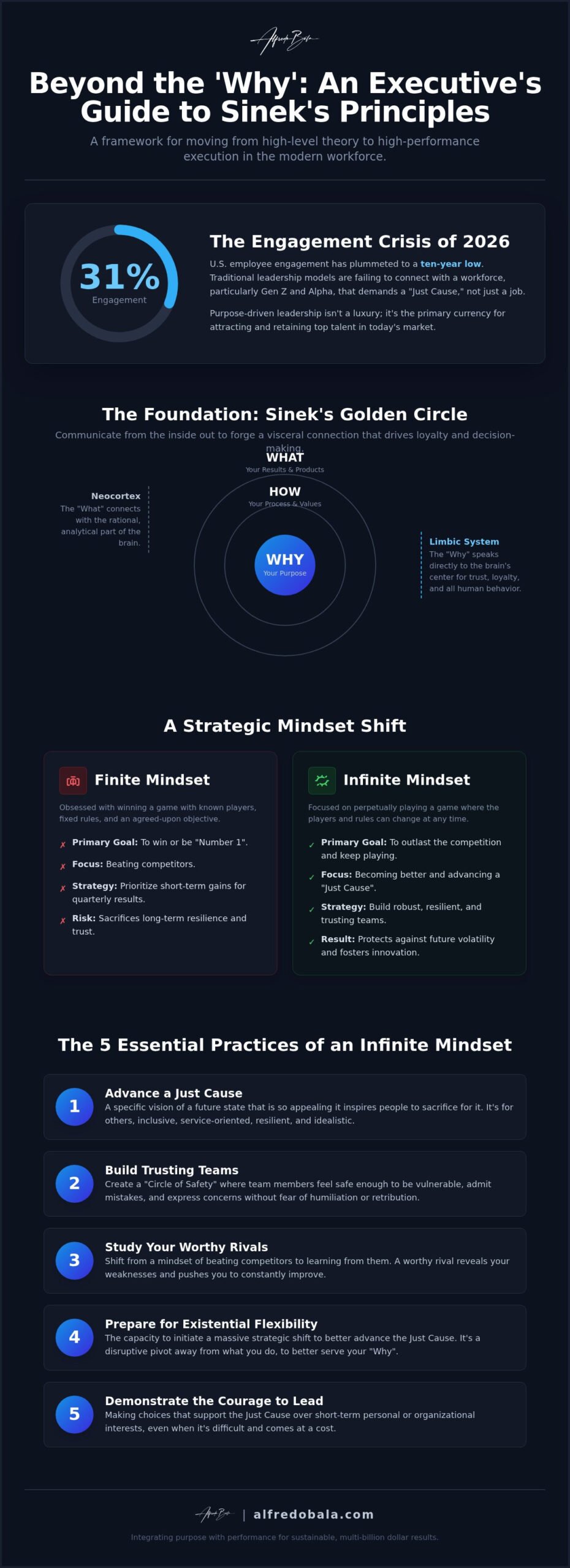
Look at the core of any enduring organization and you’ll find a clear sense of purpose. Simon Sinek’s Golden Circle, consisting of Why, How, and What, isn’t just a marketing gimmick; it’s a biological imperative. By communicating from the inside out, leaders speak directly to the limbic system, the part of the brain responsible for all decision-making and loyalty. Understanding simon sinek leadership principles at this level allows an executive to bypass the analytical neocortex and forge a visceral connection with their team. It’s the difference between a workforce that shows up for a paycheck and one that shows up to change the world.
In 2026, this connection is more than a “nice to have.” With U.S. employee engagement at a ten-year low of 31% according to Gallup, purpose-driven leadership has become the primary currency for attracting Gen Z and Alpha talent. These cohorts don’t just want a job; they demand a “Just Cause.” However, a common executive pitfall is stopping at the “Why.” Purpose provides the direction, but without a rigorous framework for execution, organizations suffer from strategic drift. To bridge this gap, vision must be paired with the mechanics of human drive found in The Motivation Equation. Vision sets the destination, but motivation provides the fuel for the journey.
Defining the Golden Circle for Global Executives
For the modern C-suite, the Golden Circle serves as a high-precision filter. It’s about ensuring that every board-level decision and every new hire aligns with the core mission. Mastering simon sinek leadership principles requires a shift from abstract theory to disciplined application. When the “Why” is articulated clearly, it naturally repels misaligned talent before they ever reach the boardroom. This isn’t just about culture; it’s about operational efficiency. Leaders who master these principles spend less time managing internal friction and more time scaling global impact because their teams are biologically wired for the same goal.
The Authenticity Gap in Modern Leadership
Authenticity is the bedrock of what Sinek calls the “Circle of Safety.” In a transparent digital age, employees can spot a marketing-driven “Why” instantly. There’s a massive difference between a mission statement on a lobby wall and a leadership “Why” that dictates behavior during a market pivot. You can’t fake the gravitas required to lead through a crisis. Genuine purpose acts as a stable compass during global volatility. It provides the courage to lead through uncertainty, ensuring that trust remains intact even when KPIs are under pressure. Without this authentic core, the “How” and “What” of your business will eventually crumble under the weight of cynicism.
The Infinite Mindset: Navigating Global Complexity in 2026
Stop trying to be “Number 1.” In the shifting landscape of 2026, the obsession with winning a game that has no finish line is a strategic trap. Business isn’t a football match; there are no winners or losers, only those who drop out because they lack the resources or the will to stay in. Adopting simon sinek leadership principles, specifically the Infinite Mindset, allows you to shift focus from beating competitors to outlasting them. This requires mastering five essential practices: a Just Cause, Trusting Teams, a Worthy Rival, Existential Flexibility, and the Courage to Lead.
When you view global competitors as Worthy Rivals rather than enemies to be destroyed, you stop reacting and start innovating. In 2026, this perspective is vital for navigating complex international regulations and AI-driven market shifts. Pitching this to a board focused on quarterly dividends requires a shift in language. You aren’t asking them to ignore the numbers; you’re showing them how an infinite mindset protects those numbers against future volatility. It’s about building a company that is robust enough to survive the leader, the product cycle, and the current economic climate.
Finite vs. Infinite Leadership: A Strategic Comparison
Short-term “spreadsheet” cultures often prioritize immediate gains at the expense of long-term resilience. While finite leaders focus on beating the competition, infinite leaders use their rivals as benchmarks for self-improvement. In 2026, your worthy rival might be a tech-disruptor or a global supply chain shift that forces “Existential Flexibility,” which is the ability to pivot your entire business model to stay true to your Just Cause.
| Metric | Finite Mindset | Infinite Mindset |
|---|---|---|
| Primary Goal | Beating the competition | Advancing the Just Cause |
| Success Window | Quarterly/Annual KPIs | Generational longevity |
| Team Culture | Performance through fear | Innovation through trust |
Developing the Courage to Lead
Leading with an infinite mindset requires more bravery than traditional management because it often means making decisions that won’t pay off in the next ninety days. It’s about investing in people when the numbers suggest cutting costs. This long-term vision is precisely what drives team retention in an era of record-low engagement. By implementing executive leadership development strategies focused on resilience, you ensure your organization doesn’t just survive volatility; it thrives on it. If you’re ready to move beyond theory, consider how a board-level advisory session can help you translate these concepts into a concrete strategy for your stakeholders.
Leaders Eat Last: Engineering a ‘Circle of Safety’ through The Motivation Equation
Trust isn’t a soft skill; it’s a hard biological asset. When you study simon sinek leadership principles, you quickly realize that the “Circle of Safety” is the prerequisite for any high-performance culture. In a world where 17% of U.S. employees are actively disengaged as of mid-2026, the leader’s primary role is to manage the neurochemistry of the room. When a team feels threatened by internal politics or job insecurity, their brains are flooded with cortisol. This stress hormone shuts down the parts of the brain responsible for creativity and cooperation. To lead effectively, you must replace that fear with a sense of belonging.
Engineering this safety requires more than just a kind word. It demands a systematic approach to human drive. While Sinek provides the conceptual “Why” for safety, The Motivation Equation provides the variables to catalyze it. You have to balance the gravitas of your executive position with the vulnerability required to build genuine trust. By “eating last,” you signal to your team that their security is your priority. This selfless act triggers the release of oxytocin, the chemical foundation of loyalty, allowing your global team to focus their energy on external market challenges rather than internal survival.
The Neurochemistry of Trustworthy Teams
Success in 2026 relies on mastering the “EDSO” framework: Endorphins, Dopamine, Serotonin, and Oxytocin. Endorphins and Dopamine drive individual achievement, but Serotonin and Oxytocin are the “social” chemicals that build the Circle of Safety. The Motivation Equation provides the specific triggers to stimulate these social bonds, even in remote or hybrid environments. To “eat last” digitally, prioritize one-on-one coaching and public recognition of effort over results. This validates the individual’s contribution to the tribe, reinforcing the biological drive to perform for the collective good.
Eliminating the ‘Internal Danger’
Internal silos and toxic office politics are breaches in your Circle of Safety. When these exist, innovation dies because people are too afraid to take risks. As a leader, you must act as a shield, protecting your organization from the “noise” of external market volatility and board-level pressure. By fostering internal security, you give your team the freedom to fail, which is the only path to true innovation. Simon sinek leadership principles emphasize that when the danger is outside, the team naturally pulls together. Your job is to ensure the danger never comes from within your own walls.
From Theory to the Boardroom: Implementing Sinek’s Principles in Global Sales
Scaling a vision across a multi-national sales force is where most executives stumble. It’s easy to “Start With Why” in a small boardroom, but maintaining that signal across thousands of decentralized representatives requires a rigorous execution plan. Implementing simon sinek leadership principles at scale isn’t about repeating a slogan. It’s about auditing your Just Cause for cultural resonance in every international market. A purpose that inspires a team in Dallas might require a different narrative lens to motivate a team in Seoul or Berlin. Without this cultural bridge, your “Why” becomes white noise.
Transformation begins by redefining the role of mid-level management. These individuals must transition from being “Task Masters” who obsess over daily activity to “Trust Officers” who prioritize the Circle of Safety. Their primary KPI should be the psychological security of their teams. Reinforce this shift by implementing peer-to-peer recognition systems that reward behaviors aligned with your core values rather than just the bottom line. Finally, track your progress by measuring a “Safety Score.” Use qualitative feedback to determine if your people feel safe enough to admit mistakes. If they don’t, your organizational growth is already hitting an invisible ceiling.
Leadership in Decentralized Organizations
In environments where you lack direct oversight, traditional command and control structures are useless. This is especially evident in network marketing leadership, where your workforce consists of independent entrepreneurs. You can’t force these individuals to care about your vision; you must inspire them to adopt it as their own. Moving from “Command” to “Empower” requires consistent, high-level storytelling. Every communication from the executive suite must re-anchor the global “Why,” ensuring that even the most distant representative feels like a vital part of the tribe.
The Role of the Keynote Speaker in Cultural Transformation
Sometimes the organizational signal becomes weak due to rapid growth or market shifts. A professional keynote speaker acts as a strategic catalyst to re-anchor the team to their Just Cause. A high-impact session can shift a sales force from finite, cut-throat competition to infinite collaboration. However, a speech is only the beginning. To truly bridge the gap between theory and the boardroom, you need a long-term advisory strategy that aligns your vision with the Motivation Equation. If you’re ready to drive this level of change, contact me today to discuss a board-level advisory role for your organization.
The Executive Edge: Why Your Organization Needs a Visionary Guide
Reading a book is a passive act; leading a multi-billion dollar entity is an active battle. While simon sinek leadership principles provide a brilliant conceptual map, the terrain of a global organization is fraught with complexities that theory alone cannot solve. You need more than an inspirational quote on a slide. You need the gravitas of a veteran who has navigated the storms of market volatility and emerged with a proven methodology. The gap between understanding a “Why” and executing it across diverse global markets is where most leaders falter. Bridging that gap requires a synthesis of vision, an infinite mindset, and the precise mechanics of The Motivation Equation.
True leadership legacy isn’t about what you achieve during your tenure; it’s about what continues to thrive after you’ve left the room. Building an organization that outlasts the individual requires a shift from personality-driven leadership to principle-centered governance. When you align organizational vision with individual performance, you create a self-sustaining ecosystem of high achievement. This synergy ensures that your “Just Cause” remains the North Star, even when the economic winds shift or the competitive landscape becomes unrecognizable.
The Strategic Advantage of Board Advisory
Institutionalizing an infinite mindset requires more than a cultural initiative; it requires board-level discipline. A corporate board advisor serves as the vital guardian of this vision, especially during high-stakes transitions like mergers, acquisitions, or IPOs. In these high-pressure moments, the temptation to pivot toward a finite, short-term focus is immense. An advisor acts as a mentor to the CEO and a shield for the organizational culture, ensuring that the “Just Cause” remains non-negotiable. This level of strategic oversight is what separates companies that flash in the pan from those that dominate their industries for generations.
Final Call to Action: Mastering Your Motivation
Transitioning from a manager to a visionary leader is the most significant leap you’ll ever take. It’s the move from counting value to creating it. By integrating simon sinek leadership principles with the practical variables of The Motivation Equation, you gain the final piece of the leadership puzzle. You don’t just inspire people; you provide them with the fuel to sustain that inspiration indefinitely.
Don’t leave your organizational culture to chance. Whether you’re looking for a keynote speaker to re-anchor your global team or a board-level advisor to drive strategic growth, the path to elevation starts with a conversation. Contact me today to discuss how we can implement these high-performance frameworks within your executive suite and build a legacy of excellence that resonates across the globe.
Mastering the Evolution of Your Leadership Legacy
You’ve moved beyond the static definitions of management. You now hold the blueprint to bridge the gap between inspiration and execution. While simon sinek leadership principles provide the vital spark of purpose, your success in 2026 depends on your ability to operationalize that vision through an infinite mindset and a robust Circle of Safety. True leadership isn’t found in a book; it’s forged in the boardroom through the disciplined application of human motivation and strategic resilience.
As the author of The Motivation Equation and a former Global CEO with decades of experience scaling high-performance teams, I’ve seen firsthand how these frameworks transform disengaged workforces into visionary powerhouses. It’s time to move from being a manager of tasks to a guardian of culture. Elevate your organization’s leadership with Alfredo Bala’s executive advisory and keynote speaking. The journey to an infinite legacy starts with a single, decisive step toward mastery. Your team is waiting for the leader you are meant to become. Embrace the challenge and lead with the clarity of experience.
Frequently Asked Questions
What are Simon Sinek’s 5 leadership lessons?
The core lessons from Sinek’s “The Infinite Game” include advancing a Just Cause, building Trusting Teams, studying your Worthy Rivals, preparing for Existential Flexibility, and demonstrating the Courage to Lead. These lessons are the bedrock of simon sinek leadership principles, moving beyond mere management to visionary stewardship. They challenge executives to stop playing to win and start playing to outlast. By prioritizing these five pillars, you build an organization capable of navigating the complex global shifts expected in 2026.
How do I find my organization’s ‘Why’ if we are already established?
Finding your “Why” in an established company requires an “Origin Story” audit rather than an invention. Look back at the founding moments or the times when your team felt most proud of their impact. Your purpose already exists in your history; you just need to articulate it. It’s about identifying the specific contribution you make to the world that would be missed if your company vanished tomorrow. This process re-anchors your team to their fundamental mission.
Can the Infinite Mindset work in a company with strict quarterly targets?
Yes, but it requires a shift in how you view those targets. Quarterly numbers are milestones, not the destination. An infinite-minded leader uses these metrics to gauge the health of the organization while keeping the “Just Cause” as the primary focus. You don’t ignore the numbers; you simply refuse to sacrifice the long-term health of your people or your vision to hit a short-term spreadsheet goal. This resilience actually leads to more sustainable growth over time.
What does ‘Leaders Eat Last’ actually mean in a corporate setting?
In a corporate environment, this means the leader takes the risk first and the credit last. It manifests as an executive who refuses to lay off staff during a downturn just to protect their own bonus. It’s about creating a culture where the team knows their leader will sacrifice their own comfort for the safety of the group. This selfless behavior is what triggers the oxytocin needed for high-performance loyalty and deep organizational trust.
How do Sinek’s principles differ from traditional management theories?
Traditional management often relies on “Command and Control” structures and finite goals. In contrast, simon sinek leadership principles are rooted in biology and long-term resilience. While old theories focus on “What” you produce and “How” you beat the competition, Sinek focuses on “Why” you exist and how you build trust. This shift moves the executive’s role from being a taskmaster to becoming a visionary guide for the tribe, fostering innovation rather than just compliance.
What is the ‘Circle of Safety’ and how do I build one?
The Circle of Safety is an environment where employees feel safe from internal threats like backstabbing or unfair firing. You build it by demonstrating empathy, transparency, and consistent support. When people feel safe inside the organization, they naturally pool their energy to face external market challenges together. It requires a leader to act as a shield, ensuring that the pressure of the market doesn’t turn into internal toxicity that kills creativity and team performance.
Is Simon Sinek’s leadership style suitable for all industries?
Human biology is universal, so these principles apply to any industry that involves people. Whether you’re leading a tech startup or a global sales force, the need for trust and purpose remains constant. While the “What” of your business changes, the “Why” and the “How” of human cooperation do not. High-pressure environments especially benefit from these strategies as they reduce the burnout caused by high cortisol levels and increase the collective drive for achievement.
How does the Motivation Equation complement Sinek’s principles?
If Sinek provides the “Why” and the “What” of leadership, the Motivation Equation provides the “How” of execution. It offers a practical framework to quantify and catalyze human drive within the Circle of Safety. By combining these philosophies, you move from abstract theory to a concrete system for motivating global teams. It’s the tool that allows an executive to translate inspirational vision into sustainable, high-performance results across any culture, ensuring the mission is met with consistent action.
 ES
ES  EN
EN
Comentarios recientes