
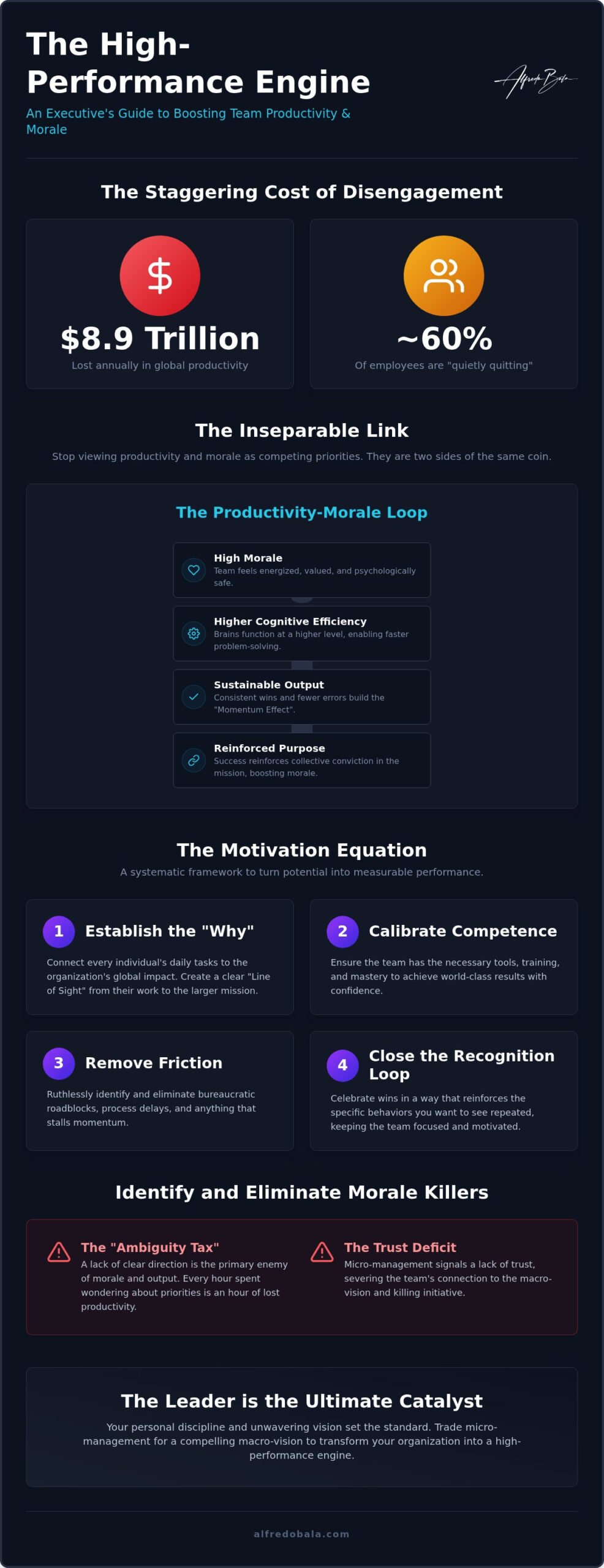
Did you know that disengagement costs the global economy a staggering $8.9 trillion annually in lost productivity? With nearly 60 percent of employees currently “quietly quitting,” the challenge of improving team productivity and morale has become the ultimate test for the modern executive. You’ve likely felt the mounting friction of demanding world-class results while watching your key talent drift toward the exit. It’s a heavy burden to carry when you know your team is capable of more, yet the old levers of management just aren’t moving the needle anymore.
I’ve spent four decades navigating these complex professional landscapes, and I can tell you that high performance isn’t a happy accident. It’s a disciplined science. This guide provides the executive framework you need to transform your organizational culture into a high-performance engine where morale drives sustainable output. We’ll explore a grounded, results-oriented methodology that moves beyond abstract theory. You’ll learn how to apply the Motivation Equation to eliminate operational friction and build a self-motivated team that hits targets with surgical precision, cementing your reputation as a high-impact leader.
Key Takeaways
- Master the “Productivity-Morale Loop” to move beyond the myth of high-pressure management and unlock sustainable, long-term cognitive efficiency.
- Apply the core components of the Motivation Equation to bridge the gap between individual daily tasks and your organization’s global impact.
- Transition your workforce from mere compliance to radical commitment by implementing a Strategic Alignment Audit across all current projects.
- Redefine accountability as a culture of personal ownership using the “Trust but Verify” model to ensure consistent results without eroding trust.
- Recognize your role as the ultimate catalyst, where your personal discipline and vision set the standard for improving team productivity and morale.
The Inseparable Link: Why Productivity Follows Morale
Stop viewing productivity and morale as competing priorities. In the high-stakes world of global leadership, they are two sides of the same coin. I’ve seen leaders try to squeeze results out of a burnt-out team through sheer pressure, but that strategy has a short shelf life. Long-term success relies on the “Productivity-Morale Loop,” a state where high spirits directly fuel cognitive efficiency. When your people feel energized and valued, their brains simply function at a higher level, leading to faster problem-solving and fewer errors. Improving team productivity and morale isn’t about choosing one over the other; it’s about understanding that one cannot exist without the other.
The outdated myth that high pressure equals high productivity is a dangerous fallacy. While fear might drive a temporary spike in output, it inevitably leads to “low morale friction.” This is the invisible tax on every corporate project, manifesting as missed deadlines, passive-aggressive communication, and a total lack of initiative. Research on employee morale and productivity confirms that when morale dips, absenteeism and turnover rise, creating a cycle of inefficiency that no amount of management can fix. Ultimately, team morale is the collective conviction in the mission.
The Psychology of High-Performance Teams
In 2026, intrinsic motivation has completely overshadowed extrinsic rewards. Professionals today aren’t just working for a paycheck; they’re working for purpose. Psychological safety acts as the bedrock for this, allowing team members to take risks and innovate without the paralyzing fear of retribution. This environment creates the “Momentum Effect.” When a team experiences small, consistent wins, their morale builds sustainably, turning the work itself into a self-reinforcing engine of growth. It’s about creating a culture where speed is a byproduct of trust, not a result of a deadline.
Identifying the Morale Killers in Your Organization
Clarity is the ultimate antidote to disengagement. A lack of clear direction is the primary enemy of both morale and output. When leaders descend into micro-management, they signal a lack of trust that effectively severs the team’s connection to the macro-vision. This creates what I call the “Ambiguity Tax.” Every hour spent wondering what the actual priorities are is an hour of lost productivity. You must identify where these gaps exist. Leaders who fail to provide a clear roadmap shouldn’t be surprised when their teams lose their way. Real growth happens when you trade micro-management for a compelling macro-vision that everyone can see and follow.
Applying The Motivation Equation to Your Team
Move beyond the superficial team-building exercises that provide only a temporary lift. Real growth requires a systematic approach rooted in the mechanics of human drive. In The Motivation Equation book, I outline a framework designed to turn organizational potential into measurable performance. This is a disciplined science, not a collection of “fun” activities. To begin improving team productivity and morale, you must execute four critical steps with precision.
First, establish the “Why” by connecting every individual’s daily tasks to the organization’s global impact. When a team member sees how their specific output moves the needle, their engagement transforms from passive compliance to active commitment. Second, calibrate competence. You cannot expect world-class results if your team lacks the necessary tools or training. Third, remove friction. Identify the bureaucratic roadblocks that stall momentum and eliminate them ruthlessly. Finally, close the circuit with the Recognition Loop. Celebrate wins in a way that reinforces the specific behaviors you want to see repeated, ensuring the team stays focused on the next objective.
Clarity as the Foundation of Conviction
Vision is only effective if it resonates at every level of the hierarchy. You need to create a “Line of Sight” where every employee understands exactly how their work contributes to the larger mission. Without this connection, you’re just managing tasks rather than leading people. To keep this alignment sharp, implement a five-minute “Alignment Check” at the start of every weekly meeting. Ask one team member to explain how their current project supports the quarterly goal. It’s a simple, high-impact tool that prevents strategic drift and maintains focus.
Developing Competence and Confidence
Improving team productivity and morale isn’t just about motivation; it’s about mastery. When you invest in your team’s skills, you aren’t just boosting output; you’re building long-term loyalty. People stay where they grow. By utilizing executive leadership development strategies, you empower your sub-leaders to take ownership of their departments. This creates a cascade of confidence throughout the entire organization. If you’re ready to scale your impact, my leadership and team development insights can serve as the blueprint for your next phase of growth.
Strategic Alignment: Synchronizing Output with Vision
Alignment is the bridge between a brilliant strategy and a high-performance reality. Most organizations settle for compliance, a state where employees follow instructions simply to avoid friction or reprimand. True leadership demands commitment. When a global team is committed, they don’t just execute; they innovate. Improving team productivity and morale requires moving beyond top-down mandates toward a culture where every contributor understands the “Big Picture.” Without this synchronization, you risk creating silos where wasted effort becomes the norm and engagement withers.
To fix this, you must conduct a “Strategic Alignment Audit.” Review every active project against your core vision. If a task doesn’t directly support your primary objectives, it’s an “Ambiguity Tax” draining your resources. Eliminating these non-essential tasks immediately reduces friction and refocuses energy where it matters most. During periods of organizational change, your role as a leader is to be the steady anchor. You must maintain focus when the environment is volatile, ensuring the team doesn’t lose sight of the destination amidst the waves of transition.
The Cascade Effect: From Boardroom to Frontline
Effective alignment is a vertical process that begins at the highest levels of governance. From the perspective of a corporate board advisor, alignment is the primary driver of global growth. It involves the nuanced art of translating high-level strategy into actionable daily tasks that resonate on the frontline. Consistency in messaging is vital, especially for diverse, global teams. If the message changes as it moves down the chain, the vision becomes blurred, and the resulting confusion is a direct hit to your team’s collective conviction.
Communication Frameworks for High-Output Teams
High-output teams require communication standards that prioritize clarity over volume. You must master the balance of radical candor; be direct about results while staying deeply invested in the person. Utilize structured feedback loops to identify morale dips before they impact your KPIs. By setting clear “Communication Standards,” you reduce the digital noise and meeting fatigue that lead to burnout. This disciplined approach ensures that improving team productivity and morale is a continuous, measurable process rather than a one-time initiative. When communication is precise, the path to achievement becomes clear for everyone.
Building Accountability Without Sacrificing Morale
Accountability is the engine of execution; however, many leaders mistake it for a mechanism of surveillance. When you treat accountability as “Reporting,” you create a culture of fear and compliance. To truly succeed in improving team productivity and morale, you must redefine accountability as “Ownership.” Ownership is the psychological state where a team member feels personally responsible for the outcome, not just the task. It’s the difference between someone saying “I did my job” and “I’ll make sure this succeeds.”
I advocate for the “Trust but Verify” model. This executive framework allows you to maintain high standards without descending into the soul-crushing depths of micro-management. You set the clear expectation, provide the resources, and then step back to allow your talent to lead. Verification happens through transparent, data-driven systems rather than constant check-ins. True mastery in improving team productivity and morale requires a shift from monitoring activity to measuring results. If you’re ready to implement these high-performance systems, you can explore my leadership and development insights to begin the transformation.
The Anatomy of a High-Accountability Culture
High-performance cultures are built on “Outcome-Based” goals. Instead of tracking the hours your team spends at their desks, focus entirely on the quality and impact of their output. This focus on results provides the psychological benefit of autonomy. People naturally work harder and with more conviction when they have the freedom to choose how they hit their targets. Establishing peer-to-peer accountability reduces the “Manager as Policeman” burden. When a team holds each other to a high standard, excellence becomes a shared cultural norm rather than a top-down mandate.
Constructive Feedback as a Growth Tool
Handling underperformance is the ultimate test of a leader’s character. You must deliver hard truths with a “Mentorship Mindset.” This means framing every critique as a path toward mastery rather than a list of failures. When setbacks occur, turn them into “Learning Sprints.” These are brief, focused periods where the team analyzes what went wrong and adjusts the strategy immediately. This keeps morale high by focusing on the solution instead of dwelling on the problem. I recommend a 3:1 ratio: for every piece of critical feedback, ensure you provide three instances of genuine recognition for excellence. This balance ensures that accountability strengthens the team spirit rather than breaking it.
The Leader as the Catalyst for Organizational Growth
Your energy as a leader is the ultimate thermostat for your organization. It doesn’t matter how many systems you put in place; if your personal conviction is wavering, your team will sense it instantly. I’ve learned through forty years of global leadership that the leader’s personal morale is the absolute ceiling for the team’s output. You must be the first to model the Motivation Equation through disciplined, visible action. This isn’t about being a cheerleader. It’s about being the primary catalyst for improving team productivity and morale by living the standards you demand from others. When you lead with clarity and conviction, you eliminate the hesitation that causes organizational drag.
Transitioning from a “Manager” to a “Visionary Guide” requires a fundamental shift in how you view your role. A manager oversees tasks, but a guide inspires the journey. You aren’t just supervising work; you’re curating an environment where excellence is inevitable. Sometimes, even the most talented teams hit a plateau where internal messaging loses its edge. In these moments, engaging a keynote speaker for organizational growth can provide the strategic reset necessary to ignite fresh momentum. An external voice of experience can often bridge the gap between individual effort and board-level strategy in a way that internal memos never will. It provides a global perspective that reframes local challenges as opportunities for mastery.
Mastering Your Own Motivation Equation
Self-leadership is the non-negotiable prerequisite for leading others. You can’t pour from an empty cup. Managing executive burnout is a strategic priority, not a luxury. It’s about maintaining a high-impact presence that commands respect and inspires trust. Developing a seasoned perspective allows you to navigate complex market shifts with a steady hand. This maturity ensures your team remains focused on the mission rather than the noise of the moment. When you master your own motivation, you provide the stability your team needs to thrive in volatile environments.
Scaling Success: From Team to Organization
To replicate a high-performance culture across multiple departments, you must identify and empower “Culture Carriers.” These are the individuals who embody your values and can transmit the Motivation Equation to their own sub-teams. Scaling isn’t just about adding headcount; it’s about multiplying conviction across the enterprise. You want your DNA in every meeting, even when you aren’t in the room. Always remember: productivity is the score on the board, but morale is the game itself. If you focus on the game, the score will take care of itself. Improving team productivity and morale is a continuous journey of elevation that starts and ends with your leadership.
Elevate Your Leadership to the Global Standard
True leadership is the art of turning complex strategy into human connection. We’ve explored how productivity is never a standalone metric; it’s the natural byproduct of a team that feels aligned, empowered, and valued. By shifting from a culture of compliance to one of radical ownership, you remove the friction that stalls growth. Improving team productivity and morale is a disciplined science that begins with your own conviction. As a former CEO of a multi-billion dollar global entity, I’ve seen firsthand that when the Motivation Equation is applied with precision, sustainable high performance becomes inevitable.
Don’t settle for incremental gains when you can build a high-performance engine that scales. Alfredo Bala brings a global perspective that bridges the gap between boardroom strategy and individual achievement. It’s time to move beyond the management of tasks and start leading a movement of excellence. Order “The Motivation Equation” to Master the Art of High-Performance Leadership and begin your transformation today. Your team is ready for a visionary guide. It’s time to lead them there.
Frequently Asked Questions
How do you measure team morale without using generic surveys?
Use high-frequency, qualitative indicators like the “initiative-to-task ratio.” Observe how often team members volunteer for challenges versus just completing assigned duties. Track the speed of internal communication and the frequency of peer-to-peer recognition. These real-time behavioral signals provide a more accurate picture of conviction than a quarterly survey ever could. When engagement is high, people lean into the work; when it’s low, they retreat into silos.
Can you improve productivity without increasing the team’s workload?
Improving team productivity and morale often involves ruthlessly eliminating the “Ambiguity Tax” and bureaucratic friction. Refine your processes so your talent spends 100 percent of their energy on high-impact results rather than “work about work.” When you clear the path of unnecessary meetings and redundant reporting, output increases naturally. You aren’t asking them to work longer; you’re enabling them to work with greater precision and focus.
What is the fastest way to boost morale after a major organizational setback?
Re-establish momentum through a “Learning Sprint” focused on a rapid, achievable win. Acknowledge the setback with radical candor to maintain trust, but pivot immediately to a small, high-visibility project that the team can conquer within days. This restores the “Momentum Effect” and reminds everyone of their collective competence. Success is the best cure for a wounded spirit. Focus on the next milestone to stop the cycle of dwelling on past failures.
How does remote work impact the balance between productivity and morale?
Remote work heightens the need for intentional strategic alignment and clear communication standards. While it offers autonomy that can boost morale, it also risks creating silos that drain energy through coordination friction. Leaders must work harder to ensure every remote employee has a clear “Line of Sight” to the global mission. Without this connection, disengagement sets in. You must trade surveillance for trust-based accountability to keep the high-performance engine running smoothly.
Is it possible to be a “high-accountability” leader and still be liked by the team?
It is not only possible; it’s preferred by high-performers who crave an environment of excellence. When you frame accountability as “Ownership” rather than “Surveillance,” you earn respect rather than resentment. Your team will appreciate a leader who protects the culture by addressing underperformance fairly and directly. Being liked is a byproduct of being trusted and respected for your integrity. High standards, when paired with genuine support, build deep loyalty.
What role does professional development play in improving team morale?
Professional development is a powerful signal that you are invested in your team’s long-term elevation. When you provide the tools for mastery, you are directly improving team productivity and morale by increasing both competence and confidence. People stay where they see a path for growth. Linking skill-building to the organization’s global goals ensures that your talent feels like a vital part of the future, not just a cog in the current machine.
How do I identify if the problem is the team’s morale or a lack of resources?
Conduct a “Resource vs. Resolve” audit by looking at the nature of the friction. If the team is highly motivated but hitting walls due to outdated tools or insufficient staffing, it’s a resource issue. If the tools are there but the initiative is missing, it’s a morale problem. Listen for the difference between “I can’t do this because” and “I don’t see why I should.” One requires a budget; the other requires leadership.
 EN
EN  ES
ES
Recent Comments