
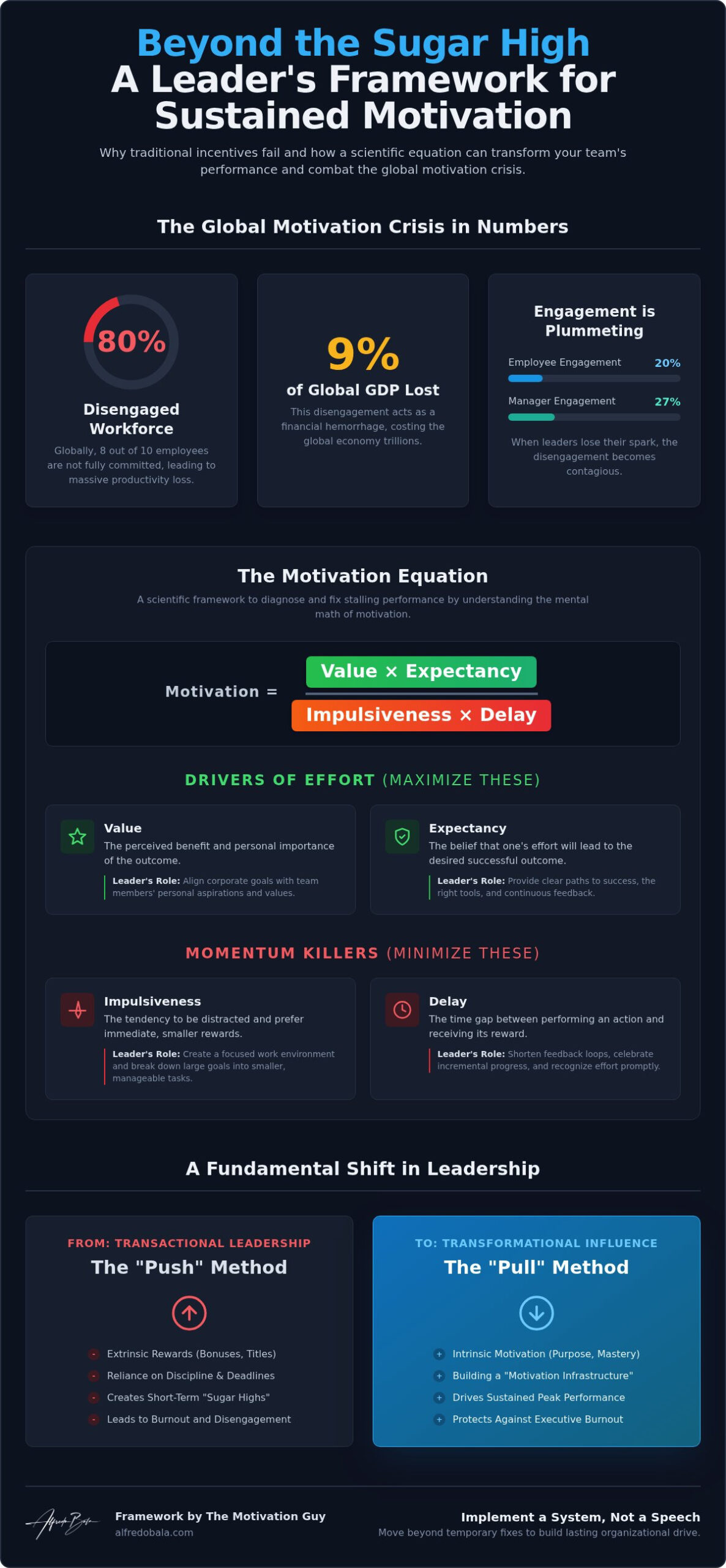
Eighty percent of the global workforce is currently disengaged, costing the world economy a staggering 9% of global GDP. As a seasoned executive, you know that the traditional sugar high of a motivational speech rarely lasts past Tuesday morning. You have likely felt the heavy burden of trying to spark fire in remote teams across different time zones while battling your own sense of being used up. Effective motivation strategies for business leaders must move beyond temporary inspiration and into the realm of structural architecture.
It is exhausting to carry the emotional weight of an entire organization when the methods you rely on feel fleeting. You deserve a repeatable framework that delivers peak performance without the inevitable crash. This article promises to move you past the fluff of typical self-help and into a results-oriented system for sustained impact. We will explore the mechanics of a definitive motivation equation, examine how to drive retention in global teams, and provide the clarity you need to master your own personal drive before burnout takes hold.
Key Takeaways
- Identify the structural gaps that cause high-performers to stall and learn why traditional “sugar high” incentives fail to sustain long-term engagement.
- Implement high-impact motivation strategies for business leaders by applying the scientific “Motivation Equation” to decode the mental math your employees use every day.
- Transition from relying on raw discipline to building a “motivation infrastructure” that encourages peak performance by default through structural systems.
- Scale your influence across global and distributed teams by mastering the “cultural translation” of what truly drives performance in different regions.
- Protect your own drive by mastering your personal motivation equation, ensuring you don’t succumb to the “quiet cracking” of executive burnout.
The Motivation Crisis: Why Traditional Strategies Fail Business Leaders
Stop looking for the next great speech to fix your culture. In the volatile market of 2026, even your most reliable high-performers are stalling. This isn’t a temporary dip in energy; it’s a structural failure of outdated motivation strategies for business leaders. When the external environment shifts rapidly, the old “sugar high” of a quarterly bonus or a high-energy town hall provides a spike that vanishes before the week is out. You’re likely seeing the results in your KPIs: a workforce that is physically present but emotionally absent.
The 2026 Gallup State of the Global Workplace Report reveals a sobering reality. Global employee engagement has dropped to approximately 20%. This disengagement isn’t just a morale issue; it’s a financial hemorrhage costing the global economy 9% of its GDP. Moving from transactional leadership to transformational influence requires you to stop treating motivation as a feeling and start treating it as a system. If you continue to rely on the “push” of deadlines and discipline, you’ll eventually find yourself exhausted, carrying the weight of an organization that has forgotten how to move on its own.
The Limits of Extrinsic Rewards
Bonuses and titles are the primary tools of transactional leadership, but they possess a short half-life. Once a reward is granted, it quickly becomes the new baseline. This is the corporate hedonic treadmill: the more you give, the more is required to achieve the same level of effort. To understand the deeper psychological drivers at play, many executives study various work motivation theories to find more sustainable paths. The Incentive Paradox in modern leadership is that providing external rewards for tasks that require internal drive often diminishes the very passion you seek to ignite. When you lead through “pull” motivation, you connect the work to a larger vision, making the effort itself the reward.
The Cost of the ‘Motivation Gap’
The drain on productivity is immense when teams lack a unified purpose. This “Motivation Gap” is particularly dangerous because it’s contagious. Manager engagement has recently dropped to 27%, and when a leader loses their spark, the ripple effect can derail an entire division within months. This disengagement fuels high-level turnover, especially in the C-Suite, where the emotional tax of “quiet cracking” leads to burnout. You cannot afford to ignore these motivation strategies for business leaders. A disengaged team doesn’t just miss targets; it erodes the very foundation of your organizational ROI and your personal health as a leader.
The Motivation Equation: A Scientific Framework for Mastery
Motivation isn’t a mystery; it’s a science. Every team member performs a subconscious calculation before they commit their full energy to a task. Alfredo Bala (The Motivation Guy)’s framework, The Motivation Equation, provides the precision required to master motivation strategies for business leaders. By breaking down drive into its constituent parts, you can diagnose exactly where a project is stalling. It’s the difference between guessing why a high-performer has gone cold and having a structural blueprint to fix it.
This equation functions like a scale. On one side, you have the drivers of effort: Value and Expectancy. On the other, you have the momentum killers: Impulsiveness and Delay. When you understand the relationship between these four variables, you stop relying on charisma and start leading with surgical precision. To see how these variables interact in real-world scenarios, you can explore the deeper mechanics of The Motivation Equation.
Value and Expectancy: The Drivers of Effort
Value represents the perceived benefit of the outcome. If an employee doesn’t see how a corporate goal aligns with their personal aspirations, the value drops to zero. Expectancy is the belief that effort will actually lead to success. In remote or hybrid environments, these variables often plummet due to a lack of visibility and connection. You must work harder to maintain these through frequent, high-impact communication. Implementing Leadership Strategies for Peak Performance involves more than just setting targets; it requires ensuring that every contributor feels the weight of their impact and possesses the tools to succeed.
Managing Delay and Impulsiveness
The denominator of the equation contains the factors that erode focus. In today’s distraction economy, a long-term goal can feel like a distant mirage, leading to high levels of Delay. Impulsiveness is the tendency to get sidetracked by low-value, immediate tasks. To combat this, you must shorten your feedback loops and provide regular validation. Micro-wins are strategic, short-term victories designed to reduce the perceived delay of a long-term goal and provide immediate validation of effort. By stacking these small triumphs, you keep impulsiveness at bay and maintain a steady rhythm of progress toward the larger vision. Mastering these motivation strategies for business leaders gives you the clarity to lead teams through the most volatile markets.
Decoding Executive Influence: Intrinsic vs. Structural Motivation
Stop acting like a cheerleader and start thinking like an architect. While many believe that leadership is about delivering the perfect pep talk, the most effective motivation strategies for business leaders focus on building an infrastructure that encourages high performance by default. You aren’t there to “push” people through discipline alone. Discipline is a finite resource that eventually leads to friction. Instead, you must create a “pull” through a shared vision that draws people toward a goal because they want to reach it, not because they’re told to.
You might think, “I shouldn’t have to motivate adults to do their jobs.” It’s a fair point, but it misses the mark. You aren’t responsible for breathing life into someone who has none. You’re responsible for ensuring your organization’s environment doesn’t suffocate the natural drive they already possess. When high-level talent stalls, it’s rarely because they’ve become lazy. It’s usually because the “Motivation Equation” we discussed earlier has been tilted toward delay and impulsiveness by poor organizational design. Your job is to remove those structural barriers.
Designing for Autonomy and Mastery
Micro-management is the ultimate motivation killer for high-level talent. If you’ve hired the best, you must give them the autonomy to solve problems without a shadow over their shoulder. Creating “Growth Tracks” allows you to develop leaders who, in turn, develop others. This is how you scale influence. When mastery becomes the primary reward, your team will push themselves harder than any external incentive ever could. This is especially vital when Motivating Teams in Times of Change, as autonomy provides a sense of control in an otherwise uncertain market.
The Power of Narrative and Purpose
Move beyond “The What” and anchor your team in “The Why.” A clear mission isn’t just a plaque on the wall; it’s a filter for hiring and retaining the right talent. If your organizational story is infectious, it acts as a magnetic force. Global giants don’t outperform competitors because they have better goals. They win because they have a structural purpose that makes disengagement impossible. By mastering these motivation strategies for business leaders, you transform your role from a supervisor to a visionary guide, building a legacy of sustained excellence.
Scaling Influence: Motivation Strategies for Global and Distributed Teams
Scale is the ultimate test of a leader’s influence. When your organization spans continents, the traditional methods of walking the floor are gone, replaced by the need for a digital-first, human-centric approach. Effective motivation strategies for business leaders in this context require a deep dive into cultural translation. You aren’t just managing people; you’re managing different psychological blueprints. A leader who fails to acknowledge these differences will find their global expansion met with silent resistance and stagnating productivity.
What ignites a team in Dallas may fall flat in Hong Kong. In many Western markets, motivation is often tied to individual achievement and direct, transparent feedback. In contrast, many Asian markets place a higher value on collective success and nuanced hierarchy. You must be able to adjust the Value variable in the Motivation Equation to resonate with these local identities while maintaining a unified global vision. If your regional leaders don’t understand how to adapt these frameworks, they will eventually succumb to the weight of disengagement. A comprehensive approach to motivating global teams requires both the cultural intelligence to read these differences and the structural systems to bridge them at scale.
Leveraging technology is about more than just software. It’s about using digital tools to maintain the human touch at scale. Video messages, personalized feedback loops, and transparent data sharing can bridge the gap created by thousands of miles. However, technology is a double-edged sword. If used only for surveillance, it kills autonomy. If used for connection, it amplifies the Expectancy variable of the Motivation Equation, giving remote employees the confidence that their work is seen and valued by the highest echelons of the company.
Communication Cadence for Global Success
The 24-hour leadership cycle is a commitment to ensuring no region feels like an afterthought. If your team in Singapore only receives directives at the end of their workday, they will eventually disengage due to time-zone fatigue. Use asynchronous communication to provide clarity without demanding immediate responses, allowing trust to grow across time zones. Presence over proximity means that your visibility and impact as a leader are measured by the quality of your engagement rather than your physical coordinates in an office.
Developing Leadership in Every Region
Empower your regional directors to be architects of their own environments. They shouldn’t just be executing orders; they need to develop a Board Seat perspective, understanding how their local success drives the global machine. Identifying high-potentials in emerging markets requires looking past traditional metrics and finding those who naturally embody the Motivation Equation. To bring these high-impact frameworks to your international teams, consider booking a keynote speaking session to align your global leadership bench and drive sustained performance.
Leading the 1%: Mastering Your Personal Motivation Equation
Leadership is often a solitary journey at the summit. While you spend your days architecting motivation strategies for business leaders to inspire your teams, who is fueling your drive? The reality is that your own motivation is the ceiling for your entire organization. If your energy is flickering, the shadow is felt in every boardroom and every remote outpost of your company. You cannot pour from an empty cup; this is the Oxygen Mask Principle of executive performance.
Recent data from 2026 reveals that more than half of business leaders report feeling “used up” at the end of the day. This phenomenon, often called “quiet cracking,” is a slow collapse of drive that happens when the Motivation Equation is neglected at the top. To lead the 1% of high-performers, you must first apply the math to yourself. What is your personal Value driver? Is it the legacy you’re building, the innovation you’re sparking, or the board-level influence you’ve earned? If your Expectancy-the belief that your current effort will lead to those rewards-has dipped, your performance will inevitably stall.
The 1% Rule suggests that massive organizational growth doesn’t require a total overhaul. Instead, it demands small, daily shifts in personal mastery. By focusing on marginal gains in your own clarity and energy, you create a ripple effect that touches every level of the company. When you master your own equation, you move from a state of “pushing” through the day to “pulling” your organization toward a transformative future.
The Science of Personal Mastery
Maintaining executive resilience under extreme pressure isn’t about raw willpower. It’s about using the Motivation Equation to audit your own schedule and energy. If your calendar is filled with tasks that have high Delay and high Impulsiveness, you’re draining your cognitive reserves. A seasoned leader uses board advisory and high-level mentorship to maintain their edge and keep their equation balanced. This structural support ensures that you remain focused on high-value outcomes rather than getting lost in the noise of daily operations.
Next Steps: Mastering the Framework
Reading The Motivation Equation is the first step toward a total organizational transformation. It provides the lexicon and the logic you need to move beyond the temporary sugar high of inspiration and into the realm of sustained, high-impact performance. Whether you’re looking to revitalize a stagnant division or align a global leadership bench, this framework is your roadmap. Discover how Alfredo Bala can transform your team’s performance by bringing these high-impact leadership insights to your next corporate event or executive retreat.
Architecting a Culture of Sustained Performance
The era of relying on temporary spikes of inspiration is over. To navigate the complexities of a global market, you must transition from being a cheerleader to becoming a structural architect of drive. By implementing the variables of the Motivation Equation, you remove the barriers of delay and impulsiveness while amplifying value and expectancy across your entire organization. These motivation strategies for business leaders are not just theories; they are the hard-won lessons from over 40 years of global leadership experience.
As the former CEO of Mannatech Inc. and the author of the groundbreaking Motivation Equation framework, I’ve seen how a repeatable system outperforms raw charisma every time. You now possess the blueprint to audit your own energy and build a leadership bench that thrives on autonomy. It is time to move past the fleeting “sugar high” and establish a legacy of high-impact results. Master the framework. Get your copy of ‘The Motivation Equation’ today. Your journey toward organizational mastery starts with a single, disciplined step. Lead with clarity and the world will follow.
Frequently Asked Questions
What are the most effective motivation strategies for remote business leaders?
Effective motivation strategies for business leaders in remote settings prioritize “Presence over Proximity” by leveraging asynchronous communication to maintain clarity. Instead of surveillance, focus on increasing the Expectancy variable by ensuring remote contributors know their effort is seen and valued. This builds trust across global time zones without the friction of constant, draining meetings.
How does ‘The Motivation Equation’ differ from traditional leadership frameworks?
The Motivation Equation treats drive as a structural output rather than a fleeting emotional state. While traditional models rely on bonuses or temporary pep talks, this scientific framework uses a precise calculation of Value, Expectancy, Impulsiveness, and Delay. It allows you to diagnose performance issues with surgical precision instead of guessing why a team has stalled.
Can motivation strategies really work for teams with diverse cultural backgrounds?
Yes, these strategies work globally by adjusting the “Value” variable to resonate with specific local identities. A team in Dallas might value individual achievement, while a team in Hong Kong often prioritizes collective success. The equation remains the same; only the inputs change to match the cultural context of your global workforce.
What is the ROI of investing in professional leadership keynote speakers?
Investing in high-impact motivation strategies for business leaders through keynote speakers provides ROI by aligning global teams under a unified strategic framework. This alignment reduces the immense productivity drain caused by disengagement, which currently costs the global economy 9% of its GDP. It moves the organization past a temporary “sugar high” into a culture of sustained performance.
How do I motivate a team that is currently experiencing high levels of burnout?
To motivate a burnt-out team, you must first address the structural “Motivation Gap” by reducing the variables of Delay and Impulsiveness. Use micro-wins to provide immediate validation and shorten feedback loops. This lowers the emotional tax on your employees and helps rebuild their internal drive without relying on the “push” of extra hours or discipline.
Is it possible to re-motivate a long-term employee who has become disengaged?
Re-motivating a disengaged long-term employee requires re-evaluating their personal “Value” and “Expectancy” drivers. Their aspirations have likely evolved since they first joined the organization. By realigning their current responsibilities with their new personal goals, you fix the mental math that caused their performance to stall over time.
How can business leaders maintain their own motivation during market downturns?
Business leaders maintain their drive by auditing their personal Motivation Equation and focusing on personal mastery. Protect your energy by eliminating low-value, impulsive tasks that drain your cognitive reserves. Remember the “Oxygen Mask” principle: your team’s level of engagement will rarely exceed the ceiling of your own personal drive.
What is the first step to implementing ‘The Motivation Equation’ in a large organization?
The first step is auditing your existing “Motivation Infrastructure” to identify where your systems are accidentally encouraging impulsiveness or creating unnecessary delay. Once these structural gaps are visible, you can begin training your leadership bench in the new framework. This ensures that high performance becomes the default setting for your entire organization.
 EN
EN  ES
ES
Recent Comments